Last Updated: October 23, 2026
Last Updated: October 23, 2026





The Supreme Court delivered a historic verdict on Wednesday. For the first time in India, the court authorized passive euthanasia. This decision came in the case of Harish Rana vs. the Central Government.
A bench of Justices J.B. Pardiwala and K.V. Vishwanathan granted the appeal for passive euthanasia from 32-year-old Harish Rana. Harish Rana, from Ghaziabad, has been unconscious for the past 13 years after falling from a building.
With his condition deteriorating day by day, his parents filed an appeal in court requesting the removal of all means of keeping him alive.
Previously, several cases seeking euthanasia have been brought before Indian courts. In all these cases, the court has made it clear that it cannot allow euthanasia, citing the Constitution as a key reason.
What is passive euthanasia? And how different is it from ordinary euthanasia?
Euthanasia means intentionally ending the life of a person suffering from an incurable or terminal illness. The primary purpose of approving this type of death was to relieve the person suffering from unbearable physical pain and suffering.
Euthanasia is broadly divided into two types: active euthanasia and passive euthanasia.
Active euthanasia, also known as active euthanasia, involves direct action to bring about the patient’s death. For example, administering a lethal substance or injection (such as sodium pentathol) to the patient, causing them to fall into a deep sleep within a few seconds, leading to a painless death in their sleep.
In passive euthanasia, the practice of passive euthanasia involves the withholding or withdrawal of essential medical treatment that prolongs a patient’s life. Doctors do not actively kill the patient, but rather, they suspend life-saving treatments or procedures. For example, by withdrawing life-support systems such as ventilators, artificial resuscitation techniques, or medications, allowing the patient to die naturally.
Is euthanasia still legal anywhere in the world?
Following the genocide in Germany, there was a long-standing debate about its legality. However, with the rise of democracies, euthanasia began to gain legal rights. One of the first steps in this direction was taken in Australia, where the Northern Territory passed the Rights of the Terminally Ill Act, which allowed euthanasia for some patients. However, this law was later repealed.
Despite this, Australia’s initiative was later adopted by many countries.
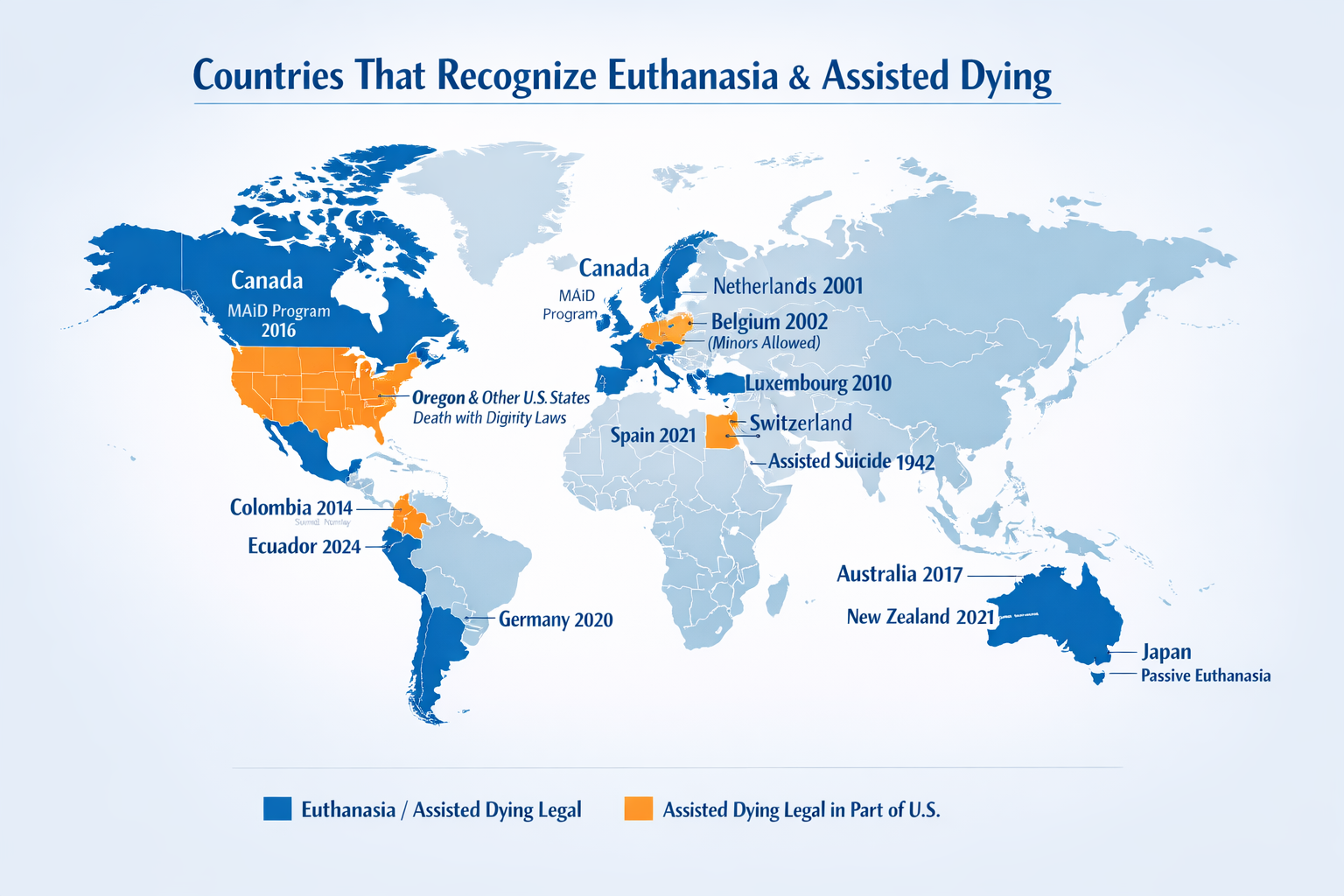
The Netherlands legalized active euthanasia in 2001, and Belgium in 2002, with clear rules and guidelines. Belgium and Luxembourg (2010) have also extended this right to minors.
Canada launched the Medical Assistance in Dying (MAiD) program in 2016, which will result in more than 15,300 euthanasia cases (4.7% of total deaths) by 2024.
Assisted suicide has been legal in Switzerland since 1942, operated by organizations like Dignitas.
The US state of Oregon enacted the Death with Dignity Act in 1997. As of 2026, this model is valid in some areas of the US, while it is strictly prohibited in 40 states.
In Asia, Japan allows passive euthanasia, i.e., the removal of life support systems.
Other countries: Spain (2021), Austria (2022), Australia (2017), New Zealand (by referendum in 2021), Colombia (2014), and Ecuador (2024) have also legalized various forms of assisted dying. Assisted dying has been permitted in Germany since 2020.
Scandinavian countries: Countries like Sweden and Norway allow physician-assisted dying under certain strict conditions, while respecting patient autonomy.
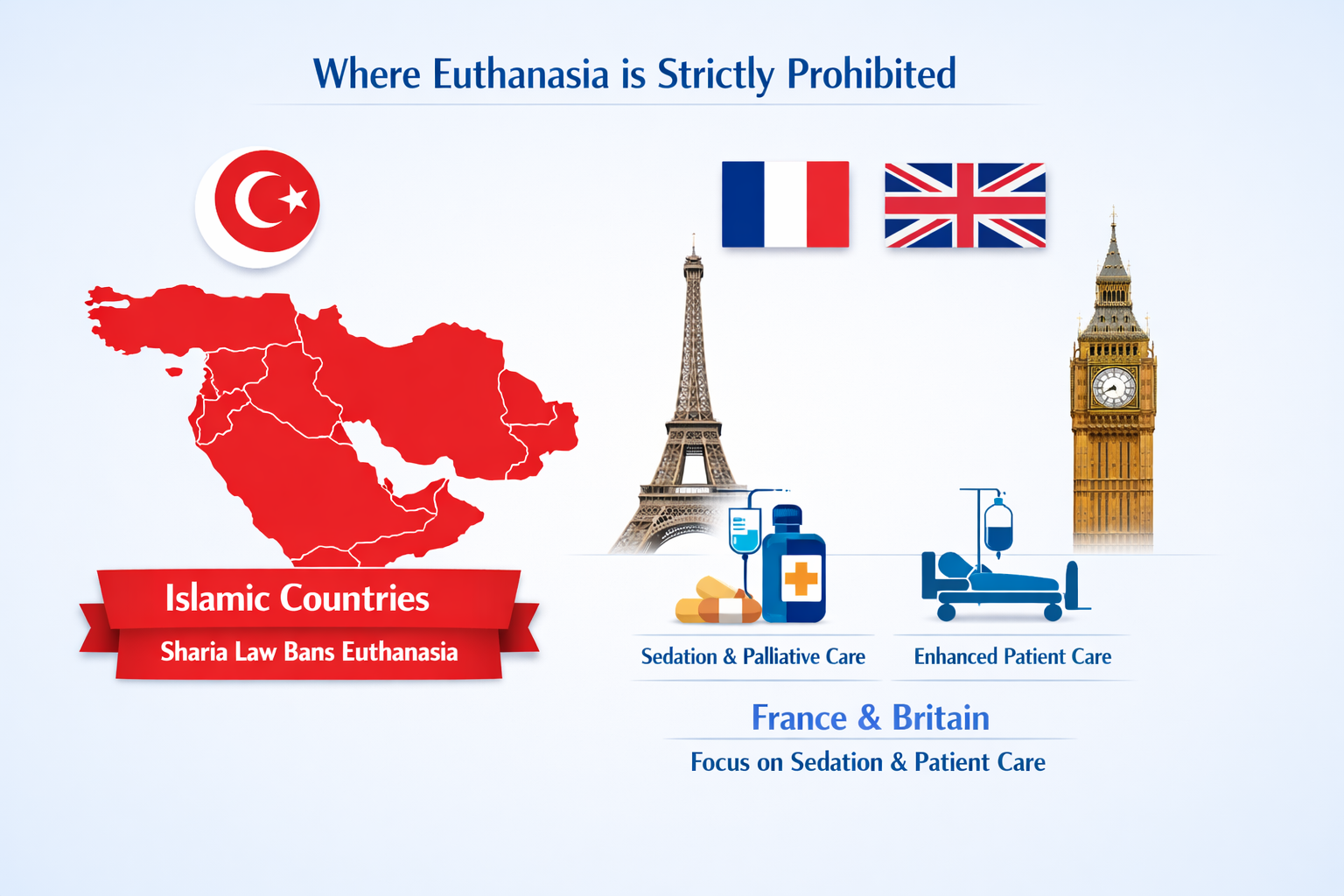
In Islamic countries, Sharia law imposes strict religious restrictions on any form of euthanasia.
On the other hand, in France and Britain also, instead of actively killing patients, sedation (pain relief with narcotic drugs) and better care are given priority to provide relief to the patients.
New Delhi: India wicketkeeper-batter Ishan Kishan has been ruled out of the second T20I against New Zealand due...

Jaipur: At least four people were killed and two others seriously injured after a car went out of...

Start your day with The Savera Morning Brief, bringing you the top India and world news, including the...

Mumbai: Indian equity benchmarks opened higher on Friday tracking positive domestic cues and buying in information technology (IT)...

Washington: US President Donald Trump suggested that further military action against Iran remained possible, while acknowledging that the...
Washington: Indian professionals waiting for employment-based green cards in the advanced-degree category saw no movement for a second...
Aries: The day will be auspicious...