Last Updated: October 20, 2026
Last Updated: October 20, 2026





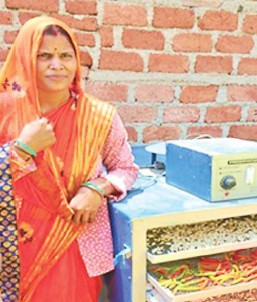
On a quiet morning in Shripura village of Guna district, Madhya Pradesh, Sarita Saini begins her day by sorting vegetables not only for immediate sale in local markets but also for drying and storage, enabling her produce to be marketed even during periods when cultivation activities are limited.
As a member of the Ekta Self-Help Group, she initially faced constraints related to limited resources, inadequate technical knowledge, and income insecurity. Her inclusion under the programme implemented by the Madhya Pradesh State Rural Livelihoods Mission marked a significant transition.
Through institutional support, capacity building, and convergence with Panchayati Raj Institutions, she received a solar dryer valued at Rs. 1 lakh. Currently, she integrates commercial vegetable cultivation with solar drying, ensuring year-round market access and generating a stable monthly income of approximately Rs. 20,000. Her journey demonstrates how well-designed governance frameworks can catalyse local entrepreneurship when opportunities are complemented by targeted support.
Narratives such as Sarita’s are rooted within a broader framework of rural governance that places people at the core of development processes. Decentralisation has long been a foundational principle of India’s rural transformation, premised on the understanding that local institutions possess the contextual knowledge required to address local needs effectively. By strengthening Gram Panchayats, Self-Help Groups, and community-based institutions, governance is brought closer to citizens, enabling participatory planning and more responsive outcomes. This paradigm shifts development from a top-down delivery of schemes to a collaborative model in which communities act as active partners, contributing to priority-setting and monitoring outcomes at the grassroots level.
Central to this rural development ecosystem are the flagship programmes of the Ministry of Rural Development, each designed to address specific dimensions of rural livelihoods while functioning in a mutually reinforcing manner. The Deendayal Antyodaya Yojana–National Rural Livelihoods Mission (DAY-NRLM) has emerged as one of the world’s largest livelihood initiatives, mobilizing over 10 crore rural households into Self-Help Groups and providing sustained handholding along with access to institutional finance. The Lakhpati Didi initiative under DAY-NRLM recognises SHG members whose households attain annual incomes of at least Rs. 1 lakh through diversified livelihood activities, reflecting a shift from subsistence-based livelihoods to greater economic stability.
As of December 24, 2025, more than 10.29 crore rural households have been mobilized into SHGs under DAY-NRLM.
Employment security constitutes a critical pillar of rural resilience. The Mahatma Gandhi National Rural Employment Guarantee Act (MNREGA), 2005, was designed to provide a statutory guarantee of at least 100 days of wage employment to rural households willing to undertake unskilled manual work, thereby offering income support while simultaneously creating durable community assets.
Since FY 2013–14, the programme has witnessed significant improvements, including an increase in women’s participation from 48% to 56.74%, Aadhaar-seeded active workers from 76 lakh to 12.11 crore, and an expansion of electronic wage payments from 37% to 99.99% by FY 2025-26, reflecting enhanced transparency and financial inclusion. In response to evolving rural economic conditions, the Government has introduced the Viksit Bharat–Guarantee for Rozgar and Ajeevika Mission (Gramin) Act, 2025, which proposes an enhanced statutory guarantee of 125 days of wage employment and anchors rural works within a convergence-driven, saturation-oriented planning framework aligned with the vision of Viksit Bharat @2047. (Courtesy: PIB)
Good Evening Viewers! Catch up on the day's biggest stories with The Savera Times Evening Bulletin. Get the...

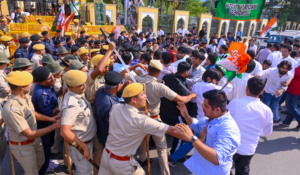
Congress leaders continued their protest outside the Jaipur Police Commissionerate on Tuesday, demanding the registration of a zero...
On the auspicious occasion of Vijayadashami, Prime Minister Narendra Modi on Tuesday called on the countrymen to unite...
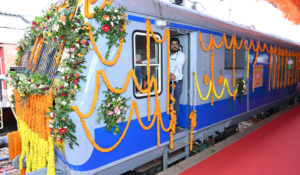
A historic milestone was achieved on Tuesday in the expansion of Chhattisgarh's rail networkA historic milestone was achieved...
Model Shraddha Dubey, one of the main accused in the death of Lucknow businessman Shiv Sharma, has been...
Rashtriya Swayamsevak Sangh (RSS) chief Mohan Bhagwat on Tuesday called for strengthening national unity, social harmony, indigenous practices...
Aries: The day will be auspicious...