Last Updated: October 22, 2026
Last Updated: October 22, 2026





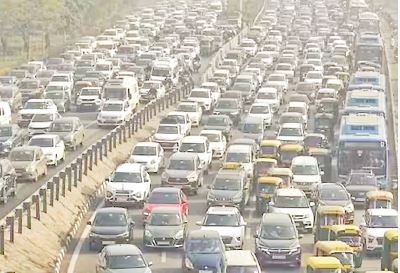
A massive traffic jam stretching nearly 20 kilometres along the Delhi-Kolkata National Highway 19 has left thousands of commuters and truck drivers stranded for four consecutive days near Sasaram and Rohtas in Bihar. Vehicles are crawling forward at an agonisingly slow pace, with many stuck for over 30 hours without access to food, water, or basic facilities.
The traffic chaos began late last week after heavy rainfall battered Rohtas district, turning parts of the highway into a muddy, slushy mess. Deep potholes and waterlogging made driving nearly impossible, bringing movement to a standstill along one of India’s busiest road corridors. Some vehicles have reportedly managed to move just five kilometres in an entire day.
Truck drivers and passengers describe scenes of complete paralysis and mounting frustration. “We have been stuck here for two days without food or water. Covering even a few kilometres takes hours,” said one driver from Kolkata, who had covered only 20 kilometres in 24 hours. Others said the situation had become unbearable, with no sign of administrative help.
Several stranded drivers alleged that neither the National Highways Authority of India (NHAI) nor the construction company responsible for the ongoing road expansion had sent officials to manage the chaos. “We pay tolls and taxes, but no one is here to help. There are no traffic police or NHAI officials on the ground,” said another truck driver who had been stuck for over a day.
The gridlock has also caused significant disruption to trade and transport. Trucks carrying perishable goods are among the worst affected, with drivers fearing spoilage and financial losses. Many small traders and transport operators said delays were likely to affect supply chains and deliveries across eastern India. Ambulances, passenger vehicles, and buses are also caught in the jam, with commuters reporting severe delays and a lack of emergency support.
National Highway 19, which forms a critical stretch of the Delhi-Kolkata route, connects major cities across Uttar Pradesh, Bihar, Jharkhand, and West Bengal. The highway, once part of the ancient Grand Trunk Road, is also a segment of the international Asian Highway Network (AH1) and India’s Golden Quadrilateral project, linking some of the country’s busiest industrial and trade centres.
The latest congestion has been traced to road-widening work underway near Shivsagar in Rohtas district. Construction work by the NHAI has narrowed the carriageway to a single lane on some stretches. When heavy rain struck, the temporary diversions created for traffic movement became waterlogged and unusable, forcing vehicles to inch through deep mud. The slowdown quickly turned into a full-blown traffic crisis as more trucks and buses entered the bottleneck.
Officials said the jam was mostly concentrated on one side of the highway, particularly on the stretch between Aurangabad and Varanasi, though the ripple effect extended for kilometres. Drivers said that in some areas, vehicles had not moved for hours, with hundreds of trucks backed up along the route.
Residents and local commuters have also been hit hard, with the jam blocking access to nearby towns and villages. Travellers described how local markets were running short of supplies and roadside eateries had run out of food due to stranded deliveries. Some stranded people were seen cooking by the roadside or seeking help from locals for drinking water.
Authorities have faced criticism for their lack of visible response. Despite the scale of the disruption, no significant traffic management measures have been put in place. Local police have reportedly been deployed in small numbers but have struggled to control the long queues of vehicles. Efforts to clear the jam have been hampered by the poor road condition and continuous movement of heavy trucks.
The incident highlights the fragile state of highway infrastructure in several parts of Bihar, where monsoon rains often expose poor drainage and inadequate maintenance. For now, thousands remain trapped in what has become one of the region’s worst traffic snarls in recent years, waiting for relief and for the long, motionless line of vehicles to finally start moving.
Good Evening Viewers! Get the latest updates from India and around the world with The Savera Times Evening...

Bharatiya Janata Party (BJP) National General Secretary Smriti Zubin Irani launched a scathing attack on Congress MP and...

New Delhi: Cockroach Janata Party (CJP) leaders Saurav Das and Ashutosh Ranka will be released from judicial custody...

According to police, three suspicious young men are seen in CCTV footage. Efforts are underway to identify them....
A video has surfaced of an alleged attempted assault on Jan Suraj Party's Bihar president Manoj Bharti. The...
Two accused have been convicted and sentenced to 10 years of rigorous imprisonment in a 2017 drug trafficking...

Aries: The day will be auspicious...