Last Updated: October 11, 2026
Last Updated: October 11, 2026





Avinash Rai Khanna
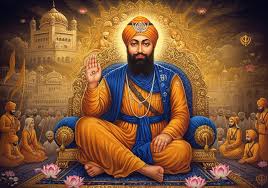
India is often called the land of saints. Many of our saints were not only devoted but also warriors in their courage. The ninth Sikh Guru, Guru Tegh Bahadur Ji, was born on April 1, 1621, in Amritsar. His father was Guru Har Gobind Ji, the sixth Sikh Guru, and his mother was Mata Nanaki. At birth, he was named Tyagmal. Observing his childhood bravery, he was later given the name Tegh Bahadur, meaning “Brave Sword,” as “Tegh” refers to a sword.
From a young age, Guru Tegh Bahadur Ji was trained not only in the religious scriptures, including the Vedas and Upanishads, but also in martial arts and equestrian skills. He was married to Mata Gujri.
When asked who would succeed the eighth Guru, Guru Har Krishan Ji suddenly replied, “Bakala Baba.” People inferred that the next Guru would be found in the Bakala region. During the search, several self-proclaimed spiritual leaders appeared, each claiming to be the next Guru. A merchant, Makhan Shah, who had earlier vowed to donate 500 gold coins to his Guru, visited Bakala to fulfill this pledge. He offered two coins to each Baba, and when he reached Guru Tegh Bahadur Ji, the Guru remarked, “You promised 500 coins.” Makhan Shah realized he had found the true Guru and exclaimed, “Guru labho re! Guru labho re!” In 1664, Guru Tegh Bahadur Ji was officially installed as the ninth Sikh Guru.
Guru Tegh Bahadur Ji traveled across India—Mathura, Agra, Allahabad, Varanasi, Assam, Bengal, Bihar, Bilaspur, Dhaka—spreading Guru Nanak’s teachings and resolving conflicts among rulers. In 1672, he established Anandpur Sahib, where he addressed grievances against Muslim rulers’ tyranny and sought justice for all. For opposing oppression, he became a target of Emperor Aurangzeb in 1675 and ultimately sacrificed his life, attaining union with the Divine.
Approximately 116 hymns by Guru Tegh Bahadur Ji, covering themes such as human emotions, pride, suffering, service, and mortality, are included in the Guru Granth Sahib. Following his martyrdom, Gurudwara Sis Ganj in Chandni Chowk, Delhi, and Gurudwara Rakab Ganj were established in his memory. His sacrifice highlighted the Sikh tradition’s focus on human rights, influencing Guru Gobind Singh Ji, who institutionalized the Khalsa identity.
Guru Tegh Bahadur Ji’s life teaches two enduring principles for today’s generation: spirituality and the defense of human rights. In a world increasingly dominated by materialism, ego, and neglect of others, adopting these values—daily devotion and respect for the rights of all—can restore balance.
Before his martyrdom, Brahmins Bhai Mati Das and Bhai Sati Das, and later Bhai Dayala Ji, were executed. During the safeguarding of his remains, devoted Sikhs, including Bhai Jaita and Chaudhary Khushal Dhaiya, protected the Guru’s head, exemplifying unity among all castes in Punjab—Brahmins, Kshatriyas, Vaishyas, and Shudras. Guru Ji forbade any acts of violence following his martyrdom.
Pakistan’s religious minorities continued to face violence, discrimination and persecution throughout 2025, with blasphemy accusations and minority women...

Bangladesh is facing acute environmental and public health risks from rising pesticide and chemical fertiliser use. Chemical fertiliser...

India’s cheetah story has entered a new phase. After the species disappeared from the country in the 1950s,...

Jaipur: The Anti-Narcotics Task Force (ANTF) of Rajasthan Police has arrested wanted drug smuggler Sohanlal, alias Sonu, carrying...

Imagine a foreign national standing among Indian citizens at a political protest, raising questions about the government or...

Aizawl: The Assam Rifles, in coordination with other law enforcement agencies, seized methamphetamine tablets and foreign-made cigarettes worth...

Aries: The day will be auspicious...