Last Updated: October 11, 2026
Last Updated: October 11, 2026





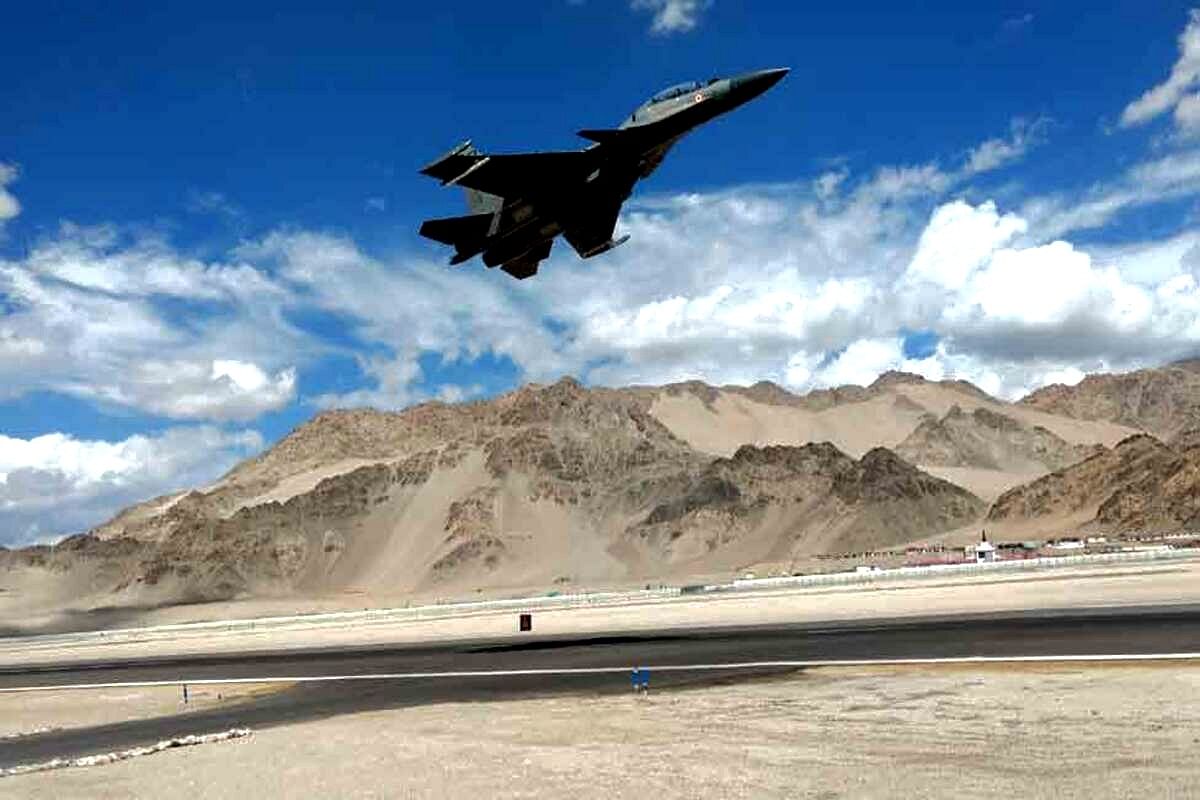
India has fully operationalised the Changthang Nyoma airbase in Ladakh, making it capable of supporting fighter aircraft at one of the highest altitudes in the world. Nyoma, a small tehsil under Leh district with fewer than 1,000 residents, sits along the southern and eastern borders with China’s Tibet Autonomous Region. Its eastern boundary, part of the Line of Actual Control established after the 1962 war, runs along the Kailash Range watershed and the Indus River, creating a strategically sensitive zone. The recent upgrade transforms an Advance Landing Ground (ALG) built during the 1962 conflict into a full-fledged airbase, reflecting India’s focus on strengthening its Himalayan frontier.
The airfield, named after nearby Mudh village, has been expanded into a 2.7-kilometre paved runway with hangars, air traffic control facilities, and minor repair areas. At 13,700 feet above sea level, it is now the world’s highest operational fighter airbase. The base can accommodate aircraft ranging from tactical transport planes like the An-32 and C-130 Super Hercules to larger strategic airlifters such as the IL-76 and C-17. Importantly, the Indian Air Force has cleared the base for Su-30 MKI fighter operations, with additional fighter types expected to operate in the near future.
Nyoma’s strategic location enhances India’s operational reach along the LAC. The airfield lies just 35 kilometres from the nearest point of the border, providing faster deployment and logistical support to sensitive sectors like Demchok and the Depsang Plains. It complements existing fighter bases at Leh and Thoise, offering rotational deployment for fighter squadrons and enabling sustained aerial surveillance and intelligence operations. The proximity to the Mahe Field Firing Range, 40–50 kilometres away, allows for comprehensive training and weapons testing in the region.
The history of Nyoma airfield reflects India’s evolving approach to high-altitude operations. Initially built in 1962, it remained largely dormant until a 2008 reactivation saw an An-32 tactical transporter complete a trial landing. Subsequent operations focused on helicopters and medium transport aircraft, which supported troop movements and supplies across the remote Changthang region. After the 2020 standoff with China along the LAC, the government decided to upgrade the airstrip to a fully operational fighter base. Construction, managed by the Border Roads Organisation, involved expanding the runway to 2.7 kilometres and establishing comprehensive support infrastructure, including hangars, watchtowers, hard-standing areas, and accommodation facilities.
The upgrade also enhances India’s airlift and rapid response capabilities. Strategic transport aircraft can now deliver troops, tanks, artillery, and air defence systems directly to the region, while drones and attack helicopters such as the ALH Rudra and Apache can operate routinely from the base. The airfield’s capacity enables the launch of composite air operations, providing both speed and operational surprise.
Despite these advantages, the base faces challenges. Its proximity to the LAC exposes it to potential surveillance, artillery fire, or electronic attacks. Extreme weather adds further complexity, with winter temperatures dropping below minus 40°C and high-altitude “hot and high” conditions in summer affecting aircraft performance. Roads and bridges in the region could be vulnerable to interdiction during conflict, though any adversary action would likely invite retaliatory measures.
Even with these risks, the operational and strategic benefits of Nyoma are significant. The airbase reduces response times, strengthens India’s deterrence along the Himalayan border, and provides critical support for logistics and surveillance. As India extends its air power to new heights, Nyoma stands as a symbol of both engineering achievement and strategic foresight, enabling sustained military presence and operational readiness in one of the world’s most challenging terrains.
The CJP clarified that a petition circulating on social media over the alleged detention of its leaders was...
CJP founder Abhijeet Dipke and leaders Saurav Das and Ashutosh Ranka were placed under preventive arrest amid security...

India has criticised the UN human rights office’s concerns over police action against CJP protesters in Delhi, citing...
Uttar Pradesh CM Yogi Adityanath and Union Minister Nitin Gadkari greet people on the first day of Sharadiya...

New Delhi: Delhi Traffic Police has announced traffic restrictions and possible diversions at around 30 key intersections and...
Pakistan’s religious minorities continued to face violence, discrimination and persecution throughout 2025, with blasphemy accusations and minority women...
Aries: The day will be auspicious...