Last Updated: October 21, 2026
Last Updated: October 21, 2026





Sheena Sandhu
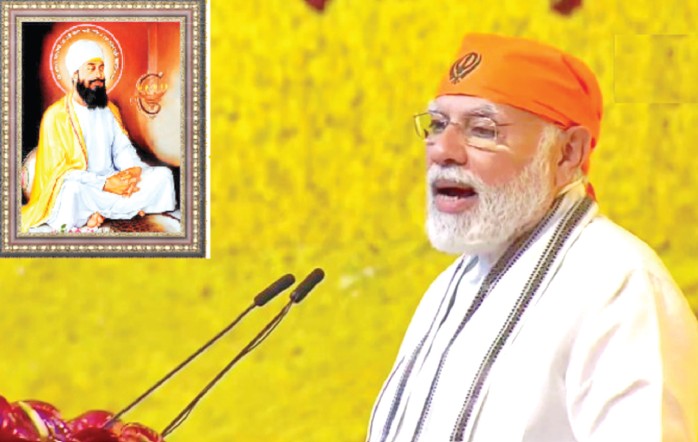
As India marks the 350th anniversary of the martyrdom of Guru Tegh Bahadur, it confronts not merely a historical episode but a civilisational moment that continues to shape the nation’s conscience. The execution of the ninth Sikh Guru in November 1675—ordered by the Mughal emperor Aurangzeb—was an act meant to crush resistance and enforce conformity. Instead, it produced the opposite: a moral thunderbolt that strengthened India’s culture of pluralism and inspired an entire people to defend freedom of conscience.
Few events in South Asian history match the moral clarity of this sacrifice. Guru Tegh Bahadur chose death not for the protection of his own community, but to defend the religious freedom of Kashmiri Pandits who had approached him in despair. At a time when the imperial state sought to impose a singular orthodoxy, the Guru insisted that no authority, however mighty, could claim dominion over a person’s inner beliefs. That insistence cost him his life, yet it gifted India an enduring ideal: that the right to believe, or not believe, is inviolable.
This anniversary invites a deeper reflection on the nature of that courage. Guru Tegh Bahadur was not a political rebel in the conventional sense. He carried no throne to defend, no army seeking territory. His resistance was moral, not strategic. His power lay in his refusal to bend before tyranny—and in demonstrating that the defence of another’s rights can be the highest expression of one’s own faith. In doing so, he offered a vocabulary of freedom long before the world discovered modern human rights charters. The relevance of this message is striking today, when societies everywhere wrestle with questions of identity, tolerance, and power. India, a nation defined by its diversity, sometimes forgets how hard-earned its ethos of coexistence has been.
Guru Tegh Bahadur’s martyrdom serves as a reminder that pluralism is not an abstract ideal but a responsibility requiring sacrifice, vigilance, and integrity.His life and teachings also illuminate the character of courage itself. Too often bravery is measured in martial or rhetorical terms. But the Guru’s courage was quiet, deliberate, contemplative—emerging from a spiritual discipline that rejected ego and anchored itself in principles. His bani speaks consistently of detachment from anger and fear, calling instead for reflection, compassion, and the recognition of the transient nature of power. His martyrdom, then, was not an impulsive act; it was the logical culmination of a life lived in alignment with his convictions. For Sikhs, this anniversary is also a moment to reaffirm the ethos that his death set in motion. It directly shaped the worldview of his son, Guru Gobind Singh, who would later institutionalise the Khalsa—a collective committed to justice, equality, and fearless living. But this fearlessness, as the Guru demonstrated, was never meant to be mere militancy. It was a call to stand upright in the world, to refuse intimidation, and to serve those who are vulnerable. It was a reminder that identity is strengthened not through exclusion but through the defence of universal values.
The broader Indian society, too, has much to derive from this legacy. The idea of “Hind di Chadar”—the Shield of India—given to Guru Tegh Bahadur by later generations captures the truth that his martyrdom belongs to all Indians, not just Sikhs. In an era of profound political and social churning, when polarisation can appear easier than dialogue, the Guru’s example asserts a simple but demanding truth: safeguarding the freedoms of others is the surest way to safeguard one’s own.
His martyrdom also underscores the importance of moral leadership. In public life today, compromise often masquerades as pragmatism, and silence as diplomacy. Guru Tegh Bahadur demonstrated the opposite—that there are moments when neutrality becomes complicity and when inaction enables injustice. True leadership, he showed, rests not in preserving power but in upholding principles even at great personal cost. It is an example that should guide institutions, governments, and citizens alike.Equally significant is the lesson about the value of dissent. The Guru’s stand—quiet, firm, and deeply ethical—affirmed the place of conscientious resistance in Indian political culture.
Dissent is not a threat to national unity; it is evidence of a society’s confidence in its institutions and its commitment to accountability. Remembering Guru Tegh Bahadur is thus also an opportunity to reaffirm the Indian republic’s promise of personal liberty, constitutional morality, and equal rights for all communities. In revisiting this history, India is invited not simply to honour a martyr but to evaluate itself. Are we living up to the standards of fearlessness he embodied? Do we defend the freedoms of others with the same conviction that he defended those of strangers? Do we cultivate the humility and depth that marked his spirituality? And above all, do we recognise that the strength of a nation lies not in uniformity but in the dignity it affords its most vulnerable?
Three and a half centuries later, the image of the Guru standing in Chandni Chowk—composed, resolute, unbroken—still speaks to us. His death was meant to silence; instead, it became a guiding light. In remembering Guru Tegh Bahadur, India remembers its own civilisational promise: that courage is moral, freedom is sacred, and the defence of human dignity is a duty that belongs to every citizen, in every era.
(The writer is a retired civil servant, views are personal.)
Good Evening Viewers! Get the latest updates from India and around the world with The Savera Times Evening...

Bharatiya Janata Party (BJP) National General Secretary Smriti Zubin Irani launched a scathing attack on Congress MP and...

New Delhi: Cockroach Janata Party (CJP) leaders Saurav Das and Ashutosh Ranka will be released from judicial custody...

According to police, three suspicious young men are seen in CCTV footage. Efforts are underway to identify them....

A video has surfaced of an alleged attempted assault on Jan Suraj Party's Bihar president Manoj Bharti. The...
Two accused have been convicted and sentenced to 10 years of rigorous imprisonment in a 2017 drug trafficking...
Aries: The day will be auspicious...