Last Updated: October 18, 2026
Last Updated: October 18, 2026





Gurugram witnessed two major bouts of intense rainfall this year. The first occurred between July 9 and 10, when the city received about 133 mm of rain within 12 hours. The second took place on September 1, bringing more than 100 mm of rainfall in just four hours. Both events led to severe waterlogging, prolonged traffic jams on key roads including NH 48, and power outages across several neighbourhoods. Authorities eventually advised offices to allow employees to work from home to avoid large-scale congestion and disruption.
The public reaction was swift and critical. Residents shared videos and photographs of flooded roads, stalled vehicles, and unsafe conditions across social media platforms, blaming the persistent infrastructure gaps that fail to manage heavy rainfall every year. The recurring nature of the problem prompted the Union Minister for Power, Housing and Urban Affairs, M L Khattar, in October, to direct the Gurugram Metropolitan Development Authority and the Irrigation Department to prepare a plan for a new stormwater drain. The proposed drain would run from Gurugram to Palwal through Sohna and Nuh, ultimately carrying stormwater to the Yamuna river near Palwal. The stated aim of the project is to reduce monsoon waterlogging by diverting excess rainwater out of Gurugram.
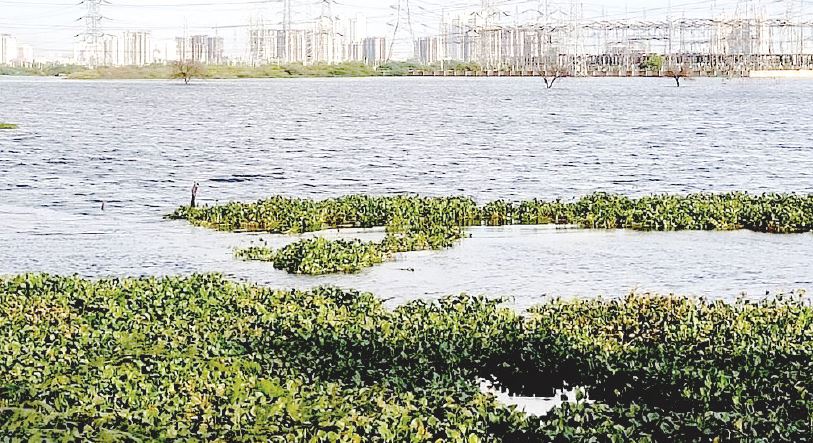
However, experts have raised significant concerns regarding the feasibility, cost, and environmental implications of the proposed plan. Their objections stem from the natural hydrology and topography of the region. Gurugram’s natural drainage pattern flows northwest towards the Najafgarh Jheel and the Sahibi river, also known as the Najafgarh Drain, which eventually joins the Yamuna in Delhi. This flow direction is shaped by a natural ridge formed by the Aravalli hills that runs through the district, dividing drainage systems. Because of this gradient, water from Gurugram and surrounding areas historically moves toward the Najafgarh basin. Diverting stormwater southward, opposite to this natural slope, would require heavy pumping mechanisms to push the water uphill for a considerable distance.
Studies of Gurugram’s terrain show an elevation difference of around 60 to 80 meters between the Aravalli foothills and the Najafgarh Jheel basin. This gradient reinforces the city’s natural drainage direction. For the proposed drain to function, the alignment would need to cut deep into the ridge at some stretches, reaching a depth of approximately 18 meters. Engineers estimate that at this depth, with a cross section of about 12 square meters and a natural flow velocity of roughly one meter per second, the drain would have a discharge capacity of about 12 cubic meters per second. If pumps are added, this might be raised to 24 cubic meters per second, which translates to a daily capacity of around 2 million cubic metres of water.
To understand how this compares to the actual stormwater volume generated during rainfall, a preliminary runoff assessment was carried out for the area governed by the Gurugram Municipal Corporation. The total municipal area, based on Sentinel 2 data from 2022, covers around 306.9 square kilometres. This includes 203.5 square kilometres of built-up land and 103.4 square kilometres of open land such as trees, farmland, and rangeland. Using runoff coefficients of 0.8 for built-up land and 0.2 for open land, three rainfall scenarios were assessed: 50 mm, 100 mm, and 160 mm of rain in a day.
The runoff estimates reveal that a 50 mm rainfall day generates about 9 million cubic metres of runoff. A 100 mm day produces around 18 million cubic metres, while a 160 mm rainfall day produces approximately 29 million cubic metres. When compared to the proposed drain’s workable capacity of about 2 million cubic metres per day, even with pumping, the gap becomes clear. The drain would be unable to handle the runoff generated during heavy rainfall events. Moreover, during short-duration downpours, which are increasingly common due to climate change, the mismatch becomes more severe. During the four-hour rainfall of September 1, the drain would only be able to remove around 0.33 million cubic metres, far below what would be required to prevent waterlogging.
Another concern is economic justification. Experts estimate the total cost of the project, including land acquisition, to be around Rs 1,500 crore. Given that the system would be required only during a limited number of heavy rainfall days in a year, it risks becoming an underused and high-maintenance infrastructure asset. Pumping systems also require continuous servicing, especially when they are idle for long periods, increasing operational costs further.
A more fundamental issue is Gurugram’s status as a groundwater stressed region. The Central Ground Water Authority has classified it as a dark zone due to severe over-extraction. In 2024, the city withdrew 212 percent of its permissible annual groundwater limit, raising concerns about aquifer depletion, land subsidence, and long-term water scarcity. Diverting stormwater out of the city removes an opportunity to recharge groundwater reserves.
The Najafgarh Jheel wetland, which sits along the natural drainage path, already serves as a stormwater reservoir. On the Haryana side alone, it has a storage capacity of around 32 million cubic metres and spreads across nearly 5,000 acres at full capacity. Allowing stormwater to accumulate here provides natural flood control and supports groundwater recharge, while also maintaining ecological balance.
The core issue in Gurugram lies in the internal urban drainage network and the extensive concretisation of land, which prevents water absorption. A more sustainable approach involves enhancing local drainage channels, restoring traditional ponds and wetlands, expanding permeable surfaces, constructing retention basins in residential and commercial areas, and integrating systems that enable local groundwater recharge.
Nature-based solutions such as bioswales, rain gardens, green roofs, permeable pavements, and urban catchment ponds offer long-term benefits and lower maintenance requirements. These measures help cities retain water where it falls, reduce runoff accumulation, and build resilience against climate-driven extreme rainfall patterns.
The evidence suggests that working with natural systems, rather than attempting to override them, is the most viable path for improving Gurugram’s water security and climate resilience.
Mumbai: Bollywood actor Imran Khan has filed a writ petition in the Bombay High Court seeking a stay...

What if a decision taken in Washington could influence India’s oil bills, export earnings and trade relations with...

Apia: Minister of State (MoS) for External Affairs, Pabitra Margherita, on Saturday interacted with members of the Indian...

At least five workers were killed and six injured after a 15-kilolitre reactor exploded during a hydrogenation process...

New Delhi: Union Minister of State Jitendra Singh has said that India’s space economy — currently valued at...

New Delhi: The Supreme Court-constituted High Powered Enquiry Committee (HPEC) has started inviting complaints and representations from people...

Aries: The day will be auspicious...