


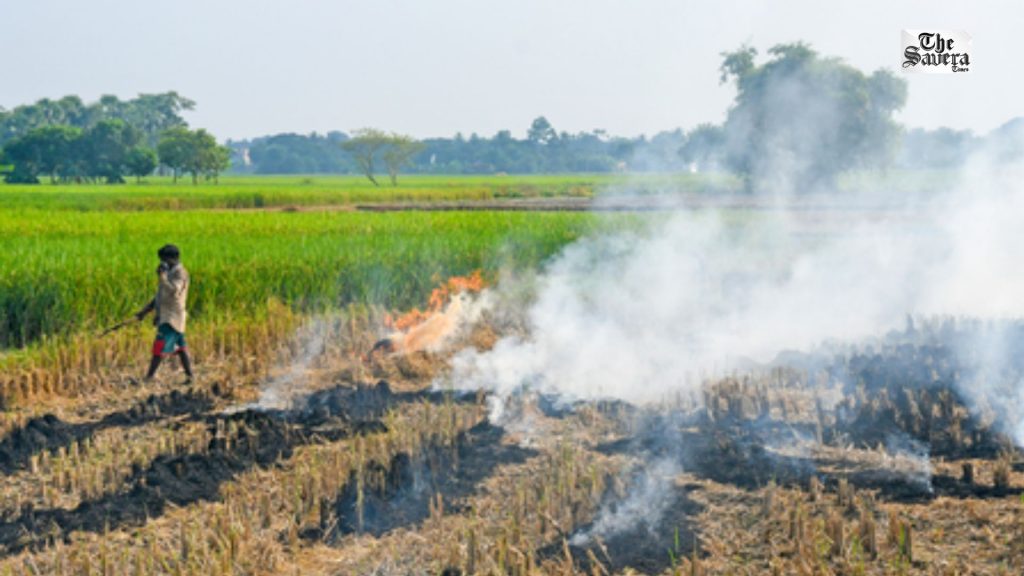
Chandigarh: Haryana will deploy a Parali Protection Force at district and block levels to prevent paddy stubble burning as the state steps up enforcement ahead of the harvesting season.
The state will also intensify late-evening patrolling, use drones to monitor farm-fire incidents and provide farmers an incentive of Rs 1,200 per acre for the optimal utilisation of crop-residue management machinery.
Chief Secretary Anurag Rastogi reviewed Haryana’s action plan on Thursday for eliminating stubble burning and ensuring compliance with directions issued by the Commission for Air Quality Management (CAQM).
Parali Protection Force to Monitor Farm Fires
The Parali Protection Force will comprise police personnel, Agriculture Department officials, administrative officers, nodal and cluster officers, and officials from other stakeholder departments.
The force will operate at both district and block levels to closely monitor incidents of paddy stubble burning and take action against violations.
Additional Chief Secretary (Agriculture) Vijayendra Kumar said late-evening patrolling would be intensified as some farmers may attempt to burn paddy residue after dark to avoid satellite detection of farm fires.
Under the enforcement plan, every verified case of paddy stubble burning will face three actions — registration of an FIR, issuance of a challan and a “red entry” in the farmer’s land record. Appropriate environmental compensation charges will also be imposed and recovered from violators.
Farmers to Get Incentives for Crop-Residue Management
Alongside enforcement, the Haryana government is focusing on providing farmers with alternatives to stubble burning.
The state is offering an incentive of Rs 1,200 per acre, apart from subsidies for purchasing crop-residue management machinery, to encourage its optimal utilisation.
The government also plans to move balers, rakers and other machines between districts according to the paddy harvesting schedule.
Harvesting begins in Yamunanagar, Ambala, Karnal and Kurukshetra from September and is expected to progress to Sirsa, Fatehabad, Hisar and Jind during the last week of October.
Officials have been directed to coordinate with baler owners in neighbouring states and adjoining Haryana districts to ensure the availability and movement of machinery during the harvesting season.
Over 8,000 Village-Level Nodal Officers Appointed
Director (Agriculture) Amit Khatri said 8,134 village-level nodal officers have been appointed for field monitoring.
Haryana has around 6,21,285 registered paddy farmers across 5,600 villages, covering approximately 34.1 lakh acres. So far, 6,04,314 farmers have been covered by the nodal officers.
Under the monitoring system, a maximum of 100 farmers can be assigned to each nodal officer, with the limit reduced to 50 in hotspot villages.
Nodal officers will use a mobile application to report active fire locations and record whether farmers are managing crop residue through in-situ, ex-situ or fodder-based methods.
The state is also moving towards drone-based surveillance. In accordance with CAQM directions, Haryana is in the process of deploying drones in association with DRIISHYA to monitor stubble-burning incidents.
Deputy Commissioners will finalise the villages and locations where drones will be deployed in advance.