Last Updated: October 24, 2026
Last Updated: October 24, 2026





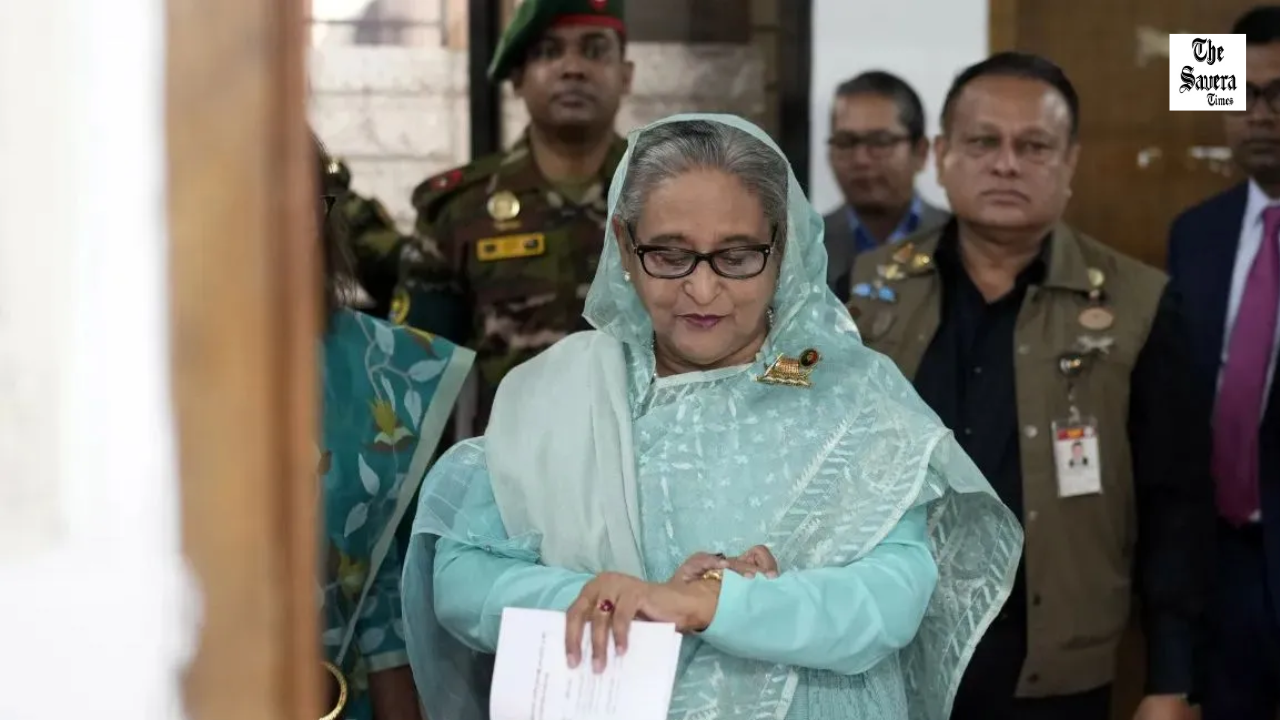
Former Bangladeshi Prime Minister Sheikh Hasina has delivered a powerful message urging the people of Bangladesh to rise up and reclaim democracy, sharply criticizing the country’s interim government led by Nobel laureate Muhammad Yunus. Speaking in an audio message played at an event in New Delhi, Hasina accused the interim leadership of undermining democratic institutions and called its rule “fascist,” “corrupt,” and illegitimate.
Hasina’s remarks come amid a deep political crisis in Bangladesh as the nation approaches a critical national election scheduled for February 12, 2026 — the first since her overthrow during mass protests in August 2024.
In her address, Hasina did not hold back in her condemnation of the interim government. She repeatedly described Muhammad Yunus and his administration as a “murderous fascist” regime, corrupt and power-hungry, alleging that it has pushed Bangladesh into chaos and lawlessness.
She accused the interim leaders of bleeding the nation dry, allowing violence and persecution to proliferate, and betraying the country’s hard-won democratic values rooted in the 1971 Liberation War.
Hasina called on Bangladeshis to stand united and resist what she described as a foreign-serving puppet regime. She invoked the spirit of the nation’s Liberation War and emphasized defending and restoring the Constitution “written in the blood of martyrs.”
She outlined a bold vision for the country, urging citizens to reclaim independence, safeguard sovereignty, and revive democratic governance. Her appeal was directed not only at political allies but also at democratic, progressive, and non-communal forces to take a solemn oath to establish a humane, inclusive and welfare-oriented democratic state.
Alongside broad rhetoric, Hasina delineated five key demands that she believes are essential to healing Bangladesh and unifying its people:
Restore democracy by removing what she calls the “illegal Yunus administration.”
End daily violence and street lawlessness.
Ensure ironclad protection for religious minorities, women, girls, and vulnerable communities.
Stop politically motivated legal actions used to intimidate journalists and opposition members.
Invite the United Nations to conduct an impartial investigation into the events of the past year.
These points reflect Hasina’s broader strategic framing of the political struggle as not only domestic but also a matter requiring international attention.
Bangladesh’s political landscape remains deeply polarized. After Hasina’s ouster following violent protests in 2024, Muhammad Yunus took over as head of an interim government tasked with steering the country to elections. However, his government’s credibility has been questioned by multiple parties, including the Awami League, which has been banned from contesting, raising concerns about electoral legitimacy.
The backdrop to Hasina’s remarks also includes attacks on journalists, suppression of press freedom, and broader concerns about declining democratic norms ahead of the elections.
The Indian Army on Friday rejected claims on social media that the Army had taken action against the...
Abdul Majid Hakim Elahi, Iran's Supreme Leader's representative and senior diplomat, said on Friday that the US has...
New York, USA: The New York City Council has passed a law to ban horse-drawn carriages, naming the...

Washington: US President Donald Trump suggested that further military action against Iran remained possible, while acknowledging that the...
Lhasa: Sixteen people were killed and 32 others injured after a 7.0-magnitude earthquake struck Tibet on Thursday, according...
More than two weeks after the Yemeni government launched a major offensive against the Houthi group, front lines...
Aries: The day will be auspicious...