Last Updated: October 13, 2026
Last Updated: October 13, 2026





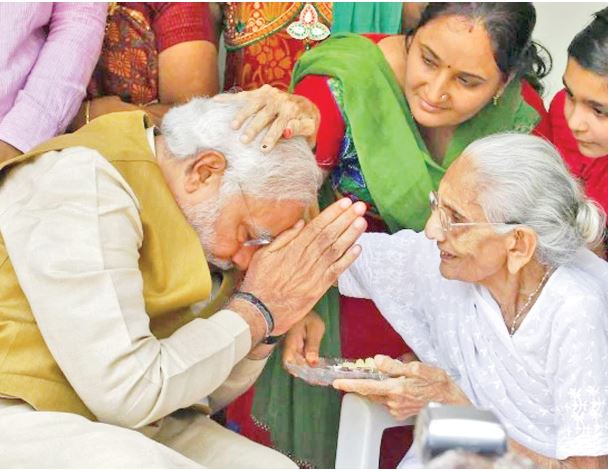
Modi grew up in a modest household where Heeraben shouldered the responsibilities of raising her children amid limited means. She managed household chores and took on additional work, from washing utensils in other homes to spinning yarn on the charkha. In a blog written on her 100th birthday, Modi recalled how she even peeled cotton and spun thread while protecting her children from the sharp thorns. (c)
On September 17, 2025, Prime Minister Narendra Modi will turn 75. As he reaches this milestone, one figure continues to loom large in the story of his life — his mother, Heeraben, who passed away in December 2022 at the age of 100. To Modi, she was more than a parent. She was a source of resilience, sacrifice, and inspiration whose influence can be traced in many of his decisions, policies, and personal values.
Born in Vadnagar in Gujarat, Modi grew up in a modest household where Heeraben shouldered the responsibilities of raising her children amid limited means. She managed household chores and took on additional work, from washing utensils in other homes to spinning yarn on the charkha. In a blog written on her 100th birthday, Modi recalled how she even peeled cotton and spun thread while protecting her children from the sharp thorns. For him, her life was a testament to hard work and quiet dignity.
Their home in Vadnagar was a small mud-walled house with a tiled roof. During monsoons, rain would seep through the roof, forcing Heeraben to place buckets and utensils to collect water. Despite such hardships, her determination ensured that her children never lost hope. Modi described her as the embodiment of resilience, one who avoided asking others for help and relied on her own strength.
A Life of Sacrifice
For Modi, his mother’s sacrifices were central to his own growth. She lived simply, with little interest in possessions or ornaments. Even in her later years, she occupied a small room and maintained a frugal lifestyle. Modi has said he never saw her wear gold jewellery or display any desire for material comforts.
Her focus was on her children and on caring for others. She treated everyone as part of the family, including Abbas, the son of a close friend of Modi’s father, who came to live with them after his father’s death. Heeraben raised him with the same affection she showed her own children, preparing his favourite dishes on Eid and supporting his education. Such acts, Modi later said, reflected her belief in respecting others’ traditions and choices.
Inspiration for Welfare Policies
Modi has often acknowledged that some of his flagship schemes were inspired by his mother’s struggles. The Ujjwala Yojana, which provided millions of poor households with LPG connections, was one such initiative. At its launch in 2016, he recalled his mother cooking on a wood-fired stove in a smoke-filled kitchen, often making it difficult to see her while she served food. Those experiences, he said, shaped his resolve to spare other families such hardships.
Cleanliness was another value that Heeraben deeply instilled in him. Modi remembered how she insisted on spotless bedsheets and would not tolerate even a speck of dust. At home in Vadnagar, when sanitation workers came to clean the drains, she would serve them tea before they left. He later said that this shaped his respect for sanitation workers and his determination to push the Swachh Bharat Abhiyan after becoming prime minister.
Lessons in Honesty and Hard Work
When Modi became Gujarat’s chief minister in 2001, Heeraben gave him one clear instruction: never accept a bribe. She may not have fully understood the workings of government, but she consistently reminded him of the need to serve the poor and act with integrity.
On her 100th birthday in June 2022, she advised him to “work with wisdom, and live life with purity.” Modi has often said that his parents’ honesty and self-respect were their most enduring qualities. Despite poverty, they never compromised on values. Their answer to every difficulty was unrelenting hard work.
Her reminders, he said, strengthened his own resolve to build a reputation for honesty in politics, embodied in his promise: “Na Khaoonga, Na Khaane Doonga” — not to take bribes or allow others to do so.
Wisdom Without Formal Education
Though she had no formal schooling, Modi often described his mother as a woman of wisdom. Once, when he expressed a wish to celebrate her as one of his teachers, she gently declined, saying that while she had given him birth, his true teacher was the Almighty.
Her humility and farsightedness, Modi wrote, continually surprised him. He considered her an example of someone who was learned without formal education. She respected his choices from childhood, even when they differed from his siblings. When he decided to leave home, his father was distressed, but Heeraben immediately gave him her blessings, urging him to follow his own path.
A Mother’s Influence
Throughout his career, Modi drew strength from her words and example. Whether it was her insistence on honesty, her discipline in cleanliness, or her sacrifices in raising a family amid hardship, Heeraben’s influence was deeply imprinted on him.
He often said that her story was not just her own but a reflection of the collective resilience of India’s mothers. In his blog, he wrote: “In my mother’s life story, I see the penance, sacrifice, and contribution of India’s matrushakti. Whenever I look at Mother and crores of women like her, I find there is nothing that is unachievable for Indian women.”
For Modi, Heeraben symbolised the unyielding spirit of India’s women, who rise above deprivation with strength and determination. Her life, he said, was proof that beyond every struggle lies resolve, and beyond every sacrifice, hope.
As Modi turns 75, the values she lived by — honesty, simplicity, resilience, and care for others — remain central to his own journey, shaping both the leader and the man.
Bengaluru: The BJP on Tuesday questioned the Congress over the alleged pushing away of Karnataka Chief Minister D.K....
Mumbai: Singer Darshan Raval has opened up about his new track ‘Jaane Kis Mod Pe’ from the upcoming...

Giridih (Jharkhand): Five people were killed and two others were seriously injured in two separate road accidents in...

New Delhi: The Supreme Court on Tuesday granted interim relief to Leader of Opposition in the Lok Sabha...

The Supreme Court on Tuesday took a serious view of the alleged assault on female journalists by police...
New Delhi: A Supreme Court lawyer has approached Chief Justice of India (CJI) Surya Kant seeking consideration of...
Aries: The day will be auspicious...