Last Updated: October 26, 2026
Last Updated: October 26, 2026





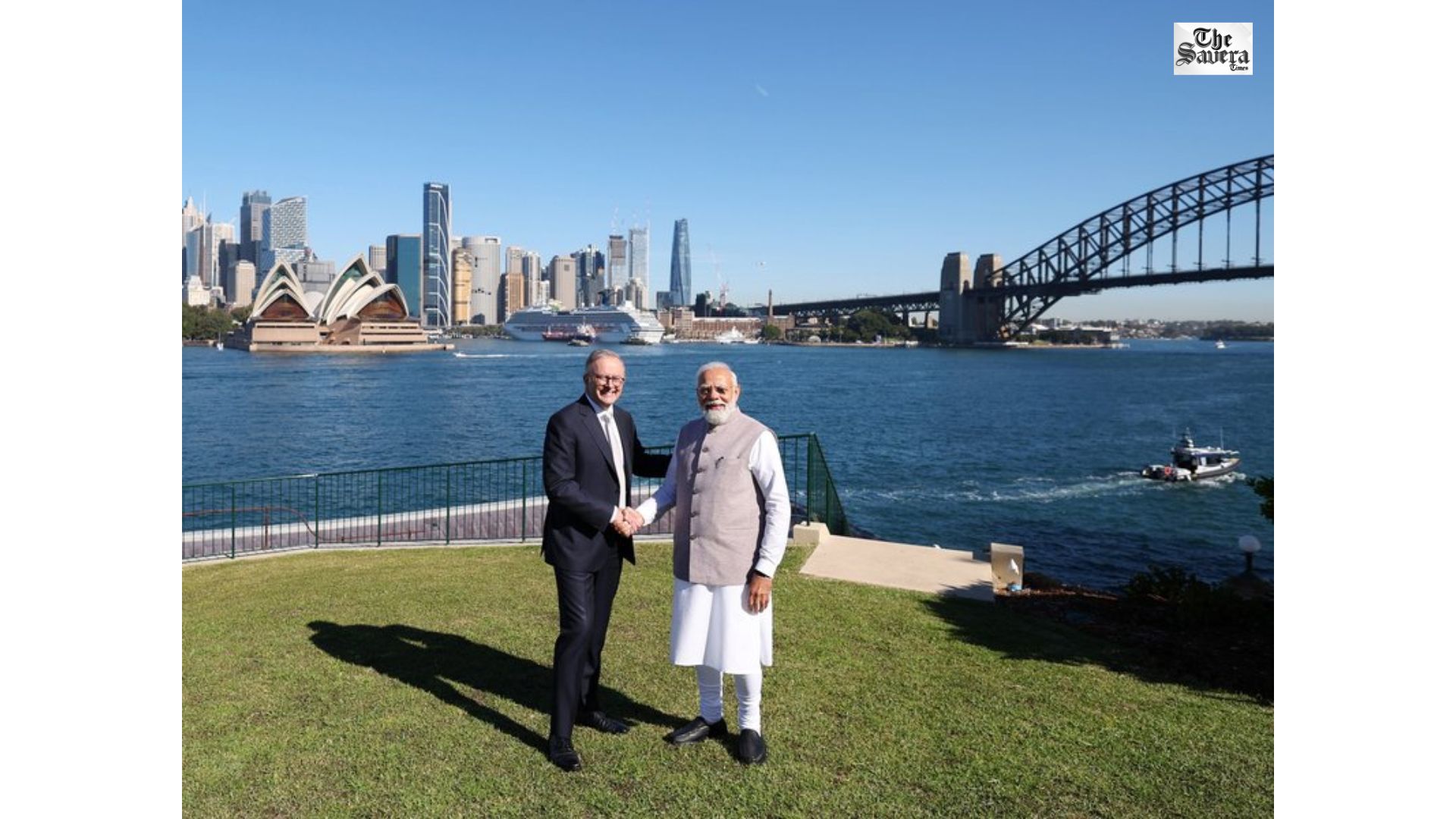
Prime Minister Narendra Modi’s recent visit to Australia marked a significant milestone in India-Australia relations, with both countries signing a wide-ranging set of agreements across defence, economic security, energy, education, science, technology and culture. The agreements reflect a growing partnership in which both nations increasingly view each other not merely as bilateral partners but as long-term strategic allies.
During his three-day visit from July 8 to 10, Prime Minister Modi held talks with Australian Prime Minister Anthony Albanese, met business leaders and addressed around 35,000 members of the Indian diaspora at Melbourne’s Docklands Stadium. The event was also attended by Albanese and Victoria Premier Jacinta Allan.
Rather than centring on a single high-profile announcement, the visit produced a comprehensive package of agreements aimed at strengthening cooperation across multiple sectors. Together, these initiatives demonstrate that India and Australia have built an institutional framework capable of supporting a deeper and more enduring strategic relationship.
Security and defence cooperation remained a key focus amid an increasingly uncertain global environment. Both leaders signed a new Joint Declaration on Defence and Security Cooperation, described as a “step-change” in bilateral ties. The agreement includes the creation of an Annual Defence Ministers’ Dialogue, greater interoperability between the armed forces of both countries, and expanded military exercises under the Mutual Logistics Support Arrangement.
The two leaders also unveiled the India-Australia Maritime Security Collaboration Roadmap to enhance information sharing, operational coordination and capability development. Additionally, a Memorandum of Understanding was signed between Australia’s Maritime Border Command and the Indian Coast Guard to strengthen maritime security cooperation.
Energy cooperation also reached a new level as both countries finalised the administrative arrangements necessary for Australia to export uranium to India for exclusively peaceful purposes. Prime Minister Modi said the agreement would support India’s clean energy ambitions while deepening bilateral cooperation in the energy sector.
For many years, Australia restricted uranium exports to countries with strong non-proliferation commitments, and India’s status outside the Nuclear Non-Proliferation Treaty (NPT) had prevented such trade. Australia’s decision to move ahead despite this reflects the growing trust it places in India as a responsible nuclear power and strategic partner.
Beyond defence and energy, the visit highlighted the importance of people-to-people ties in strengthening the broader relationship. Expanding cooperation in education, science, technology and research, alongside the growing Indian diaspora in Australia, has created a strong social foundation that supports closer strategic and economic engagement.
Taken together, the agreements signed during Prime Minister Modi’s visit present a holistic vision of the India-Australia partnership. Rather than focusing on a single initiative, they showcase a mature relationship built on institutional cooperation across defence, trade, energy, innovation, education and cultural exchange—demonstrating that both countries increasingly see each other as long-term strategic partners with shared interests across nearly every major area of national policy.
A second assault in three the representative of Dalai Lama in South Africa, is being seen as yet...
It is quite intriguing that 'Free Kashmir' posters and slogans keep appearing on university campuses and at political...

Water storage in India's 178 major reservoirs fell by nearly 3.5 billion cubic metres in seven days, with...

For generations, India’s lighthouses were places people saw from a distance. Standing at the edge of the sea,...

Leader of the Opposition in the Lok Sabha, Rahul Gandhi, will visit Punjab's Sangrur district on November 4....

Good Evening Viewers! Stay updated with The Savera Times Evening Bulletin, bringing you the latest news and top...

Aries: The day will be auspicious...