Last Updated: October 3, 2026
Last Updated: October 3, 2026





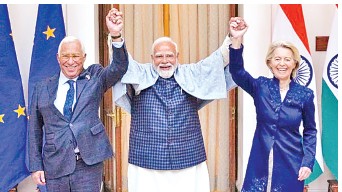
At a time when the global economy is being shaken by wars, rising tariffs and growing uncertainty, India has chosen to respond not with hesitation, but with quiet confidence. The message from New Delhi is clear – India is open for business and firmly sure of its economic direction. The long-awaited India-European Union Free Trade Agreement (FTA), often described as the “mother of all trade deals,” marks a significant milestone in this journey.
This agreement is not merely about boosting trade figures or opening new markets. It reflects something deeper: India’s rising credibility and growing negotiating strength on the global stage. By linking two massive economic zones that together represent nearly two billion people and around a quarter of the world’s GDP, India has placed itself squarely at the centre of global economic activity.
What is particularly striking is not just the scale of these partnerships, but the pace at which India has moved forward in recent years. Traditionally seen as a slow and cautious negotiator, India has surprised many by signing multiple Free Trade Agreements (FTAs) and Comprehensive Economic Partnership Agreements (CEPAs) in quick succession. Deals with countries such as the UAE, Australia, Japan and the EFTA nations, alongside ongoing negotiations with the UK and the EU, point to a clear and consistent trade strategy driven by decisive governance.
There was a time when India was often labelled a “fragile” or “vulnerable” economy, overly dependent on global conditions.
That perception is steadily changing. Today, India is emerging as a reliable, resilient and dependable trade partner. Nations are no longer viewing India simply as a vast consumer market, but as a long-term partner they can trust in an increasingly volatile global environment.
An important shift is also taking place in India’s trade relationships. The country is moving beyond traditional dependence on major powers like the United States and China. Instead, it is building a diversified network of partnerships across Europe, West Asia and the Indo-Pacific region. This diversification reduces risk and strengthens India’s strategic autonomy in global economic affairs.
This transformation rests on strong economic fundamentals, sustained reforms and policy continuity. Unlike many economies that respond to global shocks with panic-driven decisions, India has largely maintained stability and long-term planning.
As a result, global investors and governments increasingly view India as stable, predictable and full of opportunity – a rare combination in today’s fractured world.
Even external challenges have been turned into opportunities. The tariffs imposed during the Trump era, which unsettled many economies, encouraged India to widen its export base and explore new and underdeveloped markets. This shift was possible because India had already begun strengthening its internal resilience through robust domestic demand, financial discipline and a growing manufacturing sector.
Behind this renewed confidence lies a government that has managed to strike a careful balance. A capable and coherent economic leadership has guided growth without compromising stability. India today is undertaking a difficult but essential task – supporting a rapidly growing middle class, expanding manufacturing under initiatives like “Make in India,” and maintaining a strong welfare system to protect the vulnerable.
Crucially, deeper global engagement has not meant sacrificing national interests. In trade negotiations, special attention has been given to farmers, dairy producers and micro, small and medium enterprises (MSMEs). Sensitive sectors have been protected, ensuring that economic openness does not come at the cost of domestic livelihoods.
Taken together, the India-EU FTA and the broader trade push tell a larger story. It is the story of an India that is no longer viewed as an economic risk, but as a trusted global partner. It reflects a nation moving forward with confidence, backed by steady leadership, sound policies and growing international respect.
After 18 long years of negotiations, the India-EU Free Trade Agreement is not just the closing of a chapter – it is the beginning of a new phase in India’s rise as a central player in the global economy.
Dhaka: Amid growing concerns over mounting threats to press freedom in Bangladesh, at least 162 journalists faced attacks,...

New Delhi: Tech giant Apple has said it will tighten controls around Full Disk Access on Mac computers...
Mumbai: Bollywood superstar Salman Khan has lauded Indian pilot Captain Smit Machchhar for his courage and presence of...

Chennai: The Tamil Nadu government is preparing to seek the Centre’s approval for a proposed airport at Manikaneri...

New Delhi: A joint team of the SWAT team and Garhmukteshwar Police in Uttar Pradesh’s Hapur district on...

Good Morning Viewers, start your day with The Savera Times Morning Bulletin, bringing you the latest and biggest...

Aries: The day will be auspicious...