Last Updated: October 12, 2026
Last Updated: October 12, 2026





Parminder Brar
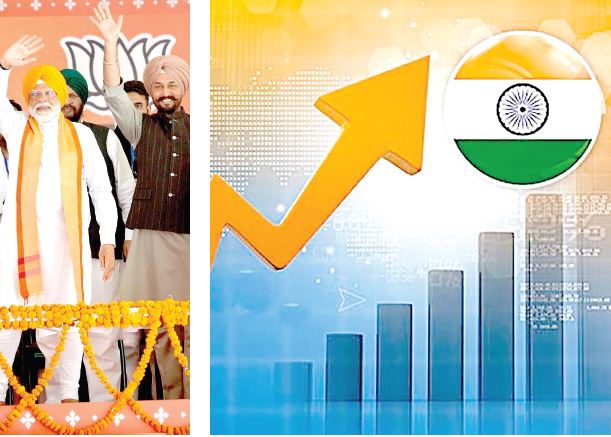
India’s New Identity on the Global Stage – Prime Minister Modi’s Visionary Leadership Today, India is not only a rapidly growing economy but has also become an active participant in global policymaking. Prime Minister Narendra Modi’s visionary leadership and sustained economic reforms have given the country a new direction, where modern infrastructure, the digital revolution, and a transparent tax system are converging to build a strong India.
According to the latest international estimates, India’s nominal GDP could reach approximately $4.19 trillion in 2025, making India the world’s fourth-largest economy. This achievement is not just a statistical leap, but a confluence of policy, confidence, and capability.
Citizen-Centric Tax Concessions: Direct Relief for the Middle Class
The new tax regime has been simplified and is beneficial in the Union Budget 2024–25.
* The standard deduction for salaried individuals has been increased from Rs50,000 to Rs75,000.
* The effective tax-free income limit for salaried individuals could reach approximately Rs12.75 lakh due to the exemption under Section 87A and the new slab structure.
These measures will increase both net savings and domestic consumption of households, boosting demand and cash flow across the economy.
Next Gen GST: Historic Changes in the Tax System
The Next Gen GST (GST 2.0), scheduled to be implemented from September 22, 2025, is the biggest structural reform in India’s tax system. The main objectives are lower rates, simplified compliance, and transparent administration.
Key Reforms
* Simpler Slab Structure: Two main rates of 5% and 18% are proposed, replacing the old four slabs of 5%, 12%, 18%, and 28%. A special slab of approximately 40% will remain for luxury and harmful goods.
* Relief on Daily Needs: There is a provision to reduce many consumer goods from higher rates to 5% or lower slabs, which will significantly reduce monthly expenditure for families.
* Health Sector: Select life-saving medicines have been made tax-free (0%). Rates on other essential medicines and healthcare equipment will also be reduced.
* Construction and Housing: The tax rate on cement and other key construction materials is being reduced from 28% to 18%, which is expected to reduce the cost of housing and urban infrastructure projects.
* Trade and Industry: Multi-Factor Authentication (MFA), faceless returns, and digital records are making tax compliance faster, simpler, and secure.
These changes are not limited to reducing tax rates; they are aimed at creating employment, encouraging industry, and boosting investment.
Developed India 2047: A Long-Term National Resolve
Developed India 2047 is not just a slogan, but a national roadmap to becoming a fully developed and self-reliant nation by the time India completes 100 years of independence. Initiatives like Next Gen GST, Make in India, Startup India, and Digital India are ensuring that the benefits of economic progress reach every citizen and every sector.
India’s Move Towards Global Leadership
India’s rise to fourth place after the US, China, and Germany is a result of sustainable economic policies and stable leadership. Tax transparency, digitization, and an investment-friendly environment have made India a pivotal partner in global supply chains, green energy investments, and digital public infrastructure.
Employment, Enterprise, and Skills
Tax simplification and digitization facilitate the entry of informal enterprises into the formal sector. Credit access, guarantee schemes, and digital records enable micro-enterprises to scale up. Skill development missions, ITI upgradation, and industry-academia partnerships are making the young workforce “job-ready.” Self-help groups, credit linking, and market connections are being expanded to increase women’s participation, boosting both household incomes and local entrepreneurship. This broad participation sustains economic energy and strengthens equality of opportunity in society.
Strong Economy, Strong Citizens
Under the leadership of Prime Minister Narendra Modi, tax transparency, investment-friendly policies, and a citizen-centric approach have given India a new direction. Next-gen GST, a simplified income tax system, and digital governance—these three pillars simplify everyday life, reduce business costs, and bring development to the masses.
This journey is not just about fiscal reforms, but about a new India that is self-reliant, inclusive, and globally competitive. This holistic vision offers concrete potential to translate the resolve to become a developed nation by 2047 into action and gives citizens the confidence to move forward with participation.
India is now decisively moving towards becoming not just a large economy, but a strong, self-reliant, and prosperous nation—a living testimony to Prime Minister Modi’s visionary leadership.
Former BJP MLA Attar Singh Bhedana died at Jaipur’s SMS Hospital after a violent clash at a crusher...

An eyewitness has recounted the fatal Mini Cooper crash in Nedumbassery, Kochi, claiming the driver said his father...

The Cockroach Janata Party plans to approach Parliament Street Police Station for permission to hold a peaceful protest...

BJP leader Kirit Somaiya has announced plans to file a complaint against actor Imran Khan over alleged OCI...

Start your day with The Savera Morning Brief, bringing you the top India and world news, breaking developments,...

Maharashtra MPSC Chairman Vivek Bhimanwar has been sent on compulsory leave until the inquiry into the alleged paper...
Aries: The day will be auspicious...