Last Updated: October 11, 2026
Last Updated: October 11, 2026





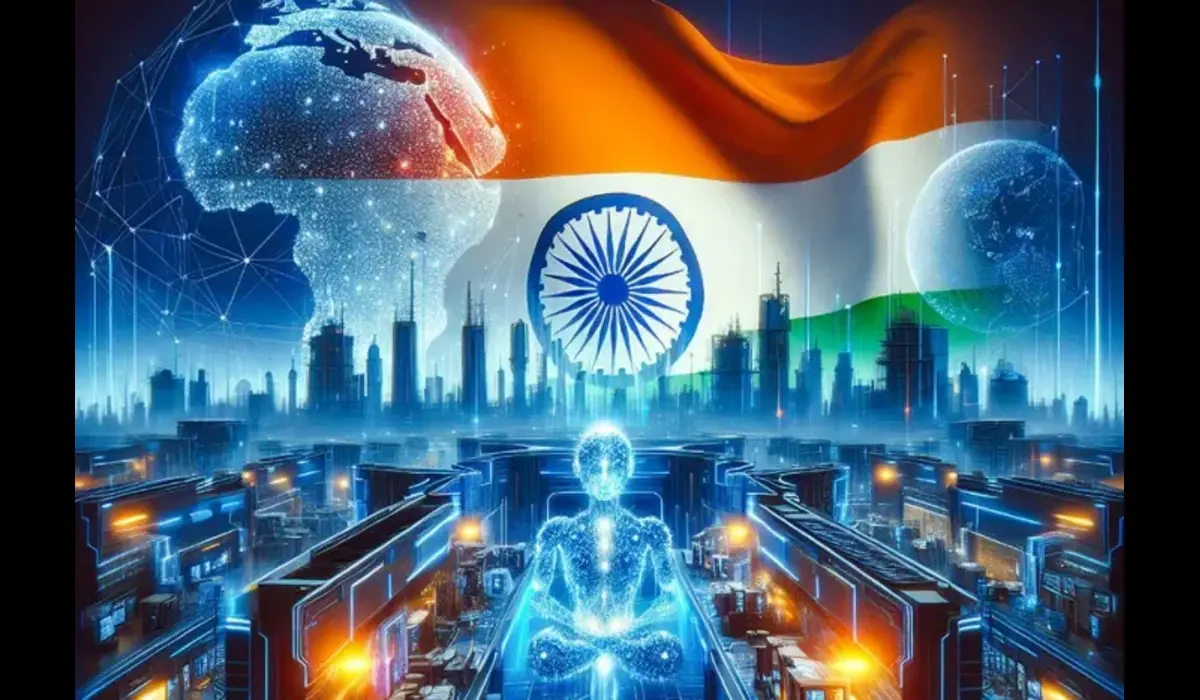
In October 2025, two defining moments reshaped India’s understanding of artificial intelligence (AI) and its place in global power dynamics. OpenAI quietly restricted Indian developers from accessing its new o3 reasoning model, while China’s DeepSeek-V3 shattered global benchmarks and offered its tools freely to the world. The message was unmistakable—AI is no longer just a futuristic technology; it is the oxygen of national power. Yet, despite its digital ambitions, India still breathes through a narrow straw. With just 0.3 percent of global AI patents, 0.8 percent of top-tier AI researchers, and under $900 million in annual AI start-up funding compared to the United States’ $69 billion, India risks becoming a digital coolie in the intelligence age. If the 20th century belonged to nations controlling oil and steel, the 21st century belongs to those controlling data and algorithms.
The first and most urgent front is national security. The 2025 Ladakh winter standoff demonstrated that future wars will be fought not on battlefields but in data centers. Before a single bullet was fired, Chinese PLA drones powered by Baidu’s ERNIE-4.5 had mapped Indian positions, predicted artillery strikes, and jammed radar networks using AI-generated waveforms. India responded with DRDO’s Maya-OS algorithms—functional but technologically outdated. Modern warfare is measured in FLOPs, not firepower. Israel’s Lavender AI identifies tens of thousands of targets in minutes, while India’s own DRDO AI Combat Assistant remains in prototype form. By 2030, nearly half of all battlefield decisions are expected to be automated. A nation that cannot code its own military AI will be forced to rely on imported intelligence. India’s Defence AI fund of $1.2 billion is commendable, but minuscule compared to China’s $400 billion AI investment plan.
The second front is economic. McKinsey projects that AI will add $15.7 trillion to global GDP by 2035. At its current pace, India might capture just $450–600 billion of that total, but with ambition matching China’s, the figure could rise to $1.8 trillion. The difference—$1.2 trillion—is equivalent to three times India’s current defence budget. Every year of hesitation costs millions of jobs and billions in lost opportunities. Flipkart’s AI-powered logistics system reduced delivery costs by 19 percent in 2024; scaling similar efficiencies across India’s 63 million small businesses could create over 20 million new jobs. Yet 94 percent of Indian enterprises still operate without AI. The problem is not potential—it is the brain drain. In 2024 alone, 41,000 Indian AI PhDs moved to the United States, a number greater than the combined AI workforce of ISRO and DRDO. India must make it attractive for these minds to innovate at home rather than abroad.
Healthcare represents another powerful opportunity. With only 0.7 doctors per 1,000 people—below the WHO’s minimum of 1.0—India faces a massive medical gap. Artificial intelligence can bridge it. Start-ups like Qure.ai are already using AI to diagnose tuberculosis faster than radiologists in 117 district hospitals. The potential extends far beyond one disease—AI can revolutionize screening for diabetes, cervical cancer, and cardiovascular illness. But accessibility remains a challenge. Most medical AI systems, such as Google’s Med-PaLM 2, do not support Indian languages. Rural patients searching for health information in Tamil or Kannada still find irrelevant English results. India urgently needs sovereign, multilingual health models trained on anonymized national health data to serve its diverse population.
Agriculture, too, stands at a crossroads. By 2030, India must produce 350 million tonnes of foodgrain with 18 percent less water and shorter monsoon cycles. Microsoft’s AI-powered sowing advisory system improved cotton yields by 31 percent in Vidarbha, proving what technology can achieve when scaled intelligently. Yet ICAR’s Krishi-AI portal, launched with fanfare, still runs on 2019-era models. In China, similar AI systems advised 16 million farmers last year. Indian farmers, facing drought, soil degradation, and erratic rainfall, are competing with algorithms they cannot even access. Advanced AI-driven farm analytics, integrated with satellite imagery and IoT soil sensors, could revolutionize India’s food security—but only if the nation invests now.
Education is the long-term frontier. Each Indian Institute of Technology produces around 1,200 computer science graduates a year, but the nation needs at least 120,000 AI engineers annually to keep pace with global demand. The solution lies not in building 100 new IITs, but in democratizing quality learning through AI tutors. Imagine an affordable ₹2,000 JioPhone running a homegrown AI model that teaches mathematics in Maithili or science in Marathi. In Bihar, a pilot project called VeLLM (Vernacular Large Language Model) was tested in 400 schools in 2025, resulting in a 340 percent improvement in math scores. Scaling such innovations across 250 million students could erase India’s education divide within a generation.
To secure its AI future, India must act with boldness and vision. A ₹1 lakh crore National AI Mission 2.0 should be launched between 2026 and 2030, focusing equally on foundational models, military applications, and vernacular innovation. Every foreign AI collaboration must include a 50 percent transfer-of-technology clause, similar to defence offsets. An AI Defence Corridor stretching from Bengaluru to Hyderabad to Chennai could host 200 start-ups, half led by women entrepreneurs. A national “Agnipath-for-Code” program could train one million young Indians as AI apprentices with stipends and assured jobs in PSUs. Simultaneously, India should build BharatGPT-200B—a massive multilingual model trained on one trillion Indian-language tokens—to empower local innovation. Tax incentives and near-free land must be offered for semiconductor fabrication units, and a reverse brain-drain policy should reward returning AI researchers with ₹5 crore grants and national honors.
The cost of inaction is staggering. If India stays passive, by 2035 nearly 70 percent of its coding jobs could be automated by foreign models. China would own 44 percent of Asia’s AI patents, while India’s share would stagnate at just over one percent. Rural healthcare costs could skyrocket, and defence imports might again dominate national procurement. India missed the semiconductor revolution in the 20th century and paid decades of technological debt. The AI revolution offers one final chance to lead rather than follow.
As OpenAI CEO Sam Altman said during his 2025 visit to Delhi, “The country that prints its own intelligence will rule the century.” India has the demographics, the linguistic diversity, and the democratic values to become the most inclusive AI superpower on Earth. The only missing ingredient is urgency. The next ChatGPT doesn’t have to emerge from Palo Alto or Shenzhen—it can rise from Pune, Patna, or Palakkad. But only if India decides that mere survival is not enough. Supremacy must be the goal.
The CJP clarified that a petition circulating on social media over the alleged detention of its leaders was...

CJP founder Abhijeet Dipke and leaders Saurav Das and Ashutosh Ranka were placed under preventive arrest amid security...

India has criticised the UN human rights office’s concerns over police action against CJP protesters in Delhi, citing...

Uttar Pradesh CM Yogi Adityanath and Union Minister Nitin Gadkari greet people on the first day of Sharadiya...

New Delhi: Delhi Traffic Police has announced traffic restrictions and possible diversions at around 30 key intersections and...

Pakistan’s religious minorities continued to face violence, discrimination and persecution throughout 2025, with blasphemy accusations and minority women...
Aries: The day will be auspicious...