Last Updated: October 20, 2026
Last Updated: October 20, 2026





Abhishek Vij
Nowadays, powerful countries are hindering the progress of trade of weaker countries with the help of their currency like dollar, pound or ruble and an import-dependent country like India has become so captive to its import needs that despite the goals of making itself an export-based economy, it is unable to fulfill them. Last year, we saw Indian trade getting affected due to US tariff policies. To overcome this, we are hoping for a beneficial India-US trade agreement. The initial understanding was that India would bear 18 percent tariff on its exports but would keep its imports tax-free or very low. The main sector of our country is agriculture or agriculture-based business.
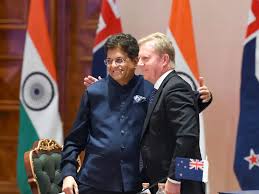
Even today, 60 percent of the country’s population remains untouched by agricultural labor in this agricultural country. These include crop production, poultry farming, and dairy farming. The country’s greatest concern is that this core business of our country should not be burdened by the burden of tax-free foreign imports. Even our politics is riddled with conflict, as was the case with the draft India-US trade agreement, over whether it will harm our farmers. However, the free trade agreement signed between India and New Zealand on April 27th, about a week ago, can be considered economically beneficial for the country. In any case, the devaluation of our currency threatens to free us from the dollar zone, and the path to this lies through free trade agreements. The India-New Zealand free trade agreement is one such agreement. This agreement provides Indian companies duty-free access to New Zealand. It will attract $20 billion in investment over the next 15 years.
This agreement has been under negotiation for a long time. Our trade is currently very low, at around $3 billion, but we aim to reach $5 billion in five years. The good news is that under this agreement, India will receive zero-tariff access on 100% of its exports. Now, goods exported from New Zealand to India also receive duty-free or reduced tariff concessions, meaning that duties on 95% of India’s imports from New Zealand have been reduced or eliminated. Our country’s concern with free trade agreements is that when imports are duty-free or reduced, they harm our farmers and domestic industries. This agreement provides tax exemptions on everything from wool, coal, timber, and wine to avocados and blueberries, but we have made every effort to protect our farmers and domestic industries.
No duty concessions were provided on milk, yogurt, cheese, sugar, spices, and rubber products.
Yes, imports of lamb, wool, coal, and wood products to New Zealand will also become duty-free. Another good thing is that some concessions have been granted to our young professionals who wish to migrate from India to New Zealand.
Five thousand three-year visa quotas will be allocated annually for those wishing to travel to New Zealand. While this concession seems small considering the number of people leaving India, it does open a path to New Zealand. We believe that the more decentralization India can achieve in foreign trade, the better it will be for its economy. The India-New Zealand Free Trade Agreement is a meaningful step in this direction.
A historic milestone was achieved on Tuesday in the expansion of Chhattisgarh's rail networkA historic milestone was achieved...

Model Shraddha Dubey, one of the main accused in the death of Lucknow businessman Shiv Sharma, has been...

Rashtriya Swayamsevak Sangh (RSS) chief Mohan Bhagwat on Tuesday called for strengthening national unity, social harmony, indigenous practices...
Amidst comparisons of youth protests in India to political movements and regime changes in France, Nepal, and Bangladesh,...

Rashtriya Swayamsevak Sangh (RSS) chief Mohan Bhagwat appealed for maintaining social unity in his Vijayadashami address in Nagpur...
Good Afternoon Viewers! Stay updated with The Savera Times Afternoon Bulletin, bringing you the latest news from Punjab,...

Aries: The day will be auspicious...