Last Updated: October 11, 2026
Last Updated: October 11, 2026





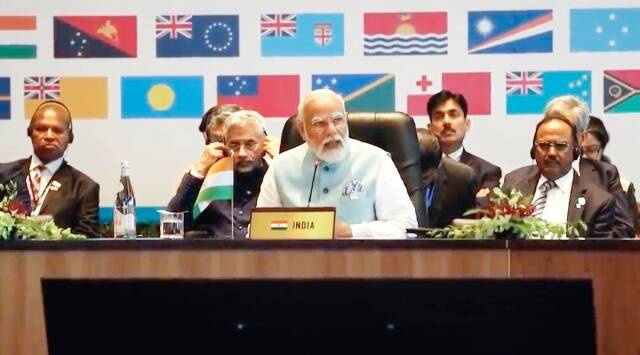
The world today is gripped by uncertainty. The international system is caught between the aspiration for a fairer, more inclusive order and the fear that any transition could merely reinforce older hierarchies in a new form. This tension, highlighted by international relations scholar Amitav Acharya, frames the debate on whether the emerging “multiplex” order will genuinely distribute power more equitably or simply repackage entrenched hegemonies.
The decline of the US-led Western dominance and the rise of China have been defining shifts for nearly two decades. The 2008 global financial crisis exposed vulnerabilities in Western economies, while Xi Jinping’s leadership from 2013 marked China’s more assertive ambition to challenge American primacy. Donald Trump’s election in 2016—and his return in 2025—accelerated this disruption. Trump questioned NATO, withdrew from global forums such as the WHO and Unesco, and obstructed the WTO’s functioning.
Even under Joe Biden, the United States leaned toward economic nationalism through initiatives like the CHIPS Act and Inflation Reduction Act, bypassing multilateral institutions. As a result, multilateralism is increasingly shaped by narrow, transactional interests. Trump’s emphasis on tariffs and his personal approach to global politics further weakened the image of the United States as a responsible leader. Former Secretary of State Condoleezza Rice observed at the Aspen Security Forum that Trump had “irrevocably upended the global order,” and a return to its earlier form was unlikely. Western concerns focus on the unraveling of a system that, despite flaws, managed global stability.
Acharya, however, sees opportunity in this disruption, arguing that the liberal order remains skewed toward World War II victors and that its decline could pave the way for a more pluralistic and representative structure. Looking ahead, analysts suggest three possible scenarios: a fragmented order dominated by competing blocs, selective cooperation based on shared interests, or a reformed institutional framework reflecting contemporary power balances.
India’s Role Amid Flux
For India, these changes are both challenging and promising. The diffusion of global power aligns with its long-held objective of strategic autonomy. Yet, New Delhi must prepare for all three potential trajectories of the emerging order. A pressing task lies in stabilising the neighbourhood. Relations with Nepal and Bangladesh have been strained by rising anti-India sentiment, while Pakistan— backed by China—remains a persistent challenge.
This requires nimble, calibrated diplomacy. In the Indo-Pacific, India has positioned itself through platforms such as the Quad, I2U2, and trilateral arrangements with partners like France and the UAE. These engagements are critical to balance China’s assertiveness. France and the UK, both increasingly active in the region, have emerged as important partners. Beyond Western-led initiatives, non-Western forums such as Brics Plus, the SCO, and ASEAN are gaining traction. Brics Plus, in particular, represents an attempt to counterbalance Western dominance. India’s interest lies in preventing China from monopolising leadership within such platforms, working instead with Brazil and other like-minded states. This aligns with India’s broader strategy of collaborating with middle powers wary of both Chinese authoritarianism and Western inconsistencies.
Risks and Opportunities
India is cautious of alliance-based commitments that risk overextension and reduce autonomy. The rise of minilateral frameworks—small, flexible, interest-driven groupings—demonstrates the declining relevance of rigid alliances. Still, some Western scholars criticise India’s focus on strategic autonomy, warning that it risks irrelevance amid intensifying US-China rivalry. New Delhi, however, is mindful of the dangers of being cast as a frontline state against China. Lessons from Ukraine underscore the perils of over-reliance on the United States. Recent tensions with Pakistan reinforced India’s sense of strategic solitude: global powers seek leverage rather than partnership.
Navigating Uncertainty
Uncertainty has become a defining feature of the global system, driven by shifts in Asian and global power balances and intensified by the disruptive leadership of Xi Jinping and Donald Trump. For India, the priority is to preserve flexibility. A multi-aligned approach, avoiding reliance on a single strategic option, offers the best safeguard. Strengthening economic resilience and maintaining credible defence deterrence, alongside stabilising the neighbourhood, will give India a stronger foundation for global engagement.
Nine people, including two children, were killed in a shooting in Erie, Pennsylvania. Police are yet to release...

Twelve people were killed and 309 injured in an attack targeting Riyadh's King Khalid International Airport as Saudi...

Police in Dhaka detained four people, including a woman, after a Rabindranath Tagore mural outside the Bangladesh Shilpakala...

The US “sold out” Tibet in its 1972 strategic deal with China, and successive administrations have continued to...
Ukrainian President Volodymyr Zelensky has criticised Donald Trump’s reported agreement to allow Russian diesel supplies to global markets,...
A 7.2-magnitude earthquake struck Panama on Friday, shaking buildings in Panama City and prompting tsunami alerts. Panama Canal...

Aries: The day will be auspicious...