Last Updated: October 21, 2026
Last Updated: October 21, 2026





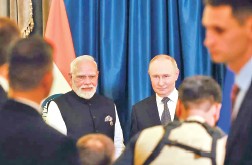
Russian President Vladimir Putin arrives in India today for a two-day visit, marking his first trip to the country since 2021. The visit includes formal talks with Prime Minister Narendra Modi, a state dinner hosted by President Droupadi Murmu, and his address at the plenary session of the Russia–India Forum. Putin and Modi will also participate in the 23rd India–Russia annual summit. The engagements are expected to draw close international attention, particularly from the United States, as New Delhi and Moscow continue to maintain a long-standing strategic partnership.
Putin’s visit comes at a time when the conflict in Ukraine continues to dominate global geopolitics. Recent high-level discussions between the United States and Russia over Ukraine failed to produce any major breakthrough. US President Donald Trump had earlier claimed he could end the conflict within 24 hours of returning to the White House, and last month presented a 28-point peace proposal. The plan, however, was rejected by both Ukraine and key European allies.
Despite efforts by the Trump administration, including meetings between Trump’s special envoy Steve Witkoff, his son-in-law Jared Kushner and senior Russian officials, progress on peace talks remains limited. Russian foreign policy adviser Yuri Ushakov described the discussions as useful and substantive but noted that no compromise had been achieved. He said some American proposals were acceptable in principle but required more deliberation, while others were not suitable for Russia. He also indicated that a possible meeting between Trump and Putin would depend on the progress made in future negotiations.
India has maintained a consistent position since the conflict began. New Delhi has repeatedly stated that only dialogue and diplomacy can lead to a resolution. India has abstained from voting on several United Nations resolutions critical of Russia. While Prime Minister Modi told Putin that this is not the era of war, India has continued to position itself as a potential mediator capable of engaging both Russia and Western powers.
Another focus of global attention during Putin’s visit is the growing US pressure on India to reduce its oil imports from Russia. India needs around five million barrels of oil per day to meet domestic demand and imports about 85 per cent of this requirement. Before 2022, Russian crude accounted for less than one per cent of India’s total imports. Instead, New Delhi relied heavily on suppliers in West Asia, including Saudi Arabia, Iraq, Kuwait and the United Arab Emirates.
This dynamic changed sharply after Western sanctions were imposed on Russia following the Ukraine invasion. Moscow began seeking new buyers for its crude oil, offering discounted supplies that appealed to major consumers like India. As a result, Russian oil became one of India’s key import sources over the past two years. The United States has publicly expressed concern about this shift and has urged India to scale down purchases, arguing that such imports help Russia sustain its war effort.
However, Indian officials have consistently maintained that the country’s energy decisions are driven by national interest and the need to ensure affordable supplies for a large population. New Delhi has stressed that energy security cannot be compromised, especially when global prices remain volatile.
Putin’s visit is expected to address a broad range of issues, including defence cooperation, energy trade, geopolitical challenges, and economic engagement. The meetings in New Delhi will be closely watched for any signals regarding India’s role in international mediation efforts, the future trajectory of bilateral defence ties, and potential adjustments in energy cooperation.
As India balances its strategic partnerships with both the United States and Russia, the outcomes of this visit are likely to have wide regional and international implications.
Good Evening Viewers! Catch up on the day's biggest stories with The Savera Times Evening Bulletin. Get the...

Congress leaders continued their protest outside the Jaipur Police Commissionerate on Tuesday, demanding the registration of a zero...
On the auspicious occasion of Vijayadashami, Prime Minister Narendra Modi on Tuesday called on the countrymen to unite...
A historic milestone was achieved on Tuesday in the expansion of Chhattisgarh's rail networkA historic milestone was achieved...
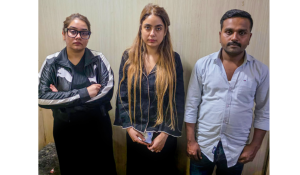
Model Shraddha Dubey, one of the main accused in the death of Lucknow businessman Shiv Sharma, has been...
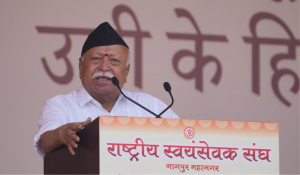
Rashtriya Swayamsevak Sangh (RSS) chief Mohan Bhagwat on Tuesday called for strengthening national unity, social harmony, indigenous practices...
Aries: The day will be auspicious...