Last Updated: October 21, 2026
Last Updated: October 21, 2026





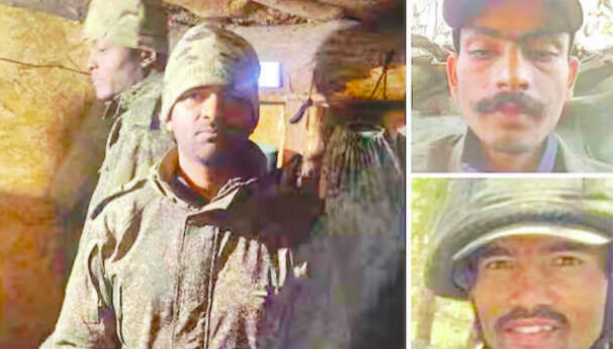
The families of several Indian men trapped in Russia’s war with Ukraine are caught in an unending cycle of grief, fear and uncertainty. Some have already performed the last rites of loved ones who never returned, while others wait anxiously for a phone call or message that may never come. What binds them all is a shared story of deception.
The men had left home with hopes of a better life, lured by promises of safe, high-paying jobs, only to find themselves pushed into a foreign war they neither chose nor understood. At Delhi’s Jantar Mantar, on a cold November morning, these families have gathered, their placards carrying the names of sons and brothers who were never meant to be soldiers.
They share their stories quietly, some breaking down mid-sentence, others staring blankly as they recall the last messages from their loved ones. Among them are the families of Sonu Kumar, Aman Punia and Mohammed Ahmed — all victims of a network of agents who preyed on their desperation and trust. In Hisar, Haryana, Sonu Kumar’s home now feels like a house frozen in time. His brother, Vikas Kumar, recalls how Sonu’s dream of earning enough to support the family ended in a nightmare. “He went to Russia on a study visa,” Vikas says, his voice subdued.
“When his studies were about to end, agents told him he could stay longer and earn well by working as a security guard. They said he would be safe, far away from any conflict.” The family’s last call with Sonu came on September 3. He sounded worried. “He told us they were sending him to the front line and that his phone would soon be taken away,” Vikas says. After that, there was silence. Then came the message that shattered their world.
“On September 19, we received a Telegram message from Russian authorities saying he had been missing since the 6th, and that his body had been found.” The officials told the family they could collect his remains from Moscow, but the cost of transporting the body to India would have to be borne by them. “They said, ‘From Moscow onwards, it’s your responsibility’,” Vikas recalls. “We borrowed money and somehow managed.” When the body arrived, it was badly burnt, identified only through computer scans. The video of his funeral later circulated online, showing the coffin draped with a Russian flag, a uniform placed beside it. For Vikas, the image still stings.
“He went there on a student visa. He was not a soldier. Why was he sent to die?” he asks. The question has no answer, only echoes among others who share the same pain. In another corner of Hisar, the Punia family lives with a different kind of torment — the torment of not knowing. Twenty-four-year-old Aman Punia has been missing for weeks. His elder brother, Ashu, says Aman was also trapped in the same web of lies. “They found him when his study visa was about to expire. They promised him a good job, permanent residency, and safety,” Ashu explains. “He didn’t know they were sending him to the war.” On October 15, Aman managed to call home. It was a call filled with fear. “He said, ‘They are sending me to the front. I might die soon’,” Ashu recalls.
Since then, there has been no word. His number remains unreachable, and every day begins with renewed dread. For these families, life has become a long wait between false assurances and fading hope. Some hold on to the belief that their sons will return, while others live with the quiet acceptance that the war has claimed them forever. Their pain is compounded by the feeling of betrayal — by agents who exploited their trust, by systems that failed to protect them, and by a war that had nothing to do with them.
At Ja n t a r M a n t a r, as candles burn beside framed photographs, the families speak of justice, accountability and dignity. But behind every demand lies something simpler — the wish that their sons had never believed the promises that took them to Russia, and that their last journey had not been one of deceit and despair.
We are very proud that at present India is the number one country in the world by surpassing...
Every investor wants the wealth-creating power of equity and the reassuring stability of debt. Balanced Advantage Funds attempt...

Tourism is a major source of government revenue in our country. There are different types of tourism. Scenic...
Good Evening Viewers! Catch up on the day's biggest stories with The Savera Times Evening Bulletin. Get the...

Congress leaders continued their protest outside the Jaipur Police Commissionerate on Tuesday, demanding the registration of a zero...
On the auspicious occasion of Vijayadashami, Prime Minister Narendra Modi on Tuesday called on the countrymen to unite...
Aries: The day will be auspicious...