Last Updated: October 21, 2026
Last Updated: October 21, 2026





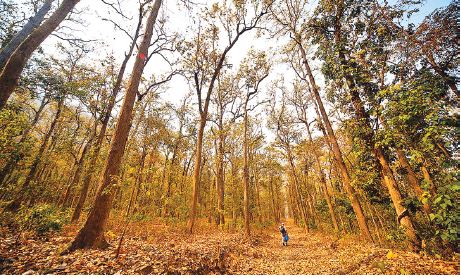
Despite a visible increase in India’s green cover, the country’s forests are showing signs of weakening under the pressures of climate change, reducing their capacity to absorb carbon dioxide, according to a new study by the Indian Institute of Technology (IIT), Kharagpur. The research, published in Resources, Conservation & Recycling, is the first to directly link forest “greenness” with changes in carbon sequestration, highlighting a concerning mismatch between growth and ecological function.
The study found declines in photosynthetic efficiency, carbon absorption, and water-use efficiency across India’s forests, both under current and projected climate scenarios. Reduced soil moisture and rising temperatures are adding stress to ecosystems, conditions expected to worsen over time. Although India accounts for only 2 per cent of global forest cover, it contributes around 7 per cent to global carbon sinks, making these declines particularly significant.
Carbon uptake fell by an average of 5 per cent nationwide, with losses reaching 12 per cent in parts of the north-east and Eastern Ghats. Co-author Jayanarayanan Kuttippurath of IIT Kharagpur noted that the study indicates forests are increasingly non-resilient, even as overall greenness rises.
Regional analysis showed mixed results. While carbon absorption increased in the Western Himalayas, North East, and Central India, sharp declines were recorded in the Eastern Himalayas, Western Ghats, and parts of the Indo-Gangetic Plain. The study linked these losses to lower rainfall, soil drying, and increased aridity. Pristine forests in the Eastern Himalayas and Western Ghats were most affected, experiencing significant soil moisture stress, warming, and higher climatic water deficits.
Human activity further exacerbates forest vulnerability. Over 50 per cent of forests in the North East and large parts of Central India show moderate to low ecological integrity due to fragmentation from land-use change. The Western Ghats lost 7 per cent of forest cover between 2001 and 2020, while human populations in forested regions rose by 40-60 per cent between 2000 and 2019.
India’s forests are also relatively young, with most trees aged 30 to 60 years, and older forests increasingly replaced by agriculture or urban expansion. This has weakened carbon sequestration, particularly in Central India and the Western Ghats, which recorded the largest losses from 2001 to 2019.
Looking ahead, the study warns that accelerated warming could reduce carbon sequestration by up to 15 per cent between 2040 and 2050, while forest biomass may decline by 23 per cent. Saturation of carbon uptake could further release additional carbon dioxide into the atmosphere, compounding climate challenges. Kuttippurath emphasized the need to assess how much carbon sequestration has already been lost, noting that India’s forests remain critical to global climate stability despite their growing vulnerability.
Start your day with The Savera Morning Brief, bringing you the latest news from India and around the...

Union Home Minister Amit Shah will pay tribute to police martyrs at the National Police Memorial in New...

Four more people, including two women, have been arrested in the Tiger Shroff firing case. Delhi Police are...

We are very proud that at present India is the number one country in the world by surpassing...

Every investor wants the wealth-creating power of equity and the reassuring stability of debt. Balanced Advantage Funds attempt...

Tourism is a major source of government revenue in our country. There are different types of tourism. Scenic...

Aries: The day will be auspicious...