Last Updated: September 22, 2026
Last Updated: September 22, 2026





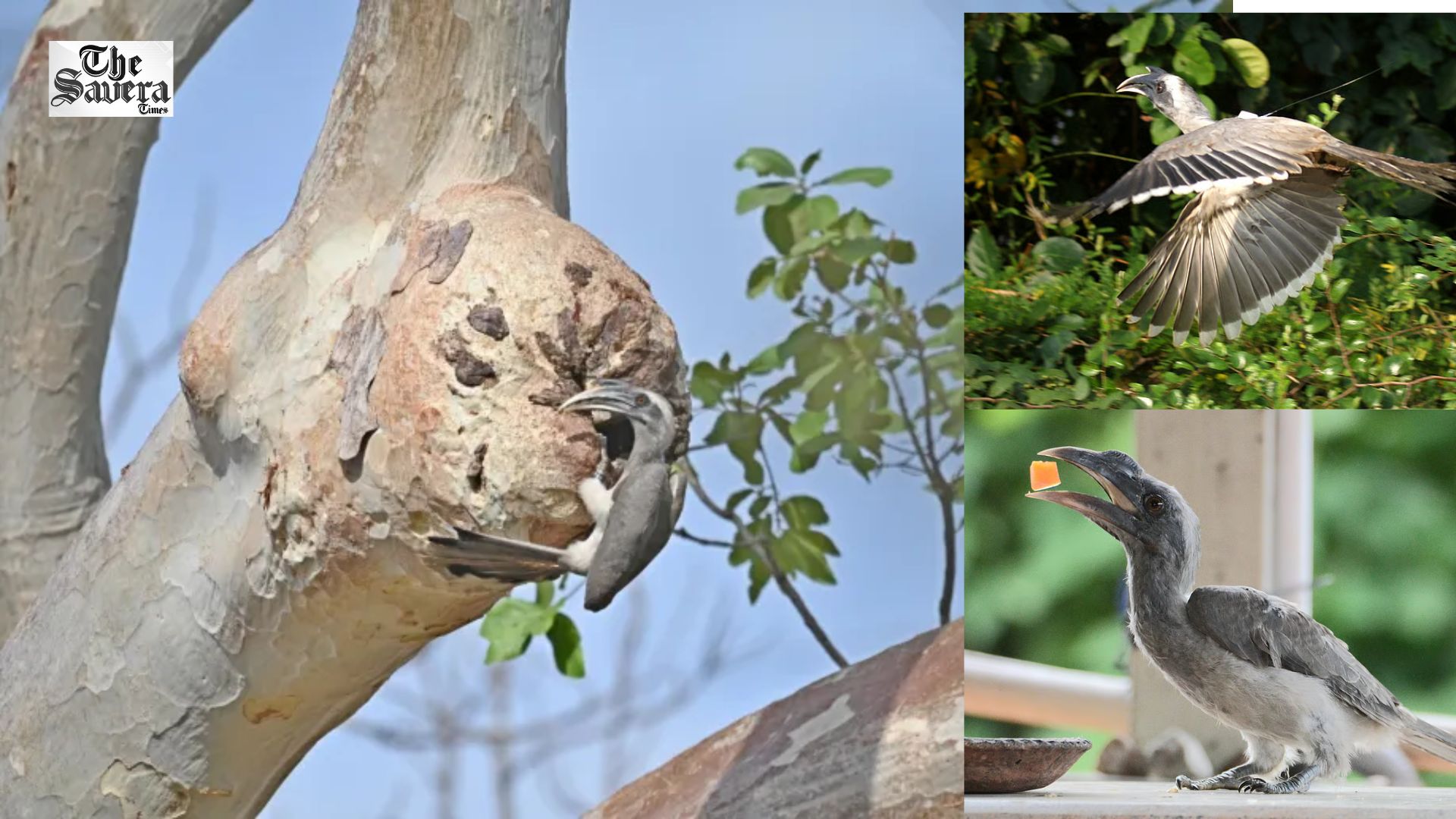
Ahmedabad: The Indian Grey Hornbill, locally known as Chilotro, has made a remarkable comeback in Gujarat’s Gir forests after disappearing from the region for nearly six decades. A recent scientific study has confirmed that the reintroduced birds have successfully adapted to the habitat, built nests and started breeding in the wild.
The findings were published in the international peer-reviewed journal ‘Birds’ in a study titled “Reintroduction of Indian Grey Hornbills in Gir, India: Insights into Ranging, Habitat Use, Nesting and Behavioural Patterns.” The research provides the first detailed assessment of the hornbill reintroduction programme carried out by the Gujarat Forest Department with partner institutions.
Hornbill Reintroduction Programme Began in 2021
The conservation initiative began in 2021, when Indian Grey Hornbills were brought from the Aravalli forests and released in Gir after scientific studies found that the ecosystem had become suitable for the species.
A total of 40 hornbills were released in two phases. Around 28 birds were introduced during 2021 and 2022, followed by another 12 birds in 2023.
Researchers found that one breeding pair successfully nested during the first year after release, while three more breeding pairs established nests in the second year. The study confirmed that the birds have now become residents of Gir and are successfully reproducing.
Conservation Success After Decades of Absence
The Indian Grey Hornbill had disappeared from Gir during the 1950s and 1960s. Officials said improved habitat protection after the declaration of the Gir Wildlife Sanctuary in 1965 and Gir National Park in 1975 helped create favourable conditions for the species’ return.
Forest officials said the Chilotro plays an important ecological role by dispersing seeds of fruit-bearing trees across long distances, helping in natural forest regeneration.
Satellite Tracking Shows Successful Adaptation
As part of the monitoring programme, satellite transmitters were fitted on 11 male hornbills to track their movement, habitat use and breeding behaviour.
Tracking data showed that after release, the birds explored larger areas of around 61 square kilometres before adapting to their surroundings. Once settled, their average home range reduced to around 5.7 square kilometres, indicating successful adjustment to the Gir ecosystem.
Their average daily movement also declined from around 4.3 km during the exploration phase to 1.4 km after settlement.
The Gujarat Forest Department said the successful return of the Indian Grey Hornbill highlights the importance of scientific species reintroduction and long-term wildlife conservation efforts.
Police in Jamui, Bihar, have initiated action against social media accounts for publicly disclosing the identity of a...

Amidst the ongoing controversy surrounding IIT Bombay Professor Suryanarayan Dula, several faculty members from IIT Bombay, IIT Delhi,...

A fire broke out in the neonatal care unit of the Rajiv Gandhi Institute of Medical Sciences (RIMS)...

Jaipur: The political tussle over the Tijara Municipal Council Chairperson election, which began on Monday morning, continued late...

United Nations: External Affairs Minister (EAM) S. Jaishankar has urged countries sharing international objectives to act together against...

Stay updated with The Savera Times Morning Bulletin. Get the latest breaking news, top headlines, national, international, business,...

Aries: The day will be auspicious...