Last Updated: October 15, 2026
Last Updated: October 15, 2026





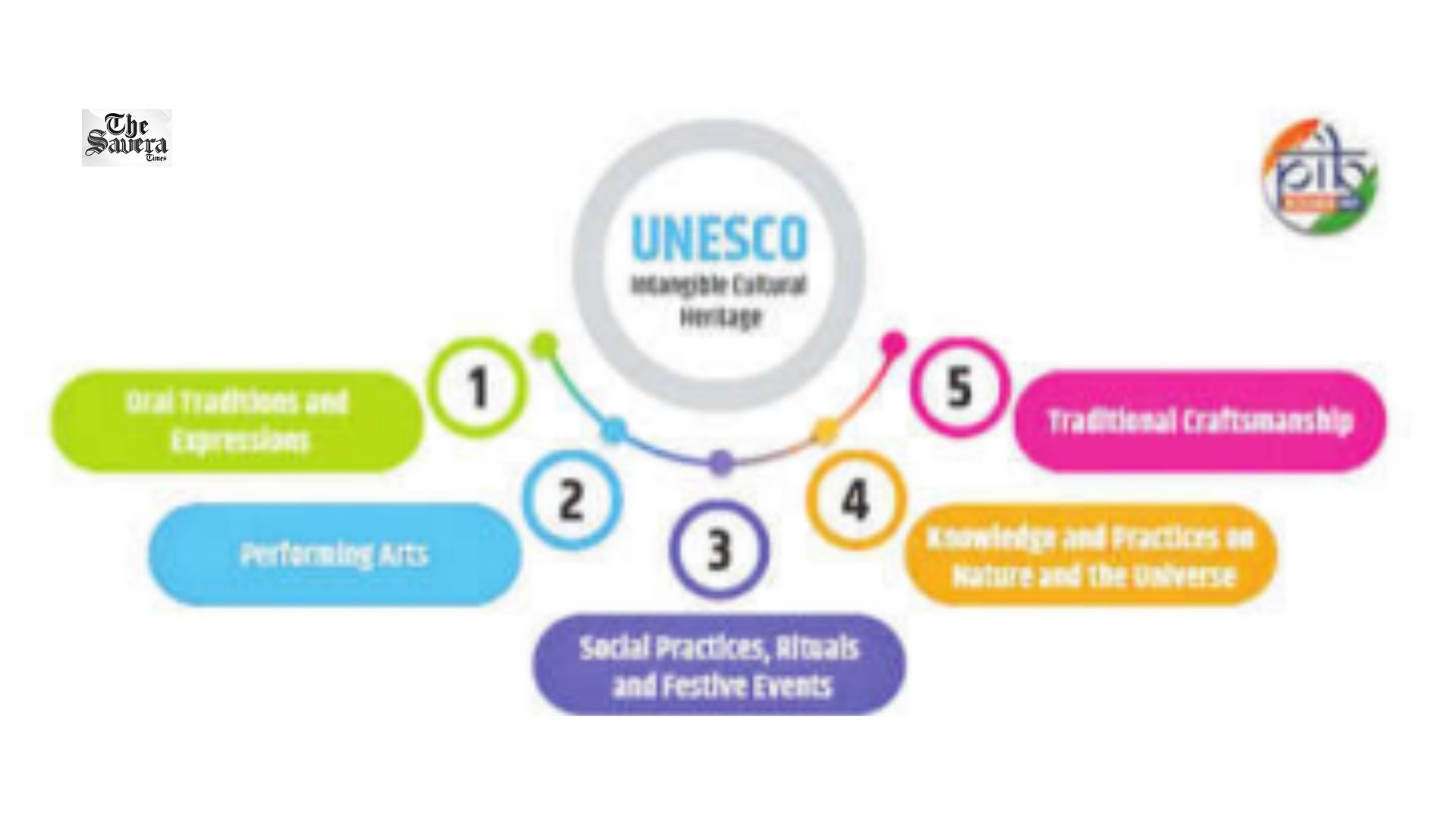
The term ‘cultural
heritage’ has changed
content considerably
in recent decades,
partially owing to the
instruments developed by UNESCO.
Cultural heritage does not end
at monuments and collections of
objects. It also includes traditions
or living expressions inherited from
our ancestors and passed on to our
descendants, such as oral traditions,
performing arts, social practices,
rituals, festive events, knowledge
and practices concerning nature and
the universe or the knowledge and
skills to produce traditional crafts.
While fragile, intangible
cultural heritage is an important
factor in maintaining cultural
diversity in the face of growing
globalization. An understanding
of the intangible cultural heritage
of different communities helps
with intercultural dialogue, and
encourages mutual respect for other
ways of life.
The importance of intangible
cultural heritage is not the cultural
manifestation itself but rather the
wealth of knowledge and skills
that is transmitted through it
from one generation to the next.
The social and economic value of
this transmission of knowledge is
relevant for minority groups and
for mainstream social groups within
a State, and is as important for
developing States as for developed
ones.
The Intergovernmental
Committee for the Safeguarding
of the Intangible Cultural Heritage
provides guidance on best practices
and make recommendations on
measures for the safeguarding of
the intangible cultural heritage.
The Committee is also in charge of
granting international assistance.
The Committee examines requests
submitted by States Parties
for the inscription of intangible
heritage on the Lists as well as
proposals for programmes and
projects. The Committee meets
annually to evaluate nominations
proposed by States Parties to
the 2003 Convention and decide
whether or not to inscribe those
cultural practices and expressions
of intangible heritage on the
Convention’s Lists.
So far, 73 elements
corresponding to 5 regions and
145 countries have been listed as
Intangible Cultural Heritage. India
has 14 elements included in this
prestigious list, all of which are
part of the Representative List of
the Intangible Cultural Heritage of
Humanity.
Main Concept : Dance, Ritual,
Vocal Music
Garba is a traditional dance
performed during the Hindu
festival of Navaratri, worshiping
feminine energy or ‘Shakti’.
Dancers encircle a lit earthenware
pot or an image of the goddess
Amba, moving counter-clockwise
with simple steps, clapping and
singing in unison. Garba involves
diverse participants such as
dancers, musicians, craftspeople,
and religious figures, fostering
inclusivity across socio-economic
and religious divides. Transmitted
across generations through practice
and observation, Garba also benefits
from institutional support including
workshops and courses in various
related arts, further enriching its
cultural significance and community
bonds.
Main Concept : Handicrafts,
Sculpture
Durga Puja is an annual festival
celebrated primarily in Kolkata and
other parts of India, dedicated to
the worship of goddess Durga over
ten days in September or October.
Artisans sculpt clay images of
Durga and her family months
before the festival using river clay,
which are then brought to life with
painted eyes on the inaugural day of
Mahalaya. The festival culminates
with the immersion of these images
in the Ganga River, symbolizing
a return to one’s roots. Durga
Puja is renowned for its blend of
religion and art, featuring elaborate
installations, traditional drumming,
and widespread community
participation that bridges social
divides of class, religion, and
ethnicity.
Main Concept : Pilgrimages.
Religious Practice, Sacred Sites
Kumbh Mela, the largest
peaceful gathering of pilgrims
globally, sees millions bathing in
sacred rivers like the Ganges to
cleanse themselves of sins and attain
spiritual liberation. Held every
four years in Allahabad, Haridwar,
Ujjain, and Nasik, the festival
attracts people from all walks of
life, including ascetics, saints, and
visitors, regardless of caste or creed.
It combines astronomy, astrology,
spirituality, and rich cultural
traditions, imparted through ancient
manuscripts, oral traditions, and the
mentorship of sadhus in ashrams
and akhadas. Kumbh Mela serves
as a profound spiritual and cultural
event, deeply influencing Indian
society and showcasing its diversity.
Main Concept : Mind, Physical
Education, Spiritual Knowldge
The philosophy of yoga, rooted in
ancient Indian traditions, profoundly
influences various aspects of society
including health, education, and the
arts. Yoga integrates mind, body,
and soul through poses, meditation,
controlled breathing, and chanting,
promoting mental, spiritual, and
physical wellbeing. Practiced by
people of all ages and backgrounds,
yoga transcends gender, class,
and religion, gaining popularity
worldwide. Traditional transmission
through the Guru-Shishya model
continues in ashrams, schools,
universities, and online platforms,
supported by ancient manuscripts
and modern literature, enriching its
practice and teaching.
Main Concept : Dance, Rituals,
Vocal Music
Sankirtana is a vibrant tradition
among the Vaishnava community
in the Manipur plains, involving
song and dance performances that
narrate the life of Krishna. Typically
held in temples or courtyards with
two drummers and about ten
singer-dancers, these performances
evoke deep religious and aesthetic
sentiments, often moving spectators
to tears or reverence. Sankirtana
serves dual roles: it unites the
community during festive occasions
and strengthens social bonds
through life-cycle ceremonies. This
practice is integral to Manipuri
culture, emphasizing community
participation and the transmission
of knowledge from mentors to
disciples, while maintaining
harmony with the natural world
through its rituals.
Main Concept : Buddhism,
Religious Practice, Vocal Music
In Ladakh, Buddhist lamas
perform sacred chanting rooted in
Mahayana and Vajrayana traditions,
practiced across four major sects:
Nyngma, Kagyud, Shakya, and
Geluk. Chanting serves spiritual
and moral purposes, performed
during life-cycle rituals and
important Buddhist and agrarian
events. Chants are conducted in
groups, accompanied by symbolic
gestures (mudras) and traditional
instruments like bells and drums.
Acolytes undergo rigorous training
under senior monks, memorizing
texts through frequent recitation.
These daily chants in monastery
halls are prayers for world peace
and personal spiritual growth.
Main Concept : Acrobats, Dance,
Hinduism, Representative Literary
Works
Chhau dance, originating
from eastern India, encompasses
narratives from epics, folklore, and
abstract themes, distinguished
by styles from Seraikella, Purulia,
and Mayurbhanj. It incorporates
mock combat, bird and animal
movements, and village household
gestures, taught primarily to male
dancers from traditional artist
families or local communities.
Performed at night with traditional
music including reed pipes and
drums, Chhau plays a vital role
in local festivals and cultural
identity, yet faces challenges from
modernization and economic
pressures that threaten community
participation and heritage
preservation.
Singapore: Two Singapore-registered container vessels were reportedly struck by unknown projectiles while transiting the Strait of Hormuz on...

Shimla: The Himachal Pradesh government has constituted a four-member commission to examine the reorganisation of administrative units in...

New Delhi: The Supreme Court on Wednesday listed for November 17 the appeal filed by self-styled godman Asaram...

Ranchi: Doctors in Jharkhand launched a protest on Wednesday over a slew of demands concerning their safety and...

Greater Noida: Police and Anti-Narcotics Team in Uttar Pradesh’s Greater Noida have seized ‘ganja’ worth Rs 1 crore...

New Delhi: The Enforcement Directorate (ED) has attached assets worth Rs 2,032.81 crore belonging to Reliance Power Ltd...
