Last Updated: October 15, 2026
Last Updated: October 15, 2026





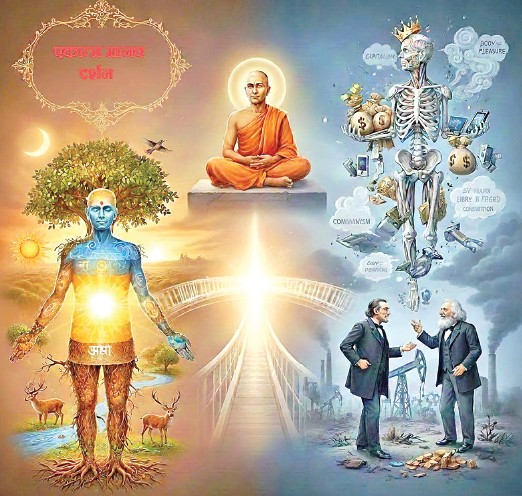
Indian visionaries and philosophers have laid the foundation for original thinking that is eternal, universal, and unchanging, aiming for the welfare of all beings and creation. While methods and social structures have evolved, the core Indian philosophy remains steadfast and inherently different from others. Central to this tradition is the pursuit of happiness and prosperity not just for individuals but for society and all of creation, a goal reflected throughout India’s history and its thinkers.
What is the definition of human happiness and prosperity? There is a fundamental difference between Indian and Western thought on this subject. The Western world considered humans merely as bodies. Simply put, humans are mere flesh and bones. Based on this notion, Western thinkers considered their happiness and concluded that the rest of creation—animals, birds, trees, plants, water, air, and the earth—were all for human consumption. Western thinkers believed that because humans are merely bodies, it is meaningless to consider the lifespan of the body before or after eighty or a hundred years. The criterion for human happiness lies in maximizing consumption within this lifespan.
Adam Smith, the father of capitalism, which began in Europe in the sixteenth century, attempted to establish in his book “The Wealth of Nations” (1776) that human happiness is entirely dependent on the comfort and prosperity of one’s body. In Europe, communism emerged in opposition to capitalism in the eighteenth century. Studying the ideas of Karl Marx, one will find that these two systems, despite their apparent contradictions, are fundamentally based on the same ideological foundation. A look at the history of the past century will reveal that these two concepts, which consider humans merely as bodies, have ultimately failed to provide sustainable order and sustained happiness to any society on the world stage.
Since ancient times, Indian philosophers and sages have deeply and seriously researched the subject of human existence. In Indian philosophy, the body is considered merely the outer covering of a human being and a means to achieve life’s goals. The mind is superior to the body. It’s a common experience that hunger brings joy upon eating delicious food. However, if the person serving the food makes an unpleasant or insulting remark about the eater, the eater’s taste will be spoiled. Despite the same body and appetite, how can the same delicious food unexpectedly taste like poison? Where did the impact occur? This is the human mind, which is extremely subtle and fickle and experiences emotions such as love, affection, respect, hatred, and so on. The mind holds a higher position than the body in determining a person’s happiness and sorrow. Intellect is superior to the mind. An incident related to the renowned American scientist John C. Lilly. He was an American physician, neuroscientist, and philosopher who made significant contributions to the study of the brain and consciousness. His research on the sensory deprivation tank is particularly renowned. It is said that he was so engrossed in his research that once, when his wife entered the research room, he did not recognize her and asked her in astonishment, “Who are you?” This incident proves that other worldly matters seem trivial to humans compared to intellectual happiness.
Indian sages also described the ultimate essence of the “soul,” transcending the human body, mind, and intellect. In the knowledge tradition, realizing the soul through yoga is considered the ultimate goal of human life. If we reflect deeply, we will realize that at the root of most of the distortions in human society is the Western viewpoint that humans are merely bodies. Systems based on this viewpoint failed to provide happiness and prosperity to humans and ultimately led society to disintegration. When considering humans and their happiness, we must consider all four: body, mind, intellect, and soul. A system based on the holistic development of these four levels will ensure the continued happiness and prosperity of humanity. Indian tradition has conceptualized the human being as a composite entity comprising body, mind, intellect, and soul.
Immediately after independence, when Indian political parties and the intellectual world were becoming overwhelmed by Western ideas, Pandit Deendayal Upadhyaya, a sage with a unique vision of Indian politics, formulated the eternal philosophy of “Integral Human Philosophy,” a holistic and comprehensive interpretation of Indian philosophy. Pandit Deendayal Upadhyaya challenged the ideas of capitalism and communism originating in the Western world in the field of ideology, awakened Indian wisdom, and urged us to study the ideas born in foreign minds and environments. Neither should they, but the source of the ideology of independent India must be the Indian mind.
Over the past decade, the resolve of the common Indian people to establish India as the world leader has grown stronger. For the present world plagued by conflicts, the path to eternal happiness, prosperity, and peace lies in the flow of wisdom propounded by India’s sages. As the sense of self-awareness and the ability to think about the individual and the collective from an Indian perspective strengthen in the common people of India, India will be able to provide solutions not only to its own problems but also to the problems of the entire world.
Good Afternoon Viewers! Stay updated with The Savera Times Afternoon Bulletin, bringing you the latest news from Punjab,...

New Delhi: Heavy rain and thunderstorms swept parts of Delhi-NCR on Thursday as dark clouds covered the national...

A street vendor has approached the Delhi High Court seeking to stop the Cockroach Janata Party (CJP)'s protest...

Suva: India and Fiji on Thursday held discussions focused on deepening bilateral ties and reaffirmed their shared commitment...

Bokaro (Jharkhand): The protest by trained youth from displaced families affected by the Bokaro Steel Plant (BSL) intensified...

Varanasi: Uttar Pradesh Chief Minister Yogi Adityanath, on a two-day visit to Varanasi, honoured sanitation workers from the...

Aries: The day will be auspicious...