Last Updated: October 20, 2026
Last Updated: October 20, 2026





Democracy does not survive merely because governments change through elections. It survives because people trust institutions, believe that their voices matter, and remain willing to listen to those with whom they disagree. At its heart, democracy is a social contract built on trust, accountability, and dialogue. Today, that foundation is facing a threat that is largely invisible, yet increasingly powerful: the unchecked spread of false, misleading, and unverified information. On the occasion of the International Day of Democracy, United Nations Secretary-General António Guterres has emphasized the importance of bringing different sections of society together to strengthen trust, enrich decisionmaking, and build peaceful, inclusive, and resilient societies.
His message underlines an important truth: democracy is not simply a system of institutions; it is a system that draws its strength from people’s participation and their trust in one another and in democratic institutions. But how can society come together when different sections of the population are receiving different versions of reality? That is the question we must confront today. Information has never been more accessible. A smartphone can bring news from across the country and the world to our fingertips within seconds. WhatsApp, Facebook, YouTube, and other social media platforms have undoubtedly democratized access to information and given ordinary citizens a greater voice. But the same platforms have also created fertile ground for misinformation, disinformation, and deep fakes.
The problem is not simply that false information exists. Falsehood has always existed. The real danger today is that false information can look remarkably like the truth, and genuine information can begin to look suspicious. That is where the real threat to democracy lies. Every year, September 15 is observed as the International Day of Democracy. The occasion reminds us not only of our democratic rights but also of our responsibilities as citizens. We often associate the protection of democracy with Parliament, elections, courts, and political institutions. Yet democracy is also protected—or weakened— by something as ordinary as the decision to forward a message on our mobile phone. Before sharing a sensational post, spending two minutes checking its source may appear insignificant.
In reality, it can be a small but meaningful act of democratic responsibility. The stakes are enormous. If citizens cannot trust the information they receive, how will they make informed choices? How will they form opinions during elections? How will they decide whether to support or oppose a government policy? How will they respond to a sensitive social issue? A citizen’s democratic choice can be meaningful only when it is informed by credible information. This is why misinformation can no longer be dismissed as merely a problem of social media. It is a problem for democracy itself. A fabricated news report can destroy a person’s reputation. Misleading health information can discourage people from seeking proper medical treatment. False claims about a community can fuel suspicion and social tension.
During elections, disinformation can influence public opinion and potentially affect voting behavior. The emergence of artificial intelligence has added another layer of complexity. Deepfake videos can make people appear to say or do things that never happened. In such an environment, simply seeing or hearing something is no longer sufficient evidence that it is true. Yet technology is not the only problem. There is another, more subtle danger: our own tendency to believe what confirms what we already think. This is how echo chambers are created. We follow people who agree with us, consume content that reinforces our beliefs, and reject information that challenges our worldview. Gradually, disagreement stops being a normal feature of democracy and begins to appear as hostility. Someone who holds a different opinion is no longer seen as a fellow citizen with another perspective but as an opponent— or even an enemy—and that is precisely what democracy cannot afford.
Democracy does not demand that we agree with one another. It demands that we learn to disagree without destroying the possibility of dialogue. For that, society needs a common ground, and that common ground must be built on credible facts. This places an enormous responsibility on journalism. The value of journalism has never been merely its ability to deliver news quickly. Its real strength lies in credibility. In the race to become the first to break a story, if verification is sacrificed for speed, journalism risks losing the very trust on which it depends. Sensational headlines may generate clicks and views, but they cannot build lasting public trust.
Media organizations must therefore strengthen fact-checking, verify sources, provide context, and maintain transparency when mistakes occur. Ethical journalism must remain more important than the race for visibility. Social media platforms and technology companies, too, must accept their share of responsibility. But citizens cannot simply leave the entire burden to media organizations, governments, or technology companies. Every citizen is a participant in the information ecosystem. When we forward a message without reading it carefully, we may be forwarding misinformation. When we share an emotionally charged video without checking its authenticity, we may be amplifying a false narrative. And when we pass on a rumour instead of questioning it, we may unknowingly contribute to the erosion of social trust.
This is why education alone is no longer enough. Citizens also need media and information literacy. From children to senior citizens, people must be encouraged to develop the habit of questioning information before accepting or sharing it. The first question should not be, “How many people have shared this?” It should be: “What is the source?” Is the information coming from a credible organization? Are other reliable sources reporting the same facts? Is the photograph or video recent, or is an old piece of content being presented as new? Does the headline accurately reflect the story? Is the message deliberately trying to provoke fear, anger, or outrage and push us towards an immediate reaction? These may seem like simple questions, but they can act as a powerful defense against misinformation.
The challenge before us is therefore much larger than combating fake news. It is about protecting the very environment in which democracy functions. A society cannot have meaningful democratic dialogue when its citizens do not agree on basic facts. When facts become fragmented, dialogue weakens. When dialogue weakens, trust declines. And when trust disappears, democracy itself becomes vulnerable. The answer is not to distrust every piece of information or to silence disagreement. The answer is to build citizens who can question information, verify claims, recognize manipulation, and engage respectfully with different perspectives. We must remember that we are not merely consumers of information.
We are also responsible participants in the information ecosystem. Every click, comment, forward, and share has the potential to influence someone’s understanding of reality. The greatest strength of democracy is its people. But the strength of people lies in their ability to make informed choices, and informed choices require reliable information. If trust is the foundation of democracy, then truth is the ground on which that foundation stands. Protecting that truth is not merely the responsibility of journalists, governments, or technology platforms. It is the responsibility of every citizen.
Nearly 100 new cases of dengue have been reported in Pakistan's Khyber Pakhtunkhwa province in the last 24...
Following violent protests and looting in France, the government has decided to impose new curfews in different areas...
North Korea on Tuesday strongly criticized the ongoing joint military exercises between South Korea and the United States,...
US Secretary of State Marco Rubio said on Tuesday that India and the US are very close to...
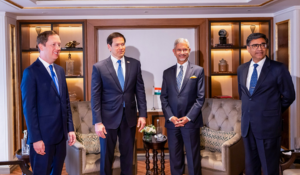
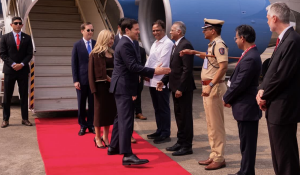
US Secretary of State Marco Rubio arrived in Mumbai on Tuesday for his second visit to India. During...
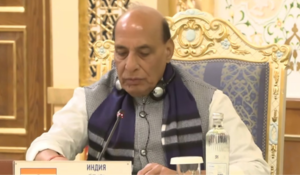
Defense Minister Rajnath Singh on Tuesday described terrorism as one of the most serious threats to peace and...
Aries: The day will be auspicious...