Last Updated: October 22, 2026
Last Updated: October 22, 2026





Sheena Sandhu
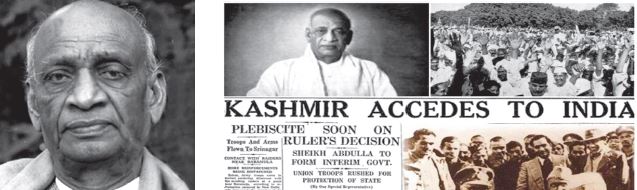
As India celebrates the 150th birth anniversary of Sardar Vallabhbhai Patel, it is not just a moment of remembrance—it is also an opportunity for introspection. The vision and actions of the man who united a fragmented India after independence are as relevant to India today as they were in 1947.
From an Ordinary Man to ‘Sardar’.
Born on October 31, 1875, in Kandiad, Gujarat, Vallabhbhai Patel came from a simple farming family. During British rule, he studied law and became a successful lawyer, but his life’s turning point came when he entered the politics of local self-rule.
As the chairman of the Ahmedabad Municipality, he transformed administration into service—his style of working was to personally clean the streets. This was the Indian way of connecting with the people and emerging as a leader from among them.
The Bardoli Satyagraha of 1928 brought him national recognition. This leader, who won the farmers’ movement through restraint, strategy, and dialogue, was then called “Sardar”—a title that became a lasting symbol of his personality.
Builder of Unity
The country became independent in 1947, but fragmented after bloodshed, partition, and the fragmentation of hundreds of princely states. Many of these states wanted to remain independent, while others were leaning towards Pakistan.
As independent India’s first Home Minister and Deputy Prime Minister, Sardar Patel faced the challenge of transforming this diverse India into a single nation. What he accomplished was not merely administrative, but historic. He integrated 562 princely states into India through dialogue, reason, and, when necessary, determination. The skill with which he resolved complex situations like those in Hyderabad and Junagadh was remarkable.
The India that the British left behind as a “fragmented country,” Patel united. In fact, the “nation” that Mahatma Gandhi envisioned, Patel transformed into a reality of geography and administration.
A Builder of Institutions
Patel’s nationalism was not limited to political boundaries. He knew that independence was incomplete without a strong system of governance.
He established the All India Services, known today as the Indian Administrative Service (IAS). He told the first batch of officers, “You are not just government servants, you are the steel spine of India.”
This vision gave independent India the administrative structure that provided stability to the nation in the decades to come.
Compassion in Toughness, Vision in Practice
Patel was often called harsh, but his toughness was tinged with compassion and responsibility. He believed in practice more than ideology.
While Nehru was immersed in dreams of the future, Patel was a patriot of the present. He knew that unless the country was united, no plan or policy would survive.
He was devout, but never made religion a political tool. For him, the nation was supreme – not region, caste, or religion.
Lessons for today’s India
Seven decades later, when India again stands on the threshold of change, Patel’s words again seem relevant.
Lesson One: Unity is not a feeling; it is a strategy.
For India, unity was not just a slogan – it was a condition for its security, progress, and survival. This finds further resonance in today’s polarized times.
Second lesson: The institution is bigger than the individual.
Patel’s true legacy is not his statue, but the institutions he built—administration, governance, and policy continuity.
Third lesson: Pragmatism is foresight.
Patel did not reject ideals, but found a way to translate them into practice. This balance is essential for governance and policymaking today.
Fourth lesson: Leadership is courage.
The balance he struck between compromise and decisiveness among kings and nawabs is true leadership—clarity of thought, firmness of decision.
Beyond statues
The Statue of Unity in Kevadia, Gujarat, is the world’s tallest statue, but Sardar Patel’s true stature lies not in stone or metal—but in his actions and vision.
Today’s India is progressing rapidly in technology and economy, but on the fronts of social unity, institutional trust, and administrative ethics, it again needs the same iron will that Patel had.
Even after a century and a half, the voice of that farmer’s son is still heard –
“Unite the country and move forward.”
This was his message, and this should be the direction of today’s India.
Good Evening Viewers! Get the latest updates from India and around the world with The Savera Times Evening...

Bharatiya Janata Party (BJP) National General Secretary Smriti Zubin Irani launched a scathing attack on Congress MP and...
New Delhi: Cockroach Janata Party (CJP) leaders Saurav Das and Ashutosh Ranka will be released from judicial custody...
According to police, three suspicious young men are seen in CCTV footage. Efforts are underway to identify them....
A video has surfaced of an alleged attempted assault on Jan Suraj Party's Bihar president Manoj Bharti. The...
Two accused have been convicted and sentenced to 10 years of rigorous imprisonment in a 2017 drug trafficking...
Aries: The day will be auspicious...