Last Updated: October 25, 2026
Last Updated: October 25, 2026





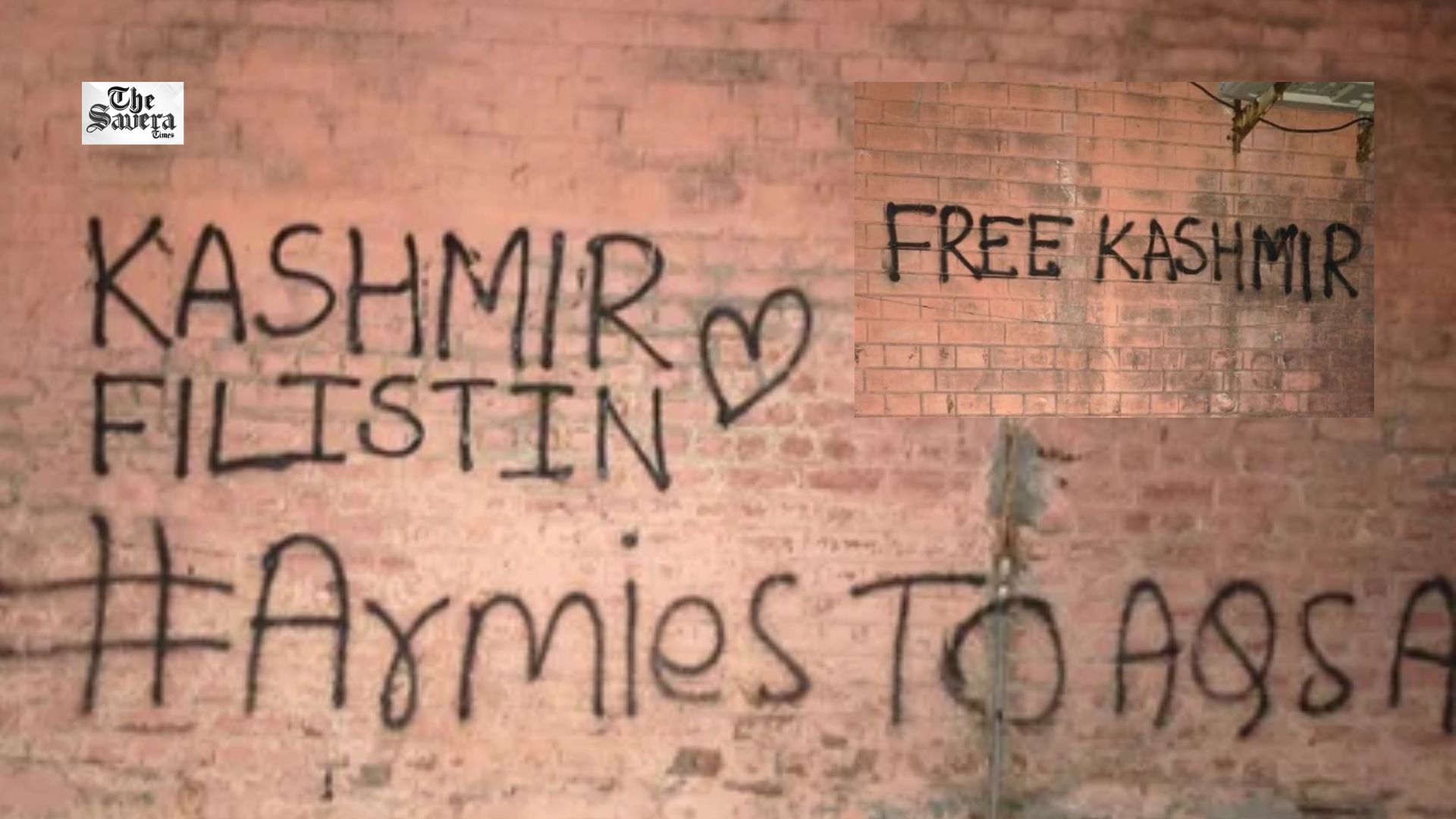
New Delhi: As Jammu and Kashmir prepares to mark its 79th Accession Day on October 26, slogans calling for a “Free Kashmir” have triggered a political controversy at Jamia Millia Islamia University in Delhi. The slogans appeared amid a student protest demanding the restoration of student union elections, bringing the Kashmir issue into an agitation focused on campus representation.
The episode has raised questions about who wrote the slogans and why they appeared during a protest over an unrelated issue. The identity of those responsible has not been established publicly. The university administration has condemned the graffiti and said it is trying to identify those involved.
The controversy has also drawn political reactions. The Congress said the slogans were not part of the students’ agitation and demanded action against those responsible. The BJP, meanwhile, accused opposition leaders of shielding individuals facing serious charges and alleged a wider political motive behind the episode.
The slogans have renewed debate over how the Kashmir issue is raised at protests outside the Union Territory, particularly when the demonstrations concern other matters.
Why October 26 Matters in Jammu and Kashmir
Accession Day marks the signing of the Instrument of Accession by Maharaja Hari Singh in October 1947. The decision came during a period of conflict, as tribal raiders backed by Pakistan advanced into Jammu and Kashmir.
The invasion began on October 22, 1947. Facing the attack, the Maharaja sought military assistance from India and signed the Instrument of Accession on October 26. India accepted it the following day, and Indian troops were airlifted to Srinagar to help repel the invaders.
Sheikh Mohammad Abdullah, who later became the state’s Prime Minister, also supported the accession. His son, Farooq Abdullah, went on to become Chief Minister and remains a prominent leader of the National Conference.
The accession became a defining moment in the region’s history. Its political relationship with the rest of India continued to evolve over the following decades, including through Article 370 and Article 35A, which provided special constitutional arrangements.
Article 370 and the Changes After 2019
On August 5, 2019, the Narendra Modi-led government moved to end Jammu and Kashmir’s special constitutional status under Article 370. The former state was subsequently reorganised into the Union Territories of Jammu and Kashmir and Ladakh.
The decision remains a major point of political debate. Supporters of the move have argued that it helped bring Jammu and Kashmir closer to the rest of the country and opened the way for development. Critics have raised concerns about political representation, constitutional protections and the process through which the changes were made.
The region has also seen infrastructure projects, improved road and rail connectivity and continued efforts to expand tourism. The Udhampur-Srinagar-Baramulla Rail Link, the Vande Bharat Express service and the Zojila Tunnel project are among the developments highlighted in discussions about connectivity.
Tourism has become an important part of the local economy. Educational and healthcare institutions have also expanded, although employment, security and the return of displaced Kashmiri Pandits remain significant issues for the region.
Security Figures and the Continuing Debate
Data cited from the Union Ministry of Home Affairs in July 2024 showed a sharp fall in organised stone-pelting incidents in Jammu and Kashmir, from 1,328 in 2018 to zero in 2023. Organised hartals also declined from 52 to zero during the same period.
The source article further cited a decline in terrorist-initiated incidents from 228 in 2018 to around 35 in 2025, along with more than 1.77 crore visitors to the region in 2025. These figures point to changes in the security situation, though the threat of terrorism has not disappeared.
At the same time, political differences over Kashmir’s future and its relationship with the Union government continue. Demands for better governance and greater political representation remain part of the public debate.
Farooq Abdullah recently made remarks at a National Conference workers’ convention in Baramulla, saying that international pressure had influenced India’s position and referring to Pakistan’s efforts to raise the Kashmir issue internationally.
His comments came just ahead of the Accession Day anniversary and added another dimension to the political discussion surrounding the region.
‘Free Kashmir’ Slogans Draw Fresh Scrutiny
The appearance of the slogans at Jamia has prompted a wider discussion about the use of political messaging during student protests. The central demand of the ongoing agitation is the restoration of the Jamia Millia Islamia Students’ Union and the announcement of an election schedule.
The university has begun steps towards drafting a constitution for the proposed students’ union, while protesters continue to press for action on their demands. The slogans controversy has added a separate dispute to the ongoing campus tensions.
The original opinion piece argues that slogans challenging Jammu and Kashmir’s accession should not be treated as an ordinary extension of unrelated protests. It also questions whether political groups use the Kashmir issue to advance their own interests. These are the author’s interpretations; the available reporting has not established who wrote the Jamia slogans or what motivated them.
Jammu and Kashmir has experienced decades of violence, terrorism and political uncertainty. Questions about its history, governance and future continue to draw strong reactions across the country.
As the Union Territory marks its 79th Accession Day, the Jamia controversy has once again brought the Kashmir issue into the national conversation. The unresolved questions surrounding the graffiti are who wrote the slogans, what prompted them and whether the investigation will establish a connection with the student agitation.
A major road accident occurred in southeastern Kenya on Sunday morning. At least 22 people were killed and...
Hereditary Prince Alois of Liechtenstein will be on a four-day state visit from October 25 to 28 at...
Prime Minister Narendra Modi inaugurated the Reserve Bank of India’s new data centre and Cybersecurity Training Institute in...
Congress president Mallikarjun Kharge sparked a political row in Patna after responding sharply to a man who interrupted...
Shiromani Akali Dal (SAD) President Sukhbir Singh Badal on Sunday welcomed senior Congress leader and former Jalalabad MLA...
The Border Security Force (BSF) has apprehended four Pakistani fishermen from the Sir Creek area in Gujarat's Kutch...