Last Updated: October 21, 2026
Last Updated: October 21, 2026





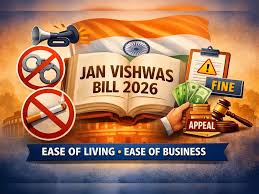
For many years, doing business in India-especially for MSMEs and startups-has not been easy. The rules were meant to ensure accountability, but in reality, they often created stress and uncertainty. Even a small mistake, like missing a deadline or filing a form incorrectly, could lead to criminal action. Not because there was any wrongdoing in intent, but because the system treated minor procedural errors very strictly.
The Jan Vishwas (Amendment of Provisions) Bill, 2026 tries to change this situation. And for MSMEs and startups, this change could make a real and visible difference in everyday business life.
At its core, the Bill focuses on one key reform. It removes criminal penalties for a large number of minor offences across central laws and replaces them with monetary penalties. This may sound like a technical legal shift, but for entrepreneurs, it changes how they deal with regulations. It reduces fear and allows them to focus more on running and growing their businesses instead of constantly worrying about legal risks.
This becomes even more important when we look at the size of India’s business ecosystem. There are over 2.12 lakh DPIIT-recognised startups and millions of MSMEs that contribute significantly to employment and economic growth. These businesses need a system that is simple, predictable, and practical, not one that creates constant pressure over small compliance issues. For a long time, entrepreneurs have worked under a sense of uncertainty. A delay in filing returns, a small error in labelling, or a minor gap in compliance could invite criminal liability. For large companies, these were manageable challenges. But for small businesses with limited legal and financial resources, such situations often became serious problems. In many cases, founders had to spend time and money dealing with compliance issues instead of focusing on expanding their business. The new law tries to fix this imbalance by clearly separating serious violations from minor, technical mistakes. Serious offences will continue to face strict action.
However, small errors that do not involve fraud or intent to harm will no longer lead to criminal cases or imprisonment. This shows a clear shift in the government’s approach-from a system based mainly on punishment to one that is more supportive and practical.
One of the biggest benefits for MSMEs and startups will be the reduction in compliance burden. Instead of dealing with complex criminal provisions, businesses will now face graded financial penalties and administrative actions. This makes compliance easier to understand and follow. It also reduces the cost involved in dealing with legal issues and lowers the chances of unnecessary harassment or prolonged legal disputes. Another important change is the introduction of an administrative adjudication system.
Under this, many minor cases can be resolved outside traditional courts. This is a significant step, especially when India’s judicial system is already dealing with more than 4.8 crore pending cases. Faster resolution of disputes will help businesses continue their operations without long interruptions. The Bill also brings changes in specific laws such as the Drugs and Cosmetics Act, Legal Metrology Act, and Motor Vehicles Act. These changes ensure that procedural mistakes are treated as minor issues rather than criminal offences. For startups working in sectors like health-tech, logistics, and consumer goods-where compliance requirements are detailed and sometimes complicated-this provides much-needed clarity and flexibility. At a broader level, the Bill also supports major government initiatives like Make in India and Startup India. It promotes a system based on trust rather than fear.
Entrepreneurs are encouraged to take risks, try new ideas, and build new solutions, without worrying that small mistakes will lead to criminal action. This kind of approach also sends a positive signal to investors, both within India and globally. Ease of doing business is not only about faster approvals or lower taxes. It is also about how fair, transparent, and predictable the system is. By reducing strict penalties for minor issues and limiting the scope for arbitrary action, the Jan Vishwas framework makes India a more attractive destination for investment.
The difference from the past is quite clear. Earlier, India’s regulatory system was often seen as complex, with too many rules and heavy penalties. This created hesitation among entrepreneurs and investors. The current reform shows a clear effort to move towards a simpler and more business-friendly system that supports growth rather than creating obstacles.
In the end, the Jan Vishwas (Amendment of Provisions) Bill, 2026 is more than just a legal reform. It reflects a change in thinking. It recognises that MSMEs and startups are not just small players in the economy, but key drivers of growth, innovation, and employment.
If implemented properly, this reform can have a long-term impact. For millions of small business owners and thousands of startup founders, it brings a sense of relief and confidence. The message is simple and clear: the government wants to support businesses and help them grow, instead of punishing them for small and unintentional mistakes.
Good Evening Viewers! Catch up on the day's biggest stories with The Savera Times Evening Bulletin. Get the...

Congress leaders continued their protest outside the Jaipur Police Commissionerate on Tuesday, demanding the registration of a zero...
On the auspicious occasion of Vijayadashami, Prime Minister Narendra Modi on Tuesday called on the countrymen to unite...
A historic milestone was achieved on Tuesday in the expansion of Chhattisgarh's rail networkA historic milestone was achieved...

Model Shraddha Dubey, one of the main accused in the death of Lucknow businessman Shiv Sharma, has been...

Rashtriya Swayamsevak Sangh (RSS) chief Mohan Bhagwat on Tuesday called for strengthening national unity, social harmony, indigenous practices...
Aries: The day will be auspicious...