Jammu: Lt Governor Manoj Sinha said on Sunday that Jammu and Kashmir is no longer settling for mediocrity and is now daring to dream big.
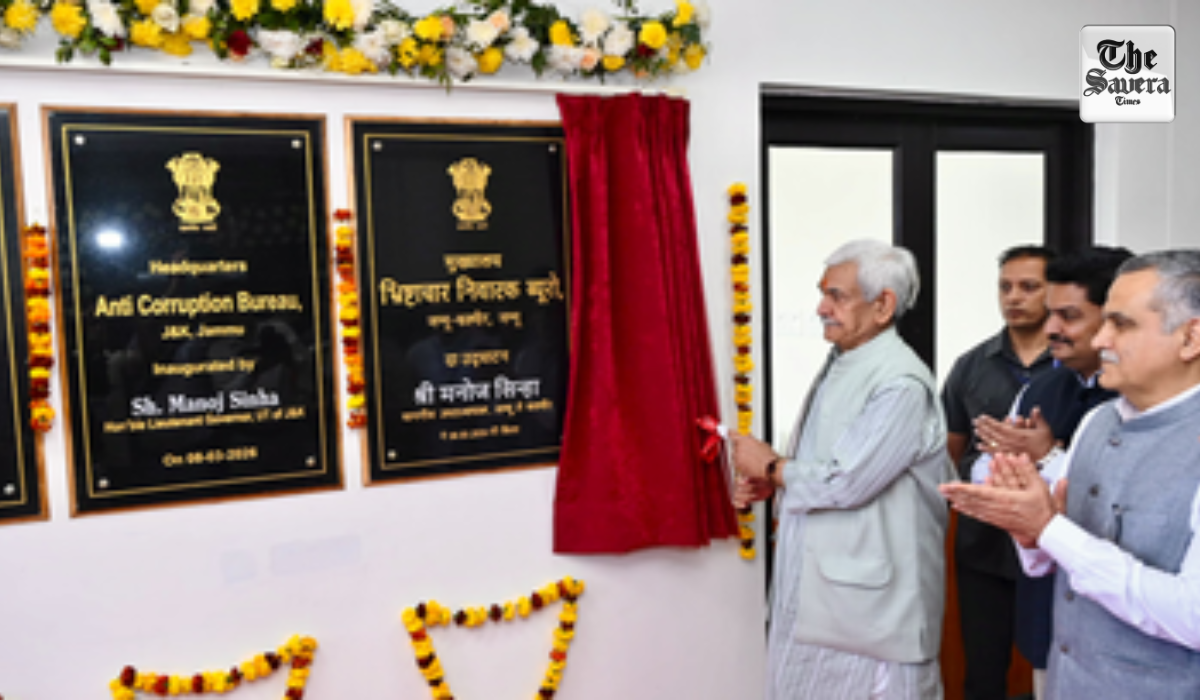
L-G Sinha inaugurated the headquarters of the Anti-Corruption Bureau (ACB) at Sidhra in Jammu city.
He said at the inaugural function, “Jammu and Kashmir no longer settles for mediocrity or the ordinary, and it dares to dream big.”
ACB Headquarters Symbol of Transparency
He said over the past few years, the region has witnessed transformative changes, thereby rendering the system transparent.
After inaugurating the Headquarters of the Anti-Corruption Bureau (ACB), L-G Sinha wrote on X, “These two buildings are not merely structures of steel, glass, and concrete; they stand as a bold declaration of transparency in public life and a corruption-free Union Territory. Today, J&K stands at a pivotal juncture. Over the past 5-6 years, we have ushered in transformative changes, rendering the system transparent and dedicating it to public service. The entire machinery now operates not for the benefit of a select few but for every individual across UT. J&K no longer settles for mediocrity or the ordinary. It now dares to dream big.”
Call for Strong Action Against Corruption
The L-G said that among the people, a firm belief has taken root that a golden future lies ahead. He added that fulfilling this vision is also the responsibility of the officers and staff at the Anti-Corruption Bureau.
“I called upon ACB to ensure that each decision, investigation and prosecution stands firm under scrutiny of the courts and must harness the authority granted by the nation’s Constitution to expose injustice, eradicate corruption, and earn the trust of the people,” he said.
Role and History of Anti-Corruption Bureau in J&K
The ACB is the premier anti-graft organisation in the union territory, and its main objective is to eradicate corruption. Earlier, offences related to corruption and bribery against government employees were covered under the provisions of the Ranbir Penal Code, 1932. Until 1949, such cases were registered and investigated by the local police.
In 1962, a separate body called the ‘Anti-Corruption Organisation’ was created to investigate cases related to bribery and corruption.
Later, several laws were introduced to deal effectively with corruption. One of the most important was the Prevention of Corruption Laws (Amendment) Act, 1983, under which the “Anti-Corruption Organisation” was renamed the “State Vigilance Organisation”. The J&K Public Men and Public Servants Declaration of Assets and Other Provisions Act, 1983, was also introduced.
New Laws Strengthen Anti-Corruption Efforts
After the enactment of the J&K Prevention of Corruption Act, 2006, a separate “Anti-Corruption Wing” was formed in the State Crime Branch to investigate corruption cases.
Under this Act, elected representatives of public bodies, MLAs and Ministers were also brought under the purview of corruption laws. Filing Annual Property Returns was made mandatory for all public servants and public representatives.
Failure to do so was considered an offence under the P.C. Act, 2006. To streamline investigations, two police stations were established — one in Jammu and another in Srinagar.
These police stations handle cases related to corruption under the Prevention of Corruption Act, 2006, and offences involving public servants under the Jammu & Kashmir Public Men and Public Servants Declaration of Assets and Other Provisions Act.