Last Updated: October 25, 2026
Last Updated: October 25, 2026





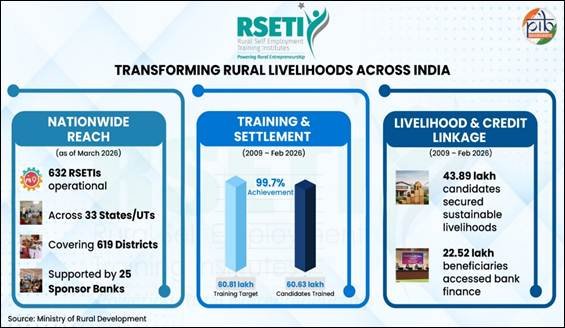
Vishnu Bai reflects on a belief that has shaped her journey: that those who rise find the world lifting them further. She was born into a modest farming family, where dreams rarely stretched beyond daily survival. Her schooling stopped after eighth standard, cut short by an early marriage and new responsibilities. Within eighteen months, she returned home, as her marital household sank under financial strain. When her brothers refused to provide financial support, she chose self-reliance and began stitching clothes at home. Each small earning carried not just income, but a fragile sense of independence. Her turning point came through the Shri Ram Self-Help Group, which introduced her to training opportunities at the Rural Self Employment Training Institute (RSETI) in Bhopal. She wanted to learn tailoring alongside other women, but social barriers stood firm. Facing mobility restrictions, she requested training in her village. The institute responded, and the Panchayat Bhawan became a classroom of hope. Women gathered there, learning stitching alongside the basics of running a small business. For many, it was their first step into a world beyond household boundaries. After completing training, Vishnu Bai opened a modest tailoring shop in her village. Her work slowly expanded to include men’s garments. A government order for school uniforms brought steady income and renewed confidence. Soon after, she owned industrial sewing machines and built a stable livelihood through her growing enterprise. Her journey reflects quiet courage, shaped not by sudden change but persistent determination. Stories like hers echo across rural India, where transformation often unfolds without noise or spectacle. Another such journey of Umesh Shivaji Ingle from daily wager to employment generator reflects how RSETIs reshape lives with strength. Coming from a financially constrained family, he could study only up to the tenth standard. For nearly five years, he worked as a daily wager in a noodle factory. Despite long hours, his earnings barely sustained his household’s needs. A friend’s suggestion introduced him to the RSETI training programme, opening an unexpected door. He enrolled in an Entrepreneurship Development Programme, drawing on his factory experience to deepen his learning. After training, he started a small noodle unit with a secondhand machine and basic tools. At first, he produced around 1,000 to 1,200 kilograms of noodles daily. Gradually, demand grew, and his enterprise began earning a monthly profit of about thirty thousand rupees. He employed four women from vulnerable backgrounds, extending opportunity beyond his own family. A loan of eight lakh rupees from the bank helped him scale his operations. He shifted to a larger unit in MIDC Akola, expanding production to meet rising demand. From a daily wager to an employer, his journey had redefined purpose by creating livelihoods for others. While some journeys begin with economic needs, others emerge from creative aspirations. In Dharwad, Sanjay Malagi’s story reflects how RSETIs help diverse dreams grow into enterprises. After completing a diploma in electrical engineering, he worked in a multinational company in Bengaluru. Over time, dissatisfaction grew, urging him to leave and return home in search of purpose. During this uncertain phase, he discovered a photography course offered by RSETI Dharwad.
Get the key updates from India and around the world with The Savera Times Evening Wrap, bringing together...

Scotland First Minister John Swinney visited Sabarmati Ashram in Ahmedabad and met Gujarat officials and teachers to explore...
Valsad police seized 2,535.1 kg of cannabis-laced tablets worth Rs 12.67 crore during raids in Vapi and Dadra....
The BJP criticised National Conference president Farooq Abdullah over his comments that Pakistan’s efforts to raise the Kashmir...
Iran's parliamentary delegation will attend the BRICS Parliamentary Forum in New Delhi on October 26–27 after Speaker Mohammad...

The JDU has expelled Mokama MLA Anant Singh for six years after he backed a Jan Suraaj candidate...
Aries: The day will be auspicious...