Last Updated: October 15, 2026
Last Updated: October 15, 2026





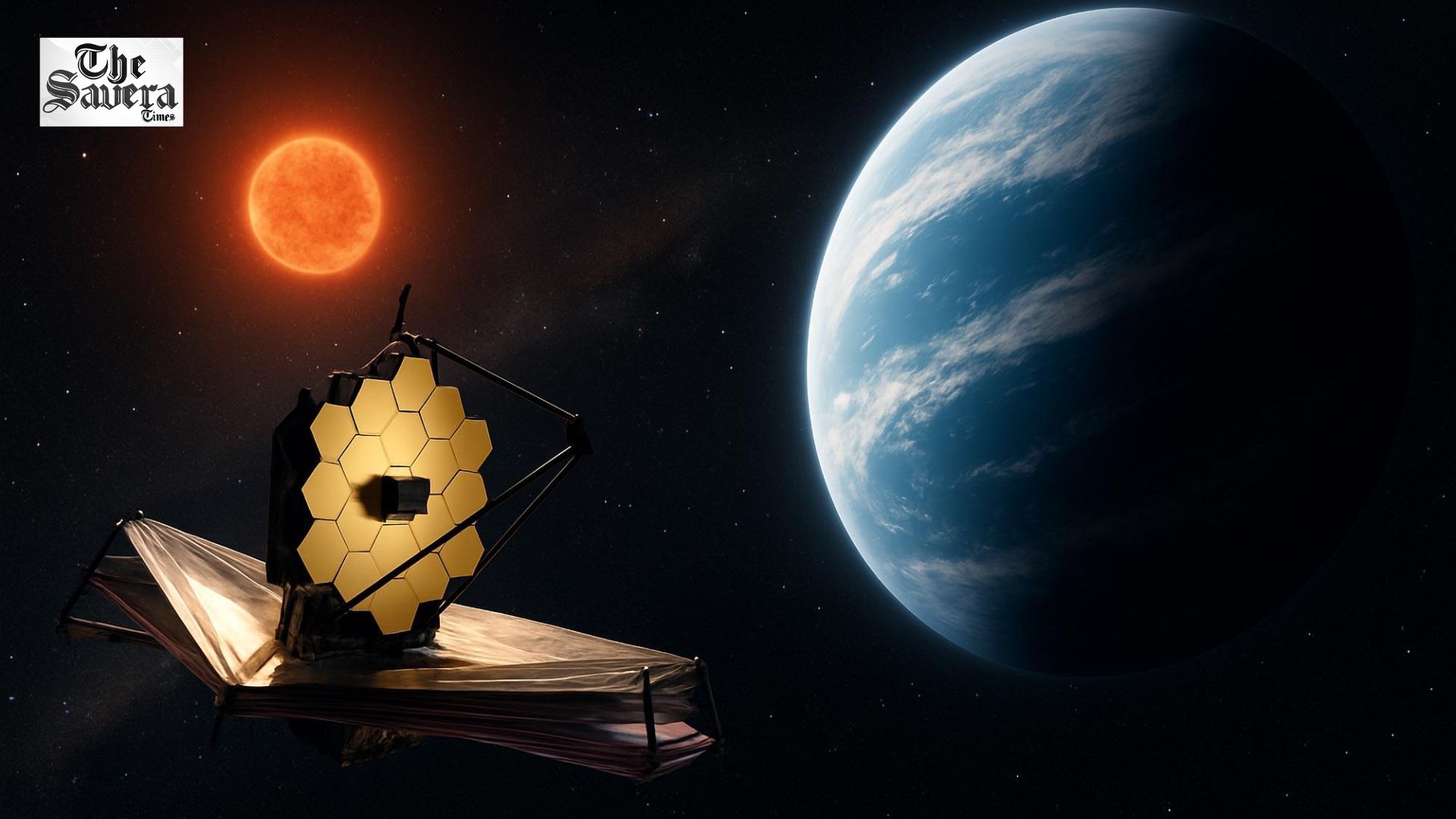
Astronomers have detected the most promising signs yet of a possible biosignature outside the solar system, although they remain cautious. Using data from the James Webb Space Telescope (JWST), the astronomers, led by the University of Cambridge, have detected the chemical fingerprints of dimethyl sulfide (DMS) and/or dimethyl disulfide (DMDS), in the atmosphere of the exoplanet K2-18b, which orbits its star in the habitable zone. On Earth, DMS and DMDS are only produced by life, primarily microbial life such as marine phytoplankton.
While an unknown chemical process may be the source of these molecules in K2-18b’s atmosphere, the results are the strongest evidence yet that life may exist on a planet outside our solar system. The observations have reached the ‘threesigma’ level of statistical significance — meaning there is a 0.3% probability that they occurred by chance.
To reach the accepted classification for scientific discovery, the observations would have to cross the five-sigma threshold, meaning there would be below a 0.00006% probability they occurred by chance. The researchers say between 16 and 24 hours of follow-up observation time with JWST may help them reach the allimportant five-sigma significance. Their results are reported in The Astrophysical Journal Letters. Earlier observations of K2-18b–which is 8.6 times as massive and 2.6 times as large as Earth and lies 124 light years away in the constellation of Leo, identified methane and carbon dioxide in its atmosphere. This was the first time carbon-based molecules were discovered in the atmosphere of an exoplanet in the habitable zone.
Those results were consistent with predictions for a ‘Hycean’ planet: a habitable ocean-covered world underneath a hydrogen-rich atmosphere. However, another, weaker signal hinted at the possibility of something else happening on K2-18b. “We didn’t know for sure whether the signal we saw last time was due to DMS, but just the hint of it was exciting enough for us to have another look with JWST using a different instrument,” said Professor Nikku Madhusudhan from Cambridge’s Institute of Astronomy, who led the research. To determine the chemical composition of the atmospheres of faraway planets, astronomers analyse the light from their parent star as the planet transits, or passes in front of the star as seen from the Earth.
Pakistan is heading into its wheat-growing season with a serious water problem. The country is facing a projected...

Jerusalem: The Israel Defence Forces (IDF) said in a statement on Wednesday that it had killed a Hamas...

US President Donald Trump has promised that if the Republican Party retains control of both houses of Congress,...

Police have arrested chemist Ashwini Kumar in connection with the shooting death of anti-drug activist Parvinder Jhota (45)...

New Delhi: American singer Mary Millben on Wednesday made an explosive claim about the Delhi protests, alleging that...

Prime Minister Narendra Modi on Wednesday wished Pope Leo XIV a speedy and complete recovery. The Pope underwent...

Aries: The day will be auspicious...