Last Updated: October 21, 2026
Last Updated: October 21, 2026





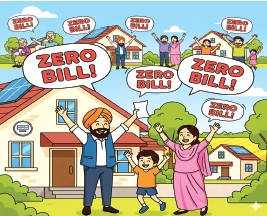
In July 2022, the Punjab Government introduced one of its most ambitious welfare reforms in recent years by offering 300 units of free electricity every month to domestic consumers. Announced under the leadership of Chief Minister Bhagwant Singh Mann, the initiative has grown into a transformative support system for families across the state. What began as a policy decision soon became a lifeline for households struggling with rising living costs and unpredictable electricity expenses.
Before the scheme took effect, many families were routinely stressed by monthly electricity bills that often forced them to cut back on essential needs. Rising tariffs, irregular power supply, and growing household demands had created a financial strain for a large section of citizens. The introduction of free electricity up to 300 units brought immediate and meaningful relief. Today, almost 90 per cent of households in Punjab receive zero electricity bills. The shift is visible not only in numbers but also in the daily lives of ordinary people who now find themselves with additional financial room.
Many residents describe this change as more than a saving on utilities. They see it as an opportunity to redirect money toward priorities that had been neglected earlier. In Ludhiana, Harjeet Kaur, a mother of two, explained how the scheme eased pressure on her family budget. She said that she no longer receives any electricity bill and is now able to use the saved amount to fund her daughter’s education. Her experience is echoed in numerous households where the policy has opened up space for better nutrition, healthcare, and planning for the future.
The benefits of the initiative have extended far beyond urban centres. In rural Punjab, farm families have also felt significant relief. Agriculture is an energy-intensive occupation that relies heavily on tube wells for irrigation. For decades, farmers depended on diesel pumps during long power cuts, which resulted in high fuel expenses and environmental harm. The promise of 24-hour uninterrupted electricity for irrigation has reduced the reliance on diesel, cut operational costs, and provided a more predictable routine for farmers. Many of them now report improved crop planning and lower input costs. This uninterrupted supply has also led to a reduction in generator-related pollution, contributing to better air quality in rural pockets.
central part of this wider initiative has been the government’s effort to strengthen the state’s power infrastructure. The administration has invested around Rs 5,000 crore to modernise the electricity grid, upgrade transmission lines, and reduce system overloads. This financial commitment aims to achieve two long-standing goals: eliminating power cuts and ensuring reliable electricity for all categories of consumers. The results are becoming visible in several districts where power disruption has reduced significantly compared to earlier years.
Chief Minister Bhagwant Singh Mann has consistently framed electricity as an essential service rather than a luxury. He has said that access to reliable power is a right of every citizen and that the state must ensure its availability without causing financial hardship. His focus on energy self-reliance is aimed at reducing the gap between power demand and supply, while also promoting efficiency. According to him, when citizens feel secure about basic utilities, they are able to plan their lives with greater confidence.
This broader vision includes not only subsidies but also improvements in production and distribution. Strengthening the power sector has been viewed as essential for economic growth, since industries, agriculture, and services all depend on dependable electricity. The government has therefore emphasised the need to generate more power within the state while gradually reducing dependence on external sources. By doing so, Punjab seeks long-term stability in its energy landscape, which in turn supports household welfare and industrial competitiveness.
The social impact of free electricity has been equally significant. In many homes, the scheme has reduced tensions that often arose from balancing monthly expenses. Families with elderly members or young children say they can now rely on fans, coolers, or heaters without constantly worrying about the meter reading. Women, especially homemakers in lower-income groups, say they feel relieved because they no longer have to compromise between household appliances and cost-saving decisions. Students too are benefiting from steady electricity supply, which helps them study without interruption.
The feature of free electricity has also encouraged the adoption of more electrical appliances that improve quality of life. Households that previously avoided using air conditioners or efficient refrigerators due to high costs now report greater comfort. While the scheme covers only up to 300 units, many families manage to keep usage within the limit through responsible consumption. Even those who exceed this limit still benefit from significantly reduced bills.
In villages, the reform has been welcomed as a step toward fairness. Rural households often felt that they were at a disadvantage when it came to power supply. Frequent cuts, low voltage issues, and unreliable systems had made daily life difficult. Over the past two years, villagers have observed improved stability in supply, partly due to infrastructure upgrades and partly due to better monitoring by power agencies.
Overall, the scheme has brought emotional and financial comfort to millions. Residents describe their homes as brighter and more cheerful, both in a literal and symbolic sense. The savings created by the policy have added dignity to households that previously lived under the constant pressure of rising utilities.
The impact of the free electricity policy continues to grow as more people experience its long-term benefits. It has evolved into a symbol of the state’s commitment to welfare and energy equity. As Punjab works toward energy self-dependence and stronger infrastructure, the initiative stands as a reminder that public policies can shape everyday lives in profound and lasting ways.
Punjab government employees are observing a two-day mass casual leave protest on October 21 and 22. The agitation...
Punjab Police have arrested seven people in a suspected drug, arms and explosives smuggling case in Amritsar. A...

Punjab has reported 404 stubble-burning incidents, with Tarn Taran and Amritsar accounting for the highest numbers. Authorities have...

The CBI has taken over the investigation into anti-drug activist Parvinder Singh Jhota’s killing in Mansa and registered...
Punjab Chief Minister Bhagwant Mann was allegedly detained for three hours at Delhi airport upon his return from...

The Punjab Vigilance Bureau (VB) during its ongoing drive against corruption in the state, has apprehended Inspector Gulshan...
Aries: The day will be auspicious...