Last Updated: September 24, 2026
Last Updated: September 24, 2026





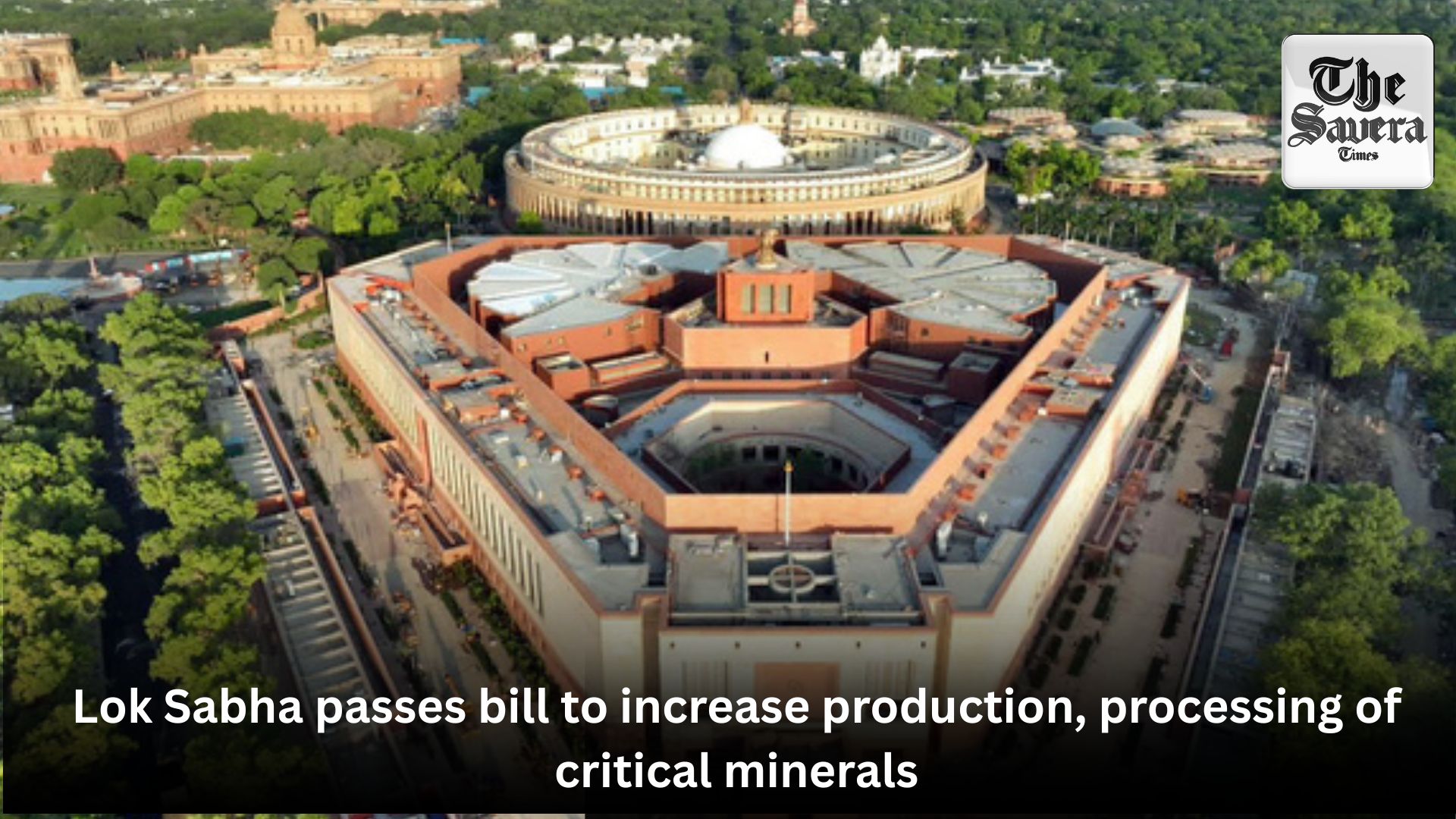
New Delhi: Lok Sabha on Monday passed a bill which seeks to provide a simpler regime for promoting conservation of minerals, zero waste mining and support the objectives of the National Critical Mineral Mission, given the significance of critical and strategic minerals in the development of the country.
The Mines and Minerals (Development and Regulation) Amendment Bill, 2025, was passed after brief debate, with Union Minister for Coal and Mines G Kishan Reddy stating that every sector is dependent on critical minerals.
The significance of critical and strategic minerals in the development of the country is continuously increasing and recent global geo-political developments has constricted the supply-chains of these minerals.
The Centre launched the National Critical Mineral Mission (NCMM) in 2025 to establish a robust framework for self-reliance in the critical mineral sector. Under this mission, the Geological Survey of India (GSI) has been tasked with conducting 1,200 exploration projects from 2024-25 to 2030-31.
The Mines and Minerals (Development and Regulation) Amendment Bill was passed amid sloganeering by opposition members over their demand for debate on Special Intensive Revision (SIR) in Bihar.
In his reply to the debate on the bill, G Kishan Reddy said that India has less production of critical minerals and is largely dependent on imports.
The bill seeks to amend the Mines and Minerals (Development and Regulation) Act, 1957 and also seeks to promote extraction of deep-seated minerals.
The minister said efforts have been stepped up since 2015 to boost the availability of critical minerals in the country. “We are moving in the right direction,” he said.
He emphasised that everyone should understand the value of critical minerals, as every sector, “from electricity and medical equipment to automobiles, defence, solar, and space, is heavily dependent on them”.
Kishan Reddy said Prime Minister Narendra Modi, during his visits abroad, seeks to expand cooperation in critical minerals.
He also attacked opposition parties over disruption in the House, saying they “do not have faith on the Supreme Court, Election Commission”.
The minister said the Mines and Minerals (Development and Regulation) Amendment Bill, 2025, is an important bill for the mining sector.
“Mining sector will be an important pillar and will have a big role in India’s journey to Viksit Bhart by 2047,” he said.
In his brief remarks while moving the bills for passing, Kishan Reddy said critical minerals is the need of the hour and sought unanimous support for the legislation. The bill was introduced in the Lok Sabha on Monday.
The Mines and Minerals (Development and Regulation) Act, 1957 has been amended several times over the years. The last amendment made in the Act in 2023 focused on increasing exploration and production of critical and strategic minerals in the country by introducing a new list of 24 critical and strategic minerals; empowering the Central Government to auction mineral concessions in respect of such minerals and introduction of exploration licence for critical and deep-seated minerals.
According to the Statement of Objects and Reasons of the Mines and Minerals (Development and Regulation) Amendment Bill, 2025, there is need to provide a dynamic market mechanism for minerals backed by a robust regulatory regime with the increased availability and demand of minerals in the country.
“Setting up of mineral exchanges will help miners and end-users of minerals in determining fair and transparent market prices based on supply and demand dynamics, stabilise markets and aid in budgeting and planning. This will promote investment in mining sector and infrastructure related to transport and storage,” the statement said.
The bill seeks to remove the limit on the sale of minerals from the captive mines so that miners can sell minerals after meeting the requirements of the end-use plant linked with the mine and on payment of an additional amount specified in the Act.
It seeks to allow the sale of dumps which have been stacked up to such date as may be specified by the Central Government in captive leases which cannot be captively utilised to reduce environmental hazards and increase safety in mine workings, bring more minerals to the market and provide additional revenue to the States.
India is mostly dependent on the import of critical minerals. A National Critical Mineral Mission has been launched to increase domestic production, including from the offshore areas of India, secure supply chains from outside India and promote processing of critical minerals.
“There is an urgent need to further amend the Act to support the National Critical Mineral Mission in its objectives,” the statement said.
The bill seeks to empower the Central Government to promote the development of the market, including trading, of minerals, their concentrates or their processed forms (including metals) through mineral exchanges.
It seeks to widen the scope and territorial domain of the National Mineral Exploration Trust to enable the use of the funds accrued to the Trust within India, including the offshore areas, and outside India for the purposes of exploration and development of mines and minerals.
Ranchi: The Jharkhand High Court has taken a stern view of the state government’s failure to install CCTV...
Mumbai: IIT Bombay has postponed its mid-semester examinations scheduled for September 26 and 27, days after the death...

New Delhi: The Supreme Court on Thursday asked the Election Commission of India (ECI) to indicate a timeframe...
Disha Salian’s father Satish Salian is set to submit a pen drive containing claimed evidence to the CBI...
Greater Noida: Passengers travelling on the double-decker bus that caught fire on the Yamuna Expressway in Uttar Pradesh’s...

Akhilesh Yadav has launched the Samajwadi Party's PDA Rath Yatra ahead of the 2027 Uttar Pradesh Assembly elections,...

Aries: The day will be auspicious...