Last Updated: October 16, 2026
Last Updated: October 16, 2026





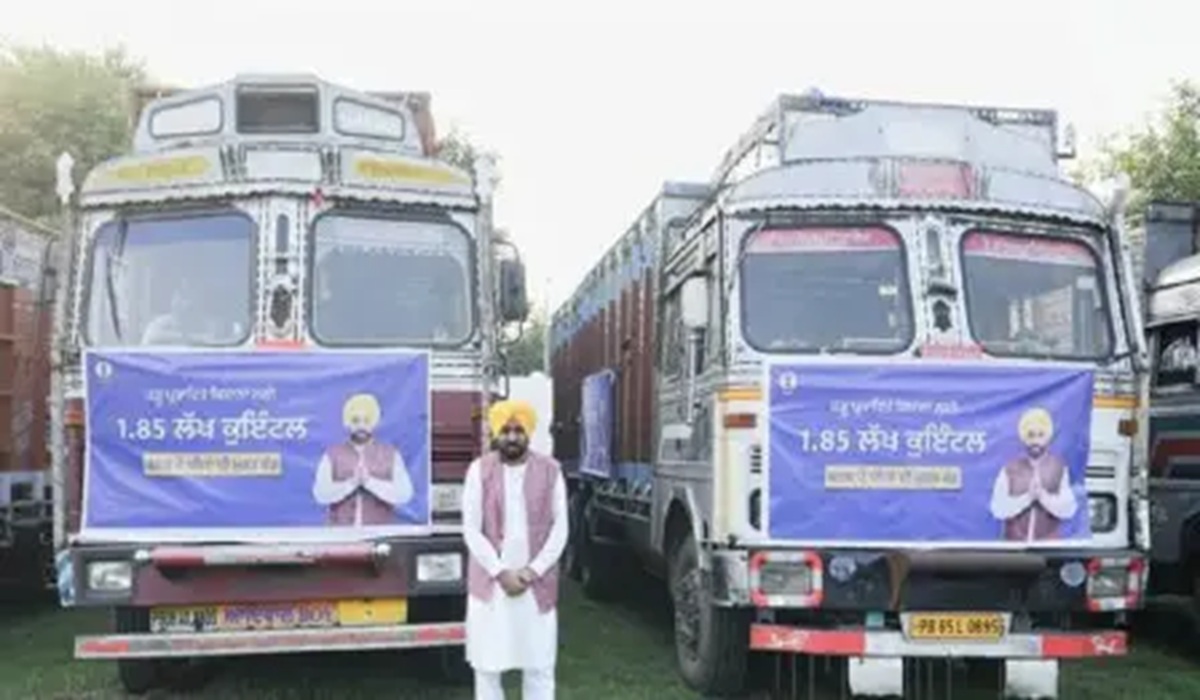
Punjab Desk: For perhaps the first time in Punjab’s history, a Chief Minister himself flagged off relief trucks loaded with essential supplies for farmers. Chief Minister Bhagwant Singh Mann dispatched seven trucks filled with wheat seeds to flood-affected districts these trucks carrying not just seeds, but hope and a new beginning for lakhs of devastated farmers.
A total of 2 lakh quintals of wheat seeds, worth ₹74 crore, are being distributed completely free of cost. When the floods ravaged Punjab, farmers were left shattered. Crops standing on five lakh acres were submerged, months of hard work were washed away, and many farmers already burdened with debt felt pushed to the brink of despair. But the government acted swiftly. Before the Rabi sowing season could begin, wheat seeds are now reaching farmers directly in their villages without any paperwork or formalities.
An emotional Chief Minister Mann said, “Our farmers are the backbone of this nation. When the entire country sleeps, the farmer keeps working in his fields. It is because of his labour that the nation is fed. When he is in trouble, how can we step back? These ₹74 crore are not expenses this is our government’s respect for our farmers.” He added that Punjab’s farmers were the pillars of the Green Revolution and ensured the country’s food security helping them in their time of crisis is the government’s duty.
The scale of destruction caused by the floods was unimaginable. Over 2,300 villages across Punjab were submerged. More than 20 lakh people were affected. Tragically, 56 precious lives were lost. Nearly 7 lakh people became homeless and were forced to live in relief camps. Children’s education stopped, elders went without medicines, and women struggled even for a place to cook a disaster unprecedented in Punjab’s history. Education and health services suffered massive damage.
· 3,200 government schools were completely ruined.
19 college buildings collapsed. · Lakhs of children were left without a place to study.
· 1,400 clinics and hospitals were destroyed, forcing patients to travel long distances.
· Several critical patients died due to the unavailability of timely medical care. This was not just damage to buildings it was the collapse of an entire support system. The destruction of infrastructure shows the true magnitude of the disaster. · 8,500 km of roads were washed away or broken.
· 2,500 bridges collapsed, cutting off villages from nearby towns.
· Delivering ration, medicines, and essential supplies became extremely difficult.
· Electric poles fell, transformers burned, and thousands lived in darkness for weeks.
· Water supply stopped because pumping systems failed. Life came to a complete standstill. Initial estimates place the total damage at 13,800 crore, though the real losses could be much higher. The loss of crops, livestock deaths, destroyed homes, and washed-away shops are difficult to quantify. Many farmers said their entire life savings vanished overnight. Those who had taken loans are now unable to repay them. This is why the government decided that immediate relief must reach the affected people without delay.
The killing of Bikramjit Singh in Gurdaspur, two days after anti-drug activist Parvinder Singh Jhota was shot dead...

Punjab is rapidly establishing itself as a key industrial hub in the country. According to the Punjab government...
Union Home Minister Amit Shah has questioned Punjab’s law and order situation over drugs, gangsterism and the murder...

A Tips School bus crashed into a house in Jalandhar's Sodhal Industrial Area on Friday morning. One child...
Charanjit Singh Channi travelled in a tipper truck to a riverbank site at night as part of Mission...

Manjit Singh Bedi, 64, has been returned to the United States after being arrested in India. He faces...

Aries: The day will be auspicious...