Last Updated: October 21, 2026
Last Updated: October 21, 2026





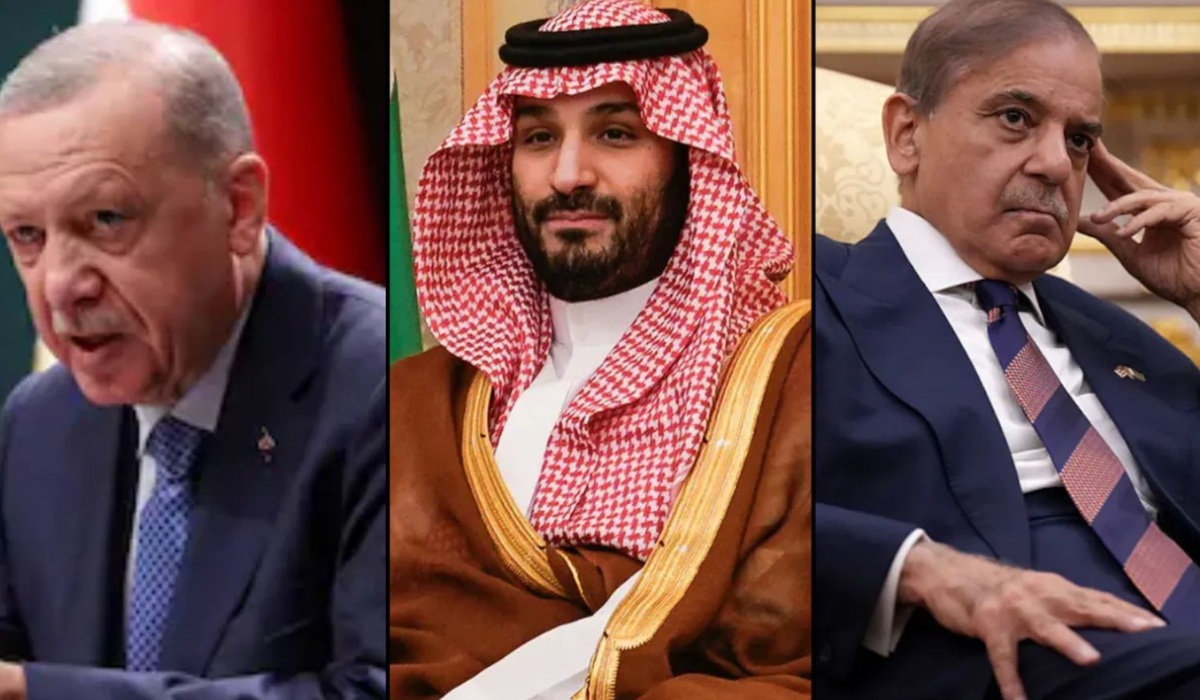
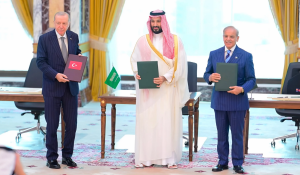
The Mecca accord is NATO modelled trilateral defense and security pact between Saudi Arabia, Turkey and Pakistan signed on 07 August, 2026. It must be viewed in the context of US/Israel-Iran conflict destabilizing West Asia raising security stakes for the region. Accord is effort to decouple from American security umbrella which failed to protect nations hosting American bases and Iran tightening control of Strait of Hormuz, clear precursor to collapsing America led security order by building an independent security deterrence. Mecca accord must ring alarm in India. Post Pahalgam attack, India coined new retaliation doctrine, treat every terrorist attack as an act of war. Pahalgam culminated in operation Sindoor. Operation Sindoor, India’s standoff attack against Pakistan was swift unconventional battle inflicting crippling damage to terrorist infrastructure aimed at early cessation of hostilities once political and military objectives were achieved. India fought at its own, was surprised with institutionalized Chinese and Turkey head in conflict pitched against three adversaries. Pakistan got battle field surveillance through Beidou navigation satellite system, hardware and technical support from China. China subtly backed Pakistan. Turkey was open and explicit. President Recep Erdogan expressed solidarity with Islamabad and condemned India’s strikes. It also supplied unmanned aerial vehicles along with military advisors to guide and coordinate war effort. Mecca agreement was not spontaneous, was waiting to happen built upon foundation of Strategic Mutual Defense Agreement (SDMA) signed in September 2025 within four months of operation Sindoor and quadrilateral consultative mechanism that includes three signatories and Egypt (R-4 group). Its core provision akin to NATO article five stipulates an attack against any member of alliance as attack against all. Accord on the face of it reflects intent to reinforce collective deterrence in the region destabilized by US-Israel & Iran war, however, impact may not remain limited to middle east. It must be appreciated in wider context and its perils for India’s security. It is also to be seen in the context of Pakistan’s illegal claims on J & K and past utterances of Turkey in international for a supporting Pakistan position on Kashmir. Pakistan, after Operation Sindoor credited Donald Trump for ceasefire, with India firmly rejecting any thirdparty intervention and maintaining ceasefire was established through direct bilateral channels. Pakistan through its surprise diplomatic stance successfully turned national security crisis into political and diplomatic win. It lost militarily but won diplomatically. It effectively aligned with Washington and landed as principal mediator between United States of America and Iran. Its diplomatic stance demonstrated expertise to leverage crisis into opportunity exploiting geographical position to hilt. Since independence India had effective and decisive conventional edge over Pakistan. Pakistan unable to blunt it, continued into state of tizzy. In desperation to blunt conventional edge, Pakistan jet sped pursuit of nuclear weapons. It was a nuclear weapon state after 1998 tests standing at equal footing with India in nuclear arena. Collaboration with China provided military impetus to Pakistan in training, technology, weapon platforms, building strong ChinaPakistan axis which was successfully tried and tested in Operation Sindoor. Pakistan’s aping of cold war era military strategy of ‘Flexible nuclear doctrine strengthening non-nuclear and specialized forces to fight insurgencies and conventional war and deployment of tactical nuclear weapons has significantly diminished India’s conventional edge, throwing new challenge for government, security policy planners. With new doctrinal principle binding to treat every act of terrorism as an act of war, government may have to resort to tightrope walk in case of Pahalgam repetition. It was okay till Pakistan was standalone enemy and adversary. Now with Strategic Mutual Defense Agreement (SDMA) followed by trilateral Mecca pact, perils and stakes for India have risen multifold which may impose hesitation and caution upon India in its response to Pakistan’s act of terrorism on Indian soil. The military collaboration and collusion now is four sided. Military leadership must factor in contingencies, India may have to encounter in case of its retaliation to Pakistan’s terrorist adventurism. India going for military strikes, will automatically enable Pakistan and partners to invoke mutual and collective security articles of Mecca pact. Trilateral pact further strengthens Pakistan’s conventional deterrence as it loads it with Saudi finance and qualitative long-term Pakistan-Turkey defence-industrial infrastructure upsetting India’s conventional and strategic arithmetic forcing it to revert to drawing board to re-strategise its defence preparations. It cannot ignore China as elephant in the room in strategic planning and vacillate. What should be our response to new emerging realities in the neighborhood as a result of Mecca pact. It is for the government and security planners to formulate doctrine. It could be upgradation of its “Cold Start doctrine” making it more devastating and lethal delivering hard punch decapacitating adversary infinitely and breaking Pakistan- China axis of misadventure. For such results, policy planners have to devise ways and means for capability building through capability acquisitions, practical defence human resource policy and not Agniveer type recruitment schemes and training. This is the only way to face the emerging geopolitical realities. India also needs factor in possibility that Bangladesh could consider joining Mecca pact. Junior foreign minister of Bangladesh Humayun Kabir says “If there is a security arrangement along Islamic nations in the middle East, it is not unusual for us to consider participating. It is being viewed positively”. Creating a muscular and credible conventional defence calls for strong defence industrial base shredding “RED TAPE” responsible for delays and capability gaps. It requires heavy investment to absorb needs of long conflicts. With lethargic decision making and abandoning trusted defence allies, India may be saddled with 4 th generation fighters with comrades Pakistan and China having sixth generation fighters. With dwindling air platforms slowly, capability for two front war is eroded, compromising national defence. Security environment along Indian borders is precarious with strained unneighborly relations, compounded by newborn bonhomie between Pakistan & Bangladesh with Dragons security and economic signages visible all around. Security environment becomes more unstable and hazardous with nuclear neighbors and disputed borders, line of control (LOC) and line of actual control (LAC) along with undermarketed territory of Siachen glacier pushing urgency into capability building. Indigenization or “Atam Nirbharta” in defence industry may take decades to fructify, import of critical components in short run seems only solution to meet current strategic security challenges despite fact that import dependence has its own perils. What is the solution to current unstable security dynamics created by Mecca accord, ChinaPakistan axis, Bangladesh showing teeth. How to ensure security and stability along borders, a must for sovereignty and territorial integrity. Unstable security environment has two connotations. Create internal upheaval through mass indoctrination of youth, pushing drug and arms, terrorism and exploit internal dissensions to weaken strata especially in border states and brace for confrontation culminating in two front wars. What India need to do urgently? First is strengthen border guarding forces through capability building with modern weapons, weapon platforms, surveillance systems, regular ground specific training and non-discriminatory human resource policies to stop aberrations like drugs ,arms on borders and not allow them to percolate into hinterland. Second is building strong defence industrial base for capability building, and settle boundary dispute with China in North, Centre and East. Despite 25 rounds of SR talks and hype of early harvest and political settlement, China continues with its policy of salami slicing unchecked which needs to stop. India must ensure strong border security and military posture against Pakistan. Strong borders will only help kill export of terrorism from across. It also needs to shed impression of weakkneed policy against China. Only strong border security and military capabilities are insurance against perils of Mecca accord and Pakistan China axis and tackle border aberrations, fight conventional wars successfully. It is high time security planners put their heads together to strengthen border security and restore edge of conventional deterrence without losing any time lest recovery becomes painful.
Protests in Jakarta, Yogyakarta and Bandung brought students onto the streets over rising costs, forest fires and civil...
Organisations linked to Neville Roy Singham are under US congressional scrutiny over funding. Their coverage of protests in...

US President Donald Trump says Washington and New Delhi are close to a trade agreement that will differ...
Iran has ruled out transferring its enriched uranium stockpile outside the country, with security official Mohsen Rezaei reiterating...

Donald Trump has urged Volodymyr Zelensky to pursue a peace deal with Russia, warning that Ukraine could face...

Pakistan, battling insurgencies at home and tensions along multiple borders, is too overstretched to offer meaningful military support...
Aries: The day will be auspicious...