Last Updated: October 8, 2026
Last Updated: October 8, 2026





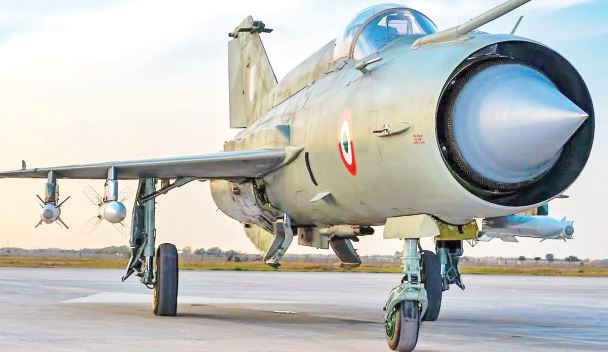
The Indian Air Force (IAF) will formally retire the MiG-21 fleet on 26 September, closing a chapter that spanned more than six decades. The Soviet-origin aircraft, inducted in the 1960s, once formed the backbone of India’s aerial combat strength and played a decisive role in the 1971 war. Over the years, however, the aircraft earned grim nicknames such as the “flying coffin” and “widow maker” after a string of crashes claimed the lives of many pilots.
The phase-out of the MiG-21 leaves India with a critical shortfall in fighter squadrons at a time when both Pakistan and China are modernising their air forces. With the indigenous Tejas light combat aircraft yet to be delivered in meaningful numbers, the question now is how quickly India can replenish its frontline strength.
A Contract for Tejas
The Ministry of Defence is expected to sign a contract with Hindustan Aeronautics Ltd (HAL) for 97 Tejas Mark-1A fighters valued at about Rs 67,000 crore. The deal, cleared by the Cabinet in August, is seen as a vital step to bolster the IAF’s depleted numbers. Officials describe the Tejas as capable of air combat, offensive support, reconnaissance, and even anti-ship operations. Once inducted, the aircraft is expected to serve as the IAF’s workhorse for the coming decades.
This fresh order comes even as HAL has yet to deliver any of the 83 upgraded Tejas jets it secured in a Rs 48,000-crore contract in 2021. HAL had promised delivery of the first jet by September 2025, but the deadline has already slipped. The delay has not gone unnoticed at the highest levels of the Air Force.
IAF chief A.P. Singh, speaking earlier this year, voiced frustration over missed timelines. “Not a single project has been completed on time,” he observed at a business summit in May. He emphasised that defence contracts must reflect achievable goals rather than unrealistic promises. “At the moment, I am just not confident of HAL,” he said bluntly.
Delays and Supply Chain Strains
HAL has attributed the hold-up to engine supply issues from US-based General Electric Aerospace, which produces the F-404-IN20 engines that power the Tejas. GE explained that after fulfilling an earlier order of 65 engines by 2016, it shut down the production line due to lack of fresh demand. It was only in 2021, with India’s renewed order, that the company had to revive its supply chain—an arduous task compounded by the Covid-19 pandemic.
Restarting production required reactivating suppliers and re-establishing specialised processes. GE has since resumed deliveries, providing three engines to HAL and pledging more by year-end. HAL has said it will deliver two Tejas Mark-1A aircraft in October, with a plan to eventually supply 24 to 30 planes annually.
The Defence Research and Development Organisation (DRDO) had once aimed to power the Tejas with its own Kaveri engine, but that project has faced repeated setbacks, forcing reliance on foreign suppliers.
The Numbers Problem
The immediate challenge for the IAF is dwindling squadron strength. Current levels stand at just 29 squadrons, far below the sanctioned 42.5 considered necessary to guard against threats on both western and eastern fronts. Each squadron typically has 16 to 18 aircraft.
By comparison, Pakistan operates around 25 squadrons, with 300 to 320 jets, and is seeking to acquire advanced J-35A stealth fighters from China. China, meanwhile, fields an estimated 1,200 to 1,300 fighter jets, including both fourth- and fifth-generation aircraft, alongside bombers and electronic warfare platforms. An internal IAF review after Operation Sindoor reportedly concluded that even 42.5 squadrons might not suffice against combined adversaries.
IAF chief Singh has warned that at least 40 new aircraft need to be inducted annually simply to maintain present levels. Given retirements of ageing fleets such as the MiG-21, the gap could widen if deliveries of the Tejas or other platforms remain slow.
The Road to Fifth Generation
India’s long-term solution lies in the Advanced Medium Combat Aircraft (AMCA), a fifth-generation stealth fighter under development. Defence Minister Rajnath Singh approved the project earlier this year, and a full-scale model was displayed at Aero India 2025. However, the project has been in the works for more than 15 years, and experts believe induction may be a decade or more away.
Meanwhile, global rivals are moving ahead. The United States operates the F-22 Raptor and F-35 Lightning II, Russia has fielded the Su-57, and China has inducted two types of stealth fighters while also working on sixth-generation aircraft. The US too has announced plans for its own sixth-generation jet under the Next Generation Air Dominance (NGAD) programme.
Looking Ahead
For the IAF, the retirement of the MiG-21 is both symbolic and sobering. It marks the end of an era when the aircraft carried Indian pilots into battle and helped secure victories. But it also underscores the urgency of modernisation as adversaries expand their capabilities.
The Tejas programme is seen as central to India’s strategy of reducing dependence on foreign imports while building a self-reliant defence industry. Yet the delays highlight the challenges of scaling up indigenous manufacturing to meet operational demands.
For now, HAL has promised to begin deliveries soon, but the pressure will remain high. The IAF’s reduced squadron strength is already a concern, and with China and Pakistan modernising rapidly, India’s ability to secure its skies will depend on how quickly contracts translate into combat-ready aircraft.
The final flypast of the MiG-21 will evoke nostalgia for a legendary aircraft, but for the IAF, the future depends on timely induction of new fighters. India cannot afford to let delays in production or procurement compromise its preparedness.
Abidjan: External Affairs Minister (EAM) S Jaishankar on Thursday congratulated Gedion Timothewos Hessebon on his re-appointment as Ethiopia’s...
New Delhi: In a strongly worded open letter, 42 former judges, including those from the Supreme Court and...
New Delhi: Congress President Mallikarjun Kharge and Leader of Opposition in the Lok Sabha Rahul Gandhi on Thursday...

Patna: Leader of Opposition in the Bihar assembly Tejashwi Yadav launched a sharp attack on Chief Election Commissioner...

Bengaluru: The Karnataka Congress on Thursday observed a ‘black day’, staging a protest against the detention of Rahul...
Leaders of Congress and other constituents of the INDIA Bloc were detained in Hyderabad on Thursday as they...

Aries: The day will be auspicious...