Last Updated: October 12, 2026
Last Updated: October 12, 2026





Written By Sheena Sandhu
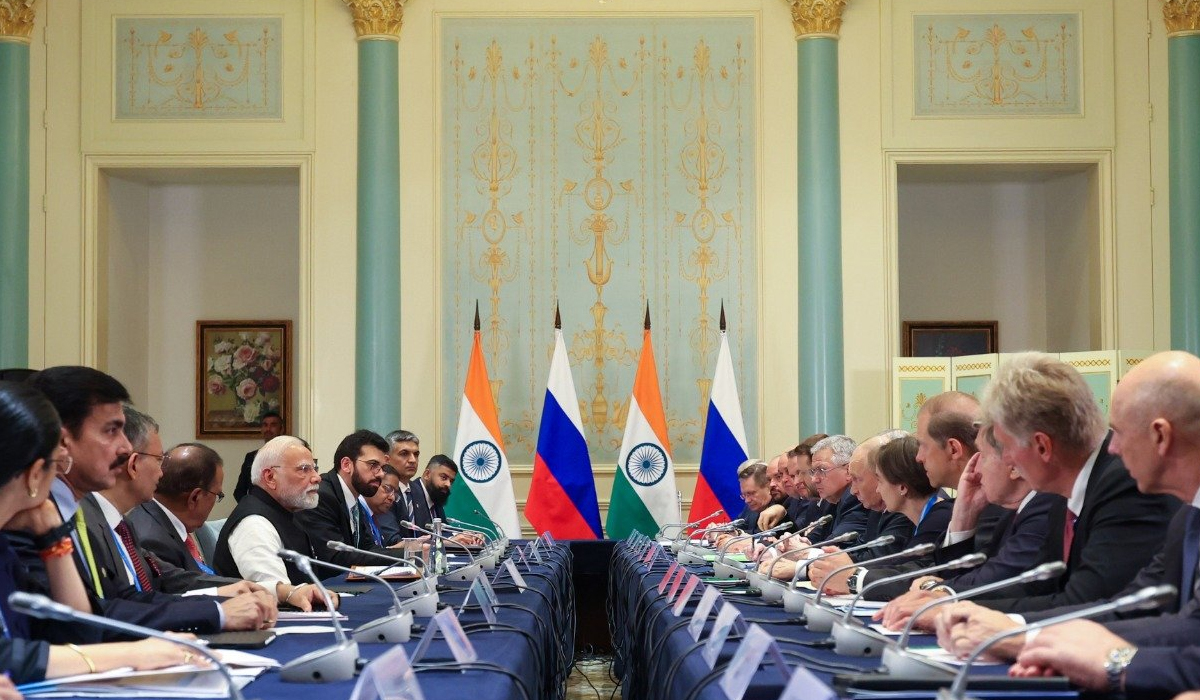
Prime Minister Narendra Modi’s visit to China for the Shanghai Cooperation Organisation (SCO) summit could easily be dismissed as a diplomatic routine. But in today’s fractured geopolitical landscape, where tariff wars are redrawing trade maps and great-power rivalries are hardening, this visit carries unusual weight. It is less about ceremonial optics and more about how India positions itself in a world sliding towards economic and strategic fragmentation.
Tariff wars and India’s economic dilemma
The global trading system is undergoing its sharpest disruption in decades. With the United States escalating tariffs on China and Beijing retaliating, supply chains are splintering. For India, this is a double-edged sword. On one hand, decoupling opens opportunities for India to present itself as an alternative manufacturing hub. On the other, it threatens India’s access to affordable inputs— particularly electronics, machinery, and critical raw materials—many of which still come from China.
In such an environment, India cannot afford a binary choice between East and West. It must keep one foot firmly in Western markets, while also hedging through new Eurasian trade corridors, energy partnerships, and technological dialogues. The SCO, despite its limitations, offers precisely that stage.
The SCO as a geopolitical arena
Unlike Western-led institutions, the SCO gives India a rare chance to engage simultaneously with China, Russia, Iran, Central Asia— and increasingly, partners who are shaping the non-Western world order.
For China, the summit is a chance to project leadership of an “alternative multilateralism.” For Russia, it is an avenue to reinforce energy and defence ties as it faces Western sanctions. And for India, it is an opportunity to test whether limited stabilization with China is possible, while also consolidating its energy and connectivity stakes with Russia and Central Asia. This balancing act— engagement without alignment—is central to India’s foreign policy.
India–China: rivals, but pragmatic partners
The border standoff in Ladakh remains the biggest obstacle to normalizing ties. India has made it clear that peace on the frontier is a prerequisite for broader cooperation. Yet, neither side benefits from perpetual hostility. China needs India’s vast market at a time when Western tariffs are biting, and India needs predictable access to Chinese inputs for its manufacturing ambitions. The SCO summit gave Modi and Xi Jinping a platform to signal a modest thaw: talk of “partners, not rivals,” more military-to-military communication, and easing of some trade barriers.
These steps do not resolve the border issue, but they reduce the risk of flare-ups and give businesses a degree of predictability. It is a bargain both sides can live with—pragmatism without trust.
Russia factor: keeping energy secure
India’s discounted oil imports from Russia have been critical for domestic price stability. But sustaining this arrangement requires deft diplomacy, as Western sanctions complicate shipping, banking, and insurance channels. Modi’s engagement with President Putin at the SCO reassures Moscow of India’s steady hand, even as New Delhi deepens ties with the US and Europe. Energy security, especially in volatile markets, is one area where symbolic presence translates directly into economic stability.
Central Asia: connectivity and security
Central Asia is often overlooked in Indian strategic debates, but for New Delhi, it is both a security buffer and a connectivity bridge. The SCO helps India keep projects like the Chabahar port and the International North-South Transport Corridor on the table. With tariff barriers rising worldwide, even incremental gains in Eurasian connectivity reduce India’s dependence on maritime chokepoints and diversify its trade routes.
The technology question
Beyond trade and energy, the SCO is also becoming a stage for setting digital and AI standards. China is pushing its own frameworks; Russia is advocating for sovereign control of data. India, cautious but present, uses the platform to ensure its interests are factored in. Participation matters: in a future where technology ecosystems are fragmented, being at the negotiating table can prevent India from being forced into disadvantageous frameworks.
What New Delhi wants— and what it must avoid India’s priorities from such engagements are clear:
• De-escalation on the border to reduce geopolitical risk premiums.
• Greater predictability in trade, especially for pharmaceuticals, agriculture, and electronics inputs.
• Continued energy flows from Russia with secure payment mechanisms. • Incremental but tangible steps in Central Asian connectivity.
What India must avoid is equally important:
grand gestures without progress on the ground, and any tilt so sharp towards the Eurasian bloc that it jeopardizes hard won partnerships with the US and Europe. Strategic hedging, not alignment, is the name of the game. The larger significance Is Modi’s SCO visit the beginning of a new non Western realignment? Not quite. India has no interest in joining a bloc that pits it against the West. But in a tariff-driven, fractured world, presence matters. By showing up in China, Modi has signaled that India will not be boxed into a corner. It will engage with all sides, extract what it can, and keep its autonomy intact.
Conclusion
This visit was not about converting adversaries into allies. It was about reducing risks on one frontier, securing energy on another, and keeping trade routes open in a fractured world. In a global order where tariffs, sanctions, and rivalries can shift overnight, India’s best bet is to hedge, diversify, and engage. Modi’s trip to China, under the SCO banner, was a step in exactly that direction.
US President Donald Trump is scheduled to attend the ASEAN summit in Manila on November 16 before travelling...
An Indian national injured in the October 10 attack on Riyadh’s King Khalid International Airport has died, taking...

Ukrainian President Volodymyr Zelenskyy says he was unaware of Donald Trump’s announcement of an immediate energy ceasefire between...
Colombian businessman Alvaro Pulido Vargas has been arrested in Florida over two US federal cases involving alleged bribery...
Republican Senator Thom Tillis has questioned the legality of Trump's Russian diesel deal, while John Barrasso defended it...
Bangladesh is grappling with mounting stagflationary pressures as persistently high inflation, weak economic growth, subdued private investment and...
Aries: The day will be auspicious...