Last Updated: October 8, 2026
Last Updated: October 8, 2026





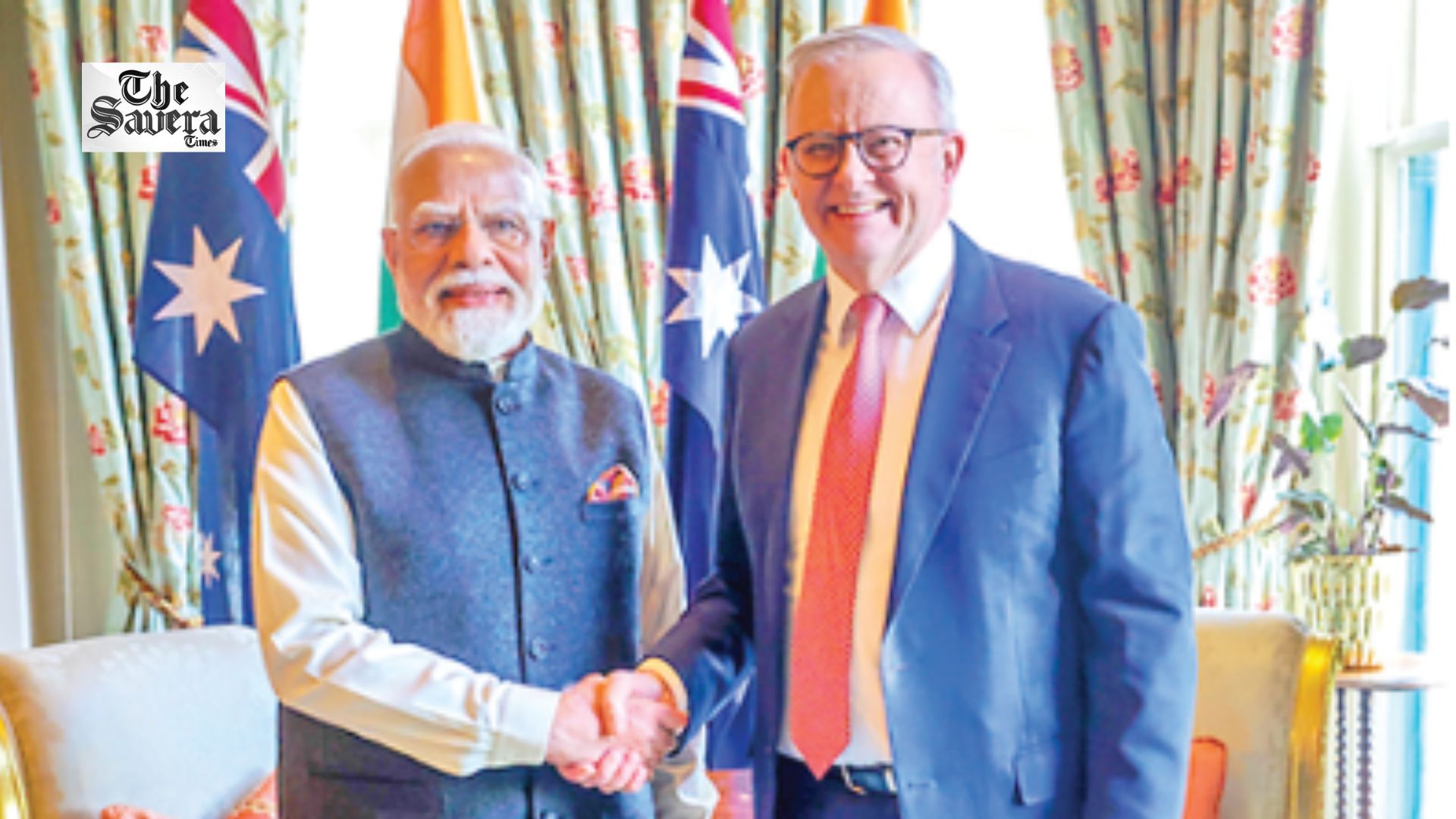
Prime Minister Narendra Modi’s recent state visit to Indonesia marks a defining moment in India’s engagement with Southeast Asia. More than a diplomatic engagement, the visit showcased how India is increasingly combining its civilizational heritage with strategic statecraft.
Guided by the vision of “VikasBhi, VirasatBhi” (Development Alongside Heritage) and the broader MAHASAGAR (Mutual and Holistic Advancement for Security Across the Regions) framework, the visit demonstrated that India’s ancient cultural connections are now serving as a foundation for a comprehensive partnership spanning defence, maritime security, technology, education, healthcare and the digital economy. The conferring of Indonesia’s highest civilian honour, the BintangAdipurna, upon Prime Minister Modi symbolises far more than recognition of an individual leader.
It reflects Indonesia’s acknowledgement of India’s enduring civilizational legacy and the deep cultural bonds that have connected the two nations for more than two millennia. For centuries, Indian traders, scholars and monks carried ideas, faith, language and commerce across the seas to the Indonesian archipelago. The influence of the Ramayana, Mahabharata, Sanskrit traditions, the Garuda emblem and Bali’s vibrant Hindu heritage continues to shape Indonesian society even today. Rather than viewing these historical links merely as reminders of the past, India under Prime Minister Modi is transforming them into instruments of contemporary diplomacy and strategic cooperation.
Indonesian President Prabowo Subianto’s remarks describing himself as having “Indian DNA” and his public appreciation of Prime Minister Modi’s governance further underscore the growing cultural affinity and respect that India enjoys in Indonesia.
Such statements reflect the increasing role of civilizational diplomacy in strengthening India’s international relationships. One of the most visible examples of this approach is India’s commitment to assist in the conservation and restoration of the ninth-century Prambanan Temple Complex in Yogyakarta, a UNESCO World Heritage Site dedicated to the Hindu Trimurti.
The initiative embodies the principle of preserving shared heritage while building future partnerships, reinforcing India’s commitment to protecting common cultural assets beyond its borders. The evolution of India-Indonesia relations is particularly remarkable when viewed through a historical lens. During the 1965 India-Pakistan war, Indonesia openly supported Pakistan. Six decades later, the relationship has undergone a dramatic transformation.
Today, Indonesia is emerging as one of India’s closest strategic partners in Southeast Asia-a reflection of India’s expanding diplomatic credibility and growing influence under Prime Minister Modi’s foreign policy. Defence cooperation has emerged as one of the strongest pillars of this partnership. Indonesia has agreed to procure India’s BrahMos supersonic cruise missile system, marking another significant milestone in India’s defence exports. Following India’s demonstrated missile capabilities during Operation Sindoor, Indonesia has also decided to acquire Astra air-to-air missiles.
The partnership extends beyond equipment procurement, with Indonesian military officers set to receive professional training at India’s National Defence Academy (NDA) and Defence Services Staff College (DSSC), further deepening institutional military cooperation.
Maritime collaboration has also assumed strategic significance. Both countries have finalised a framework for maritime safety and security cooperation covering coast guard collaboration, the blue economy, port development and maritime trade across the Indian Ocean.
Of particular importance is the joint development of Sabang Port, located near the entrance of the strategically vital Strait of Malacca and close to India’s Great Nicobar infrastructure project. This cooperation strengthens maritime connectivity while enhancing security across one of the world’s busiest shipping corridors. Economic and technological cooperation has expanded substantially through agreements on critical minerals and advanced manufacturing.
A trilateral agreement involving India’s National Ferrous Technology Development Centre (NFTDC), Midwest Limited and Indonesia’s PT PERMINAS seeks to develop rare earth permanent magnets while diversifying global supply chains. Additional cooperation in steel, nickel and critical mineral technologies is expected to encourage Indian investment in Indonesia’s manufacturing sector, contributing to resilient industrial ecosystems.
The two nations are also preparing to strengthen collaboration in outer space through joint research, technology sharing and capacity building in satellite technology and remote sensing. Such cooperation is expected to improve agricultural monitoring, disaster management, environmental assessment and communications through satellite data sharing. India’s expanding soft power is increasingly rooted not only in its cultural heritage but also in its institutional capabilities.
The establishment of the Indian Institute of Management Bangalore’s first overseas campus in Indonesia’s Singhasari Special Economic Zone represents a significant step in exporting India’s globally recognised higher education ecosystem. By training future Indonesian business leaders and professionals, India is investing in long-term people-topeople linkages and deeper economic integration across ASEAN. Democratic cooperation has also entered a new phase. India will assist Indonesia in developing its own Electronic Voting Machines (EVMs) under a Memorandum of Understanding between the Election Commission of India and Indonesia’s General Elections Commission (KPU).
The agreement facilitates knowledge sharing, capacity building and technological cooperation between the world’s largest and third-largest democracies, further strengthening democratic institutions. Healthcare and public welfare have also become central pillars of bilateral engagement.
India plans to expand the availability of affordable medicines for Indonesia’s nearly 280 million citizens while launching fellowship programmes for doctors and healthcare professionals. New Delhi has also shared its successful models of the Mid-Day Meal Scheme and Public Distribution System, highlighting common priorities in poverty reduction, food security and social welfare. Agricultural cooperation has received a significant boost with India’s announcement of the supply of 100 tonnes of high-quality DWR162 wheat seeds to Indonesia. The initiative promotes food security while facilitating agricultural research and knowledge exchange between two major agrarian economies.
Digital transformation forms another major component of the expanding partnership. India has proposed cooperation in wireless communications, quantum technologies and next-generation digital infrastructure while offering to share its globally recognised Digital Public Infrastructure framework. Discussions are underway to establish payment connectivity between India’s Unified Payments Interface (UPI) and Indonesia’s QRIS digital payment system, opening new opportunities for digital commerce, financial inclusion and cross-border transactions.
Recognising that both countries are highly vulnerable to natural disasters, India and Indonesia have also signed an agreement between India’s National Disaster Management Authority (NDMA) and Indonesia’s BNPB. The partnership focuses on technology-driven early warning systems, disaster preparedness and coordinated emergency response, strengthening resilience for millions of people living in disaster-prone regions.
Taken together, these agreements represent far more than a series of diplomatic announcements. They illustrate the emergence of a multidimensional partnership that integrates defence, maritime cooperation, education, healthcare, technology, digital innovation, democratic institutions and cultural heritage within a common strategic framework.
Prime Minister Modi’s Indonesia visit demonstrates how India’s foreign policy increasingly combines historical identity with contemporary strategic interests. Ancient civilizational ties are no longer confined to cultural exchanges; they have become valuable diplomatic assets supporting India’s engagement across the Indo-Pacific. As geopolitical competition intensifies across Asia, the IndiaIndonesia partnership offers a model of cooperation rooted not only in shared strategic interests but also in centuries of mutual trust and cultural familiarity.
From the temples of Prambanan to the waters of the Malacca Strait, from digital public infrastructure to defence technology, the relationship reflects India’s growing ability to transform its civilizational heritage into a source of strategic influence and global leadership. The journey that began more than 2,000 years ago through trade, culture and ideas is today entering a new eraone defined by shared prosperity, security and an enduring partnership for the future.
New Delhi: Prime Minister Narendra Modi welcomed policymakers, maritime leaders, and experts from around the world to the...
Kabul: Two civilians were injured in a blast in the northern Afghan province of Badakhshan on Wednesday, provincial...
Expressing firm faith in the country's collective resolve, Prime Minister Narendra Modi on Wednesday laid out key national...
The Reserve Bank of India’s Monetary Policy Committee (MPC) meeting -- led by Governor Sanjay Malhotra -- on...
As concerns grew around the world over a plague outbreak, the World Health Organisation (WHO) said on Tuesday...
A Ukrainian drone attack triggered a fire on a Liberian-flagged oil tanker carrying an all-Indian crew off Russia’s...

Aries: The day will be auspicious...