Last Updated: October 26, 2026
Last Updated: October 26, 2026





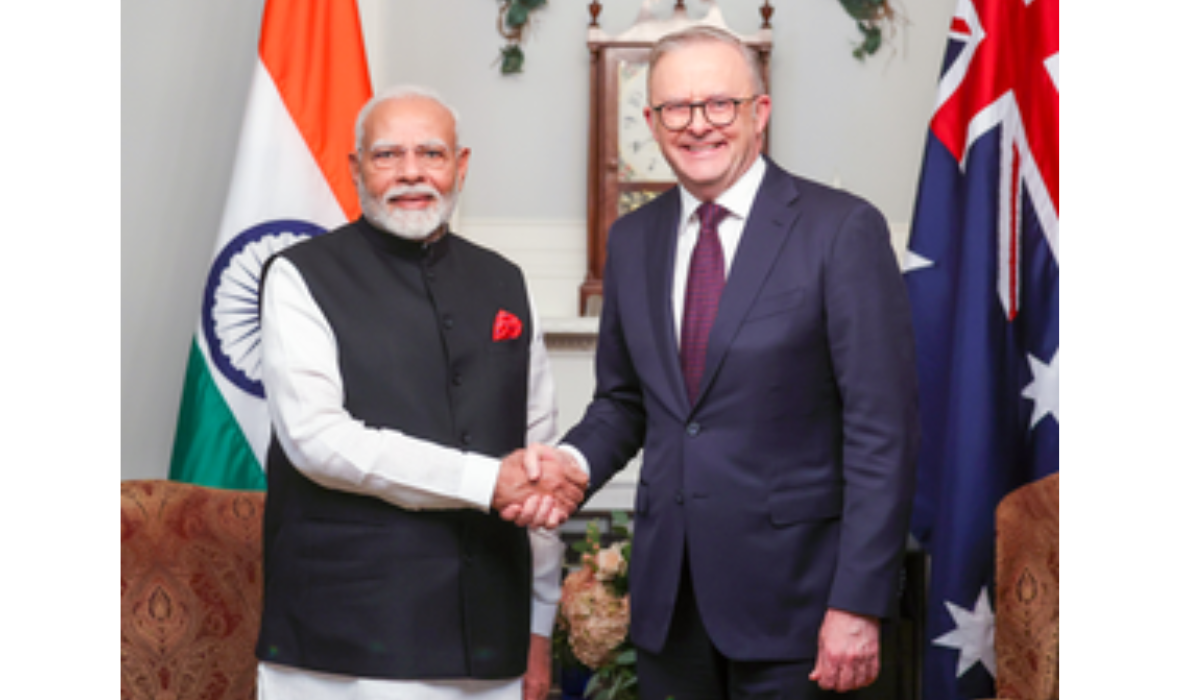
Prime Minister Narendra Modi’s recent visit to Australia delivered substantial outcomes, particularly in the defence and security sectors. Amid growing unease about depending on the US to resist China, Australia and India are eager to see how they can gain strength from each other.
During the visit, PM Modi and his Australian counterpart Anthony Albanese participated in the third Australia-India Annual Summit, where the two sides reviewed progress across the full spectrum of bilateral cooperation, including trade and investment, critical minerals, clean energy, technology, defence and security, education, skills, mobility, science and innovation, culture, sports and people-to-people ties.
Both leaders also exchanged views on regional and global developments and reaffirmed their commitment to a free, open, inclusive and prosperous Indo-Pacific.
The summit witnessed the finalisation of several MoUs in areas including defence, maritime security, energy (including nuclear), critical technology, education and skilling, among others.
A Joint Declaration on Defence signed during PM Modi’s visit is especially notable as, despite substantial growth, there is still considerable room for further cooperation. The decision to build interoperability and information sharing between the defence forces of the two nations and to strengthen the complexity of defence exercises has been widely welcomed, according to a report published on the Australian Strategic Policy Institute’s analysis platform.
Another important aspect of the declaration is its focus on strengthening regional security. The declaration calls for addressing disputes through peaceful means without resorting to force, in line with international law, a position regarded as particularly significant on the 10th anniversary of the UN Tribunal award in favour of the Philippines.
Perhaps the most striking element is the undertaking “to consult on defence-related developments in the Indo-Pacific that affect shared interests.” Such language would have been almost unthinkable between Australia and India just a few years ago.
As Griffith University professor Ian Hall has noted, the wording is almost alliance-like, resembling the language used in Article 3 of the ANZUS Treaty, which states: “The Parties will consult together whenever, in the opinion of any of them, the territorial integrity, political independence or security of any of the Parties is threatened in the Pacific.”
This development is significant because India has, for decades, avoided entering formal alliances, fearing they could restrict its strategic autonomy. There is little doubt about the reasons behind this shift in approach. PM Modi’s Australia visit also followed the highly successful visit of Japanese Prime Minister Sanae Takaichi to India earlier in July.
The second major outcome of the visit was in the civil nuclear energy sector, particularly regarding the sale of uranium to India. Australia had previously restricted uranium exports to countries with strong non-proliferation commitments, and India’s status outside the Nuclear Non-Proliferation Treaty (NPT) had long been a major obstacle.
India, however, has consistently argued that despite not being a signatory to the NPT, it has adhered to the treaty’s principles more responsibly than several signatory nations. This had long been a source of frustration in India, especially as Australia continued uranium exports to China despite concerns over Beijing’s commitments under the NPT and the Nuclear Suppliers Group.
Despite the progress, India and Australia still have considerable work ahead. There remains insufficient joint action in responding to China’s coercive policies, including the use of trade as a strategic tool. It is increasingly being argued that Indo-Pacific partners should develop a coordinated framework to respond collectively to Beijing’s assertive tactics.
As noted in The Strategist, trade has never been separate from geopolitics. From Napoleon’s Continental System, which sought to economically isolate Britain, to Cold War-era technology controls, commerce has long been used as an instrument of great-power competition.
Leader of the Opposition in the Lok Sabha, Rahul Gandhi, will visit Punjab's Sangrur district on November 4....

Good Evening Viewers! Stay updated with The Savera Times Evening Bulletin, bringing you the latest news and top...

The weather system forming in the Bay of Bengal is steadily strengthening. In view of this, Cyclone Warning...

A major road accident occurred in southeastern Kenya on Sunday morning. At least 22 people were killed and...

Hereditary Prince Alois of Liechtenstein will be on a four-day state visit from October 25 to 28 at...
Prime Minister Narendra Modi inaugurated the Reserve Bank of India’s new data centre and Cybersecurity Training Institute in...
Aries: The day will be auspicious...