Last Updated: October 20, 2026
Last Updated: October 20, 2026





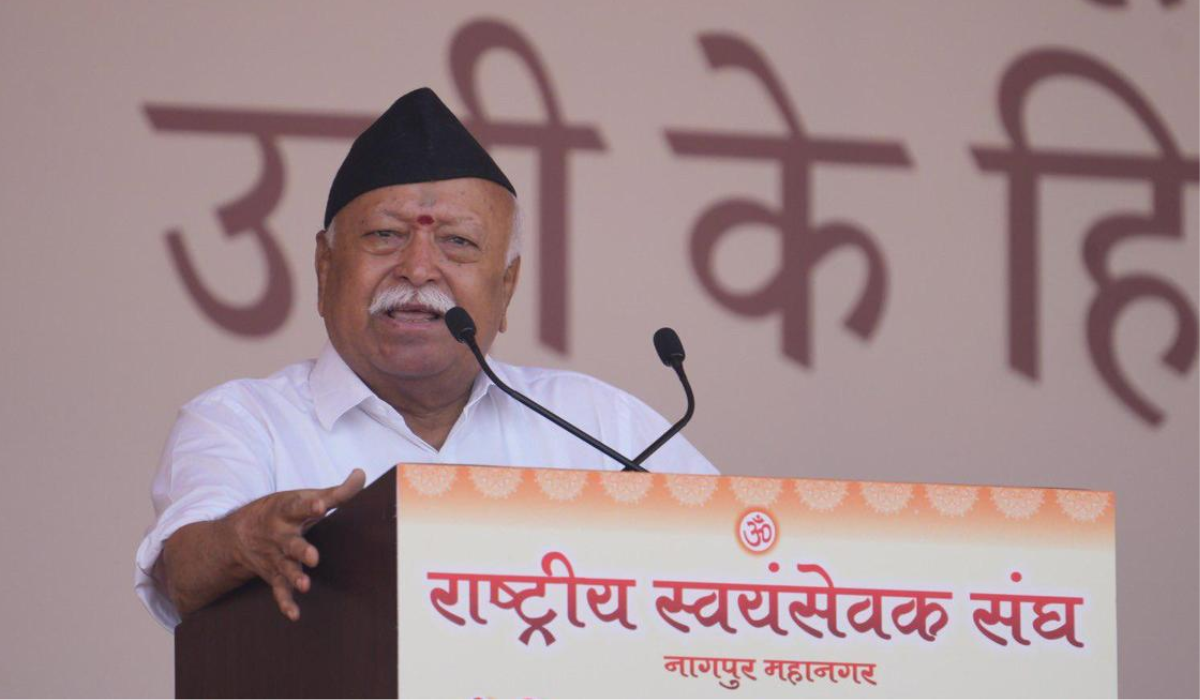
Addressing the RSS Vijayadashami celebrations in Nagpur, Bhagwat spoke about the organisation’s centenary, the importance of India’s cultural identity, the need for balanced development and the responsibility of the younger generation in shaping the country’s future. He also highlighted the RSS’s five initiatives under its Panch Parivartan framework: social harmony, family awareness, environmental protection, self-awareness and Swadeshi, and civic discipline.
Bhagwat Highlights RSS Centenary and Social Initiatives
Bhagwat said the RSS had spent the past 100 years working to organise and strengthen India on the basis of its cultural identity and civilisational ethos. He said the centenary programmes aimed to expand the organisation’s outreach among communities in India and abroad.
Referring to the legacy of Sant Ravidas, Bhagwat said his teachings on devotion, commitment to one’s faith and social harmony remained relevant. He also recalled Swami Shraddhanand, Swami Laxmanananda Saraswati and Raj Narayan Basu, highlighting their contributions and sacrifices.
Sharing details of the centenary outreach, Bhagwat said contact campaigns had reached 461,527 villages and 41,076 urban localities, covering 101,988,511 households. He added that discussions involving intellectuals had been organised in 1,117 districts, with 426,497 participants, while goodwill meetings had taken place in 5,036 blocks.
According to the figures presented in his address, Hindu conferences were held in 34,187 mandals, while youth conferences witnessed participation from 3,925,225 young people.
Bhagwat said the organisation had also undertaken outreach in Western countries to explain India’s culture, Hindu society and the RSS’s objectives. He added that discussions on Indian traditions and their relevance to global challenges had received attention abroad.
Five Initiatives to Promote Social Transformation
The RSS chief said the five initiatives under Panch Parivartan were intended to bring lasting changes in individual behaviour and social life rather than remain limited to a year of celebrations.
The initiatives include social harmony, family awareness, environmental protection, self-awareness and Swadeshi, and civic discipline.
Bhagwat said these principles needed to be adopted through everyday actions so that they could become habits and eventually shape society’s behaviour. He stressed that social transformation required continuous efforts across different sections of society.
He also highlighted community participation in education and rural development. Citing examples from 21 regions and 210 districts, he said initiatives in around 1,296 schools had shown improvements in student attendance, learning levels and parental participation where villagers and volunteers worked together.
According to Bhagwat, these efforts also involved educational support, infrastructure, sports, cultural activities and value-based learning.
Calls for Responsible Use of Technology and Action Against Drugs
Bhagwat said scientific and technological progress was important for improving people’s lives but cautioned against development driven solely by material consumption. He stressed that technology should be guided by ethical responsibility and sound judgement.
Referring to artificial intelligence, he said technological advancements could be misused to mislead people, spread falsehoods and facilitate fraud if appropriate safeguards and responsible behaviour were absent.
He also raised concerns about the influence of social media and digital platforms on young people. Bhagwat said families, schools and society needed to help the younger generation distinguish between appropriate and inappropriate information.
He specifically called attention to the growing problem of drug addiction, describing it as a serious national concern. He urged the government, administration and society to work together to tackle the problem and called on young people to stay away from activities that could lead to addiction.
Bhagwat said the RSS would work towards building a nationwide effort to combat drug abuse by bringing different sections of society together.
Advocates Balanced Development and Environmental Responsibility
The RSS chief said India needed a comprehensive and balanced model of development that combined scientific progress with environmental protection and ethical responsibility.
Referring to the devastation caused by a disaster in Nepal, Bhagwat argued that development across ecologically sensitive regions, including the Himalayan belt, needed to account for environmental consequences.
He said technology was a means to an end and that human judgement determined whether it was used constructively or destructively. Without ethical discipline, he cautioned, scientific knowledge could produce weapons and technological systems capable of causing harm.
Bhagwat said India should present an alternative development model rooted in harmony, restraint and an integrated understanding of life. He added that the country could contribute to addressing global challenges by combining modern scientific knowledge with its civilisational values.
Hindu Ethos and Cultural Identity as Foundations of Unity
Bhagwat described the Hindu ethos as a broad civilisational outlook based on spirituality, humanity and universal brotherhood rather than a particular form of worship, food habits, language, region or political ideology.
He said India’s diversity of religions, languages, communities and customs could remain a source of strength if people recognised their underlying social and emotional bonds.
According to Bhagwat, devotion to the country, pride in shared ancestral heritage and commitment to the values of Indian civilisation were important foundations of national unity.
He maintained that strengthening Hindu society did not conflict with respect for different faiths or the emotional unity of the nation. Instead, he said, an inclusive outlook could promote goodwill, ethical conduct and social cohesion.
Bhagwat also stressed that unity had to be reflected in everyday behaviour. He urged people to avoid hostility, prejudice and unnecessary conflict, particularly when disagreements arose over public policies or social issues.
Warns Against Divisive Politics and Unrest
Bhagwat said protests were a natural part of society, particularly when people sought solutions to genuine problems. However, he argued that movements should focus on resolving issues rather than creating divisions, hostility or disorder.
He called on protesters, government officials and political leaders to remain within constitutional and legal limits and maintain respectful conduct even when emotions ran high.
He also cautioned against allowing electoral interests, political ambitions or the pursuit of popularity to override good judgement and goodwill.
Bhagwat said social problems could not be resolved by governments or protests alone. Dialogue, community participation and collective efforts could also help find solutions.
He warned that movements could become political tools when they were driven by hostility towards individuals, groups or ideologies. In such situations, he argued, forces seeking to weaken India could exploit existing divisions and deepen public distrust.
The RSS chief called for vigilance against attempts to intensify differences and urged people to remain calm, preserve social harmony and stay focused on national objectives.
Recalls Partition and Calls for Unity Beyond Differences
Bhagwat referred to the partition of Bengal under British rule and the role of the Vande Mataram movement in opposing the division. He argued that national unity had historically been strengthened when people resisted attempts to divide society along communal lines.
He also reflected on the Partition of India in 1947, saying that political interests, separatist thinking and divisions had weakened the bonds that held society together.
Bhagwat said Vande Mataram continued to serve as a symbol of national unity and urged people to sing it with pride and without hesitation.
He called on Indians to move beyond narrow identities, personal pride and misconceptions about different religious practices. According to him, devotion to the motherland, pride in shared heritage and commitment to Indian cultural values could help preserve unity while respecting diversity.
Calls on Youth to Help Build a Strong India
Concluding his address, Bhagwat said the responsibility of building a prosperous India and helping the country contribute to global welfare rested on the efforts of every citizen, particularly the younger generation.
He urged people to learn from the strengths of other countries while remaining rooted in India’s national values and cultural identity.
Bhagwat said progress would require consistent efforts in personal, family, social and professional life. Small acts of responsibility, he said, could contribute to larger national goals.
He added that the RSS would continue its work beyond the centenary celebrations, focusing on building an organised, socially responsible and capable society.
Bhagwat stressed that India’s aspirations to become a Vishwaguru—a nation that contributes to global knowledge, peace and well-being—could be achieved only through collective effort, discipline and sustained commitment.
Good Evening Viewers! Catch up on the day's biggest stories with The Savera Times Evening Bulletin. Get the...

Congress leaders continued their protest outside the Jaipur Police Commissionerate on Tuesday, demanding the registration of a zero...
On the auspicious occasion of Vijayadashami, Prime Minister Narendra Modi on Tuesday called on the countrymen to unite...
A historic milestone was achieved on Tuesday in the expansion of Chhattisgarh's rail networkA historic milestone was achieved...

Model Shraddha Dubey, one of the main accused in the death of Lucknow businessman Shiv Sharma, has been...

Amidst comparisons of youth protests in India to political movements and regime changes in France, Nepal, and Bangladesh,...

Aries: The day will be auspicious...