Last Updated: October 12, 2026
Last Updated: October 12, 2026





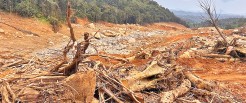
As Kerala prepares for another round of local body elections, a striking silence hangs over Wayanad’s high ranges. Banners, campaign songs, and door-to-door appeals fill the air across the district, yet one place remains untouched by this democratic bustle. Mundakkai, once a ward of the Meppadi gram panchayat, no longer exists. It has been erased both from the map and the electoral rolls, leaving behind only memories and grief.
Until last year, Mundakkai was one of Meppadi’s 22 wards, a small hill village where plantation workers and small farmers lived close to the land. Life moved at its own pace along the tea and coffee slopes. Today, the ward is gone, destroyed in the landslides that swept across Wayanad on July 30, 2024, killing nearly 300 people in Mundakkai, Chooralmala, Punchirimattam and Attamala. The terrain shifted so dramatically that roads disappeared, streams changed course and entire neighbourhoods were buried beneath mud and debris.
The Election Commission has now redrawn Meppadi’s electoral boundaries. The old Ward 11, representing Mundakkai, has been dissolved. A new entity called Mundakkai Chooralmala, with 2,241 registered voters, has taken its place. The original polling stations at Mundakkai GLP School and Vellarmala GVHSS have been removed from the rolls. Their replacements, Noorul Islam Madrassa and St Sebastian Church, lie far from the vanished settlement.
According to panchayat president K Babu, who once represented the lost ward, the electoral map bears the scars of the disaster. Most former residents of Mundakkai now live in rented rooms, government shelters or with relatives. Many will return only on polling day, and even then only to cast their votes for a place that no longer exists.
The emotional toll remains heavy. In neighbouring Chooralmala, former ward member C K Noorudeen, who broke the Left’s decades-long hold by winning as an independent backed by the UDF in 2020, has withdrawn from the contest. Many people he once met daily are no longer alive, he says, and he cannot bring himself to seek votes from families still mourning their losses.
Survivors of Mundakkai are scattered across Wayanad, most of them plantation workers waiting for rehabilitation in a planned township at Elstone Estate near Kalpetta. The government has announced housing and basic infrastructure for more than 400 displaced families. Until that promise becomes reality, they live in temporary shelters or rented homes, caught between memory and uncertainty.
Before the disaster, Mundakkai was a quiet rural settlement with churches, small shops, a ration depot and a daily rhythm centred on plantation work. But years of deforestation, road cutting and unregulated construction had weakened the hill slopes. Scientists had warned that the area was vulnerable to landslides, yet the community had little choice but to stay.
When the hill collapsed, it buried entire families within minutes. Villagers who returned later could not identify where their homes once stood. The landscape had been completely rewritten. Today, the area is a ghost zone of broken walls, uprooted trees and unstable soil. Survivors visit occasionally to place flowers and lamps at spots where paths and streams once ran.
For many, the loss of their ward on official maps is a second blow. They feel their identity has been erased again, this time by administrative necessity. Relief efforts by the government and NGOs, including large contributions from organisations like the People’s Foundation, have helped, but delays in rehabilitation and confusion over beneficiary lists have deepened frustration.
The tragedy underscores the growing fragility of Kerala’s highlands. From Puthumala in 2019 to Mundakkai in 2024, the pattern is clear. Fragile hills destabilised by unscientific development and climate extremes are collapsing with deadly force.
As Kerala votes, the people of Mundakkai will travel back to a place that no longer exists. They will cast ballots in a ward created from loss, carrying memories of a village that lived, worked and hoped on the slopes of Wayanad. Their story stands as a reminder that the cost of environmental neglect is no longer distant. It is immediate, irreversible and written into the land.
Good Evening Viewers! Stay updated with The Savera Times Evening Bulletin for the latest news from Punjab, India...

eader of the Opposition in the Lok Sabha, Rahul Gandhi and 10 other INDIA bloc leaders have moved...

Amidst protests in central Delhi, the Delhi Metro Rail Corporation (DMRC) announced the reopening of entry and exit...
The Delhi Police has registered an FIR regarding the alleged disturbance at the Bangla Sahib Gurdwara in...
The Delhi Police on Monday removed Jantar Mantar from the list of officially designated protest sites. The police...
The Supreme Court on Monday clarified that it has not passed any judgment on the Election Commission's (ECI)...
Aries: The day will be auspicious...