Last Updated: October 20, 2026
Last Updated: October 20, 2026





A Constitutional Turning Point: The Rise of Women in Indian Democracy
Parth Kapole
Political Analyst, New Delhi
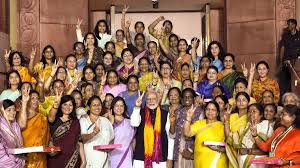
The history of Indian democracy is not confined merely to elections and changes in government. It is also a narrative of how, over time, a greater number of people gained representation, efforts were made to include every section of society, and the very nature of power underwent transformation. Throughout this entire journey, women were, for a long time, denied an equal footing. While they were indeed present in politics, both their influence and their numerical strength remained limited. Against this backdrop, the ‘Nari Shakti Vandan Adhiniyam’ (Women’s Reservation Act) stands as a significant stride forward—one that moves toward ensuring strong and meaningful participation for women in the political sphere. The parliamentary debate scheduled to take place between April 16 and 18 is not merely a formal procedural exercise; rather, it serves as a crucial test of the maturity of Indian democracy and its commitment to an inclusive ethos.
Although the concept of women’s reservation received constitutional recognition in 2023, its actual implementation had remained stalled due to technical impediments. The stipulation regarding the completion of the Census—followed by the subsequent delimitation process (i.e., the redrawing of constituency boundaries)—stood as the most formidable hurdle. Now, by authorizing the delimitation exercise based on the 2011 Census data, the government has taken a decisive step toward resolving this impasse. Consequently, the likelihood of the 33 percent reservation for women being implemented in both the Lok Sabha and the State Legislative Assemblies by 2029 has significantly strengthened. This is not merely a legal formality; it marks the inception of a profound and transformative shift in the very structural fabric of Indian politics.
The history of women’s reservation is a saga of a protracted struggle oscillating between moments of opportunity and periods of hesitation. Since its initial introduction in 1996, the Bill remained entangled for nearly three decades amidst political discord, societal complexities, and the dynamics of vote-bank politics. Despite having been passed by the Rajya Sabha in 2010, it failed to advance further in the Lok Sabha. The primary factors responsible for this stagnation were a palpable lack of political will and the calculated considerations of vote-bank politics. In contrast, the current Central Government—demonstrating political will and rising above vote-bank considerations—has decided to implement this legislation in a phased and systematic manner. The most significant impact of this transformation will be visible in the increasing participation of women in Parliament. While the number of female MPs currently stands at approximately 74, this figure could potentially exceed 270 in the future. This will ensure that women’s perspectives are given greater prominence in policymaking, rendering the decision-making process more balanced and inclusive.
The commendable performance of women at the Panchayat (village council) level—where they have demonstrated effective leadership—has laid a strong foundation for this transformation. Now, this very capability has the potential to chart a new course for politics at both the national and state levels.
This entire process is part of a phased initiative, driven by clear vision and a well-planned strategy. Women’s empowerment was not confined solely to the political sphere; rather, priority was first given to ensuring social dignity, economic self-reliance, and health security. Initiatives such as the ‘Swachh Bharat Abhiyan’ and ‘Ujjwala Yojana’ alleviated the daily hardships faced by women; schemes like ‘Jan Dhan’, ‘Direct Benefit Transfer’, ‘Mudra Loans’, and ‘Lakhpati Didi’ boosted their economic participation; while ‘Ayushman Bharat’ provided them with health security. The objective behind these efforts has been to transform women from mere beneficiaries into active participants—and now, the final phase of this journey is political empowerment.
Today, the rising voter turnout among women serves as a clear indicator of this transformation. In 2024, the percentage of female voters stood at 65.8%—a figure that, in several states, actually surpassed that of male voters. This is not merely a statistic; it signifies that women have successfully carved out a distinct political identity for themselves. Consequently, granting them constitutional representation has now become an imperative for our democracy. Amidst all this, however, some voices of dissent have also emerged. Certain political parties have characterized this process as hasty. Sonia Gandhi, the former President of the Congress party, has also penned an article questioning the government’s intentions. Nevertheless, it is essential to evaluate these allegations in light of the actual facts. Sonia Gandhi claims that the government is acting in haste; however, this is the very same Congress party that, immediately after the bill was passed in 2023, demanded its immediate implementation. Rahul Gandhi had explicitly stated that it should be implemented without delay. Through press conferences held across the country, the Congress had raised this very demand—arguing that waiting for the census and delimitation was unnecessary. In light of this, labeling the government’s current move as hasty now appears contradictory.
In her article, Sonia Gandhi has portrayed women’s empowerment as a legacy of Rajiv Gandhi; however, there is another side to this historical narrative. The 1986 Shah Bano case serves as a prime example, wherein the Rajiv Gandhi government overturned a Supreme Court verdict by enacting a specific law. This decision was driven by political pressure and vote-bank politics, thereby snatching away the justice that a woman had secured. Remarkably, even during the tenure of the UPA government—from 2004 to 2014—this matter was never revisited.
Sonia Gandhi also asserts that the credit for granting reservation to women belongs to the 73rd and 74th Constitutional Amendments. While it is true that reservation was implemented in Panchayats and municipal bodies in 1993, the pertinent question remains: why was this measure not extended to the Parliament and State Legislative Assemblies over the subsequent 30 years?
The questions raised regarding OBC reservation and the concerns of smaller states also merit attention; however, these issues, too, are steeped in a specific political history. Between 1998 and 2010, the Samajwadi Party and the Rashtriya Janata Dal opposed this bill—using these very issues as their premise—and successfully stalled its passage. At that time, the Congress party, too, failed to adopt a firm stance against its allies. Consequently, this issue evolved into a matter of political strategy rather than one of social justice. As far as the issues of delimitation and state representation are concerned, Prime Minister Narendra Modi has unequivocally clarified that no state will witness a reduction in its Lok Sabha seats. Furthermore, assurances have been given regarding the provision of legal safeguards to address the concerns of South Indian states and smaller states. Delimitation is a constitutional process that has been deferred for a considerable period; its implementation is now imperative to ensure balanced representation.
All in all, the ‘Nari Shakti Vandan Adhiniyam’ (Women’s Reservation Bill) holds the potential to usher in a transformative shift in Indian politics. The government is actively striving to build a consensus across the political spectrum, and positive outcomes are anticipated. The onus now lies on the Congress party to make a choice: will it persist in its opposition for political expediency, or will it rectify a historical error by extending its support to this pivotal initiative?
Good Evening Viewers! Catch up on the day's biggest stories with The Savera Times Evening Bulletin. Get the...

Congress leaders continued their protest outside the Jaipur Police Commissionerate on Tuesday, demanding the registration of a zero...
On the auspicious occasion of Vijayadashami, Prime Minister Narendra Modi on Tuesday called on the countrymen to unite...
A historic milestone was achieved on Tuesday in the expansion of Chhattisgarh's rail networkA historic milestone was achieved...
Model Shraddha Dubey, one of the main accused in the death of Lucknow businessman Shiv Sharma, has been...
Rashtriya Swayamsevak Sangh (RSS) chief Mohan Bhagwat on Tuesday called for strengthening national unity, social harmony, indigenous practices...
Aries: The day will be auspicious...