Last Updated: October 21, 2026
Last Updated: October 21, 2026





Abhishek Vij
Germany’s importance in the world is undeniable. Germans are known not only for their intellect and inventiveness but also for their progressive and forward-thinking approach. Similarly, there is no doubt about India’s developmental progress. In the last 12-14 years, the country has progressed rapidly and is poised to become the world’s third-largest economic power, demonstrating remarkable dynamism.
At a time when US President Trump is resorting to threats ranging from tariff wars to military conflict and imposing tariff barriers on emerging and developing countries, the increased cooperation between India and Germany and their pledge to jointly combat terrorism is of great significance.
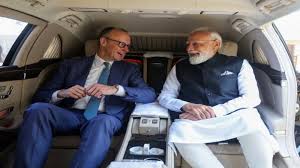
On Monday, Prime Minister Narendra Modi and German Chancellor Friedrich Merz held bilateral talks in Gandhinagar, Ahmedabad. During the talks, twenty joint declarations and seven memoranda of understanding were signed. According to these agreements, not only will projects be advanced, but both countries will also fight terrorism together. The MoUs have been signed. Both countries have worked together in the past and will continue to do so in the future. Today, more than 2,000 German companies are operating in India. This means that German investors have faith in India’s potential. The Indo-Pacific region is a priority for both countries. Here, both countries will create a reliable and robust supply chain and diversify it.
It is hoped that the friendship between the two countries will improve the global environment and put some check on American hegemony. The leaders of both countries visited the Mahatma Gandhi Ashram, paid their respects to Bapu together, and then jointly flew kites at the International Kite Festival on the Sabarmati Riverfront.
The important agreements and declarations made between the two countries are of immense significance. India and Germany have also made a joint declaration to strengthen mutual cooperation in the defense industry. To enhance economic and investment cooperation, India and Germany have agreed to establish a CEO forum under the joint India-Germany Investment Committee. India and Germany will collaborate on the related ecosystem in the semiconductor sector.
They will also increase mutual cooperation in the mineral sector. Both countries have also decided to work together on technology and development in the telecom sector. The Petroleum and Natural Gas Regulatory Board will collaborate with its German counterpart. An agreement has been reached between the Indian company AM Green and the German company Uniper Global Commodities to promote green ammonia. Along with this agreement, the German Chancellor won the hearts of Indians by saying something else positive: “Mahatma Gandhi’s teachings are needed more than ever today.” The decision of India and Germany to work together during the festive days of Lohri and Makar Sankranti is welcome. In the new global order, if these two countries complement each other and pursue long-term development goals, nothing will stop them from becoming self-reliant superpowers. Such developments have an immediate impact on the diplomatic landscape.
Recently, despite calling Prime Minister Modi his good friend, US President Trump was threatening to impose 500 percent tariffs on India. But look at the statement of US Ambassador to India, Sergio Gor, after the India-Germany agreement: “No country is more important than India, trade deals can be discussed, Trump may visit India next year.” Ambassador Sergio Gor also said that India is going to become a member of the ‘Pax Silica’ alliance. India will be invited to join this group of nations as a full member next month. The Pax Silica alliance is a secure, resilient, and innovation-based silicon supply chain. The US, which is creating this alliance, has now invited India to become a member. See the power of diplomacy: as soon as India and Germany joined hands, the American attitude towards India changed almost immediately.
A suspicious explosion occurred on Tuesday at a building under construction on Jermiah Road in the Pulikesi Nagar...
The Ayushman Bharat Pradhan Mantri Jan Arogya Yojana (PMJAY) is proving to be a significant relief for poor...
Rescue teams recovered the bodies of four youths from the Kotri canal in Kota on Wednesday morning, after...

A balloon containing a suspected flammable chemical burst during a stage play in Siwan, injuring around 10 spectators....

State Bank of India has confirmed that 3,897 customer records containing personal information were found on the dark...

A fire in a hut in Nonapar village of Deoria district claimed three lives, including those of a...

Aries: The day will be auspicious...