Last Updated: October 12, 2026
Last Updated: October 12, 2026





Sheena Sandhu
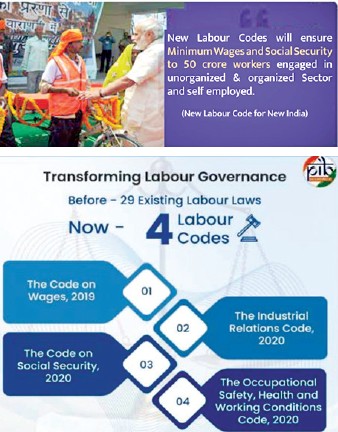
The rollout of the four labour codes by the Union Government—namely the Code on Wages, 2019, Industrial Relations Code, 2020, Code on Social Security, 2020 and Occupational Safety, Health and Working Conditions Code, 2020—is being met with protests and resistance from some labour unions. But a closer look suggests these reforms have the potential to deliver real benefits for labourers, including those in agriculture, and that many of the objections rest on misleading or incomplete readings of the changes.
The benefits for labourers and farm-workers
Under the new codes, all workers—including many in informal employment—must be given written appointment letters and formally recognised employment status. For farm-workers, agricultural labourers and allied rural labourers, this means the gap between formal and informal work narrows: instead of being entirely outside the labour-law umbrella, many now become eligible for protections such as minimum wage floors and social security.
Additionally, the Code on Wages creates a statutory right to a minimum wage for all workers, replacing a patchwork of old laws that covered only “scheduled employments”. That means labourers in rural areas stand a better chance of being paid a fair base wage (provided states align their rules).
One of the most important changes: workers in previously-excluded categories — such as gig, platform, contract or temporary workers — are now explicitly covered under the social security framework.For rural labourers who alternate between farm work, allied work, seasonal labour, this is a big step: benefits like maternity coverage, pensions, gratuity, insurance become more accessible.
Moreover, the occupational safety code mandates free annual health check-ups (for workers above 40) and stronger safety, health and working-condition norms.For farm-workers exposed to physical labour, heat, chemicals, long hours, this is a tangible gain.
The codes ensure “equal pay for equal work” is a legal requirement, and extend maternity leave (26 weeks) plus crèche facilities and other protections for women workers in the unorganised sector. In rural settings, this can mean that women farm-labourers and allied workers have stronger legal backing.
For migrant workers — a large share of rural labourers move across states for harvests or construction — the codes mandate equal wages and welfare benefits, portability (via Aadhaar-linked UAN), and claims for pending dues up to three years. That means rural labourers who have had to move around for work might get more consistent protection and relief.
The concept of “fixed-term employment” (FTE) under the new regime means workers hired on a fixed term must receive the same benefits as permanent workers: same wages, same leave, same medical benefits. For rural seasonal labourers employed for defined periods (e.g., harvesting, plantations), this strengthens their rights rather than leaving them entirely casual.
Also gratuity eligibility drops from five years to one year for fixed-term workers.
One of the original problems: India had 29 different central labour laws and many state-laws, making compliance difficult and enforcement weak. Simplifying them into four codes means easier enforcement, clearer rights and fewer loopholes for unscrupulous employers. For farm-workers often at the mercy of brokers and multi-layered contractors, a simpler legal regime is a plus.
Why the protest narrative is misleading and unjust
While protests by unions and organisations are legitimate in a democracy, the blanket rejection of the codes as being “anti-worker” lacks nuance and risks denying labourers the very protections they are being offered. Here’s why many of the objections don’t hold up or are overstated.
Objection: “These laws make hire-and-fire easy, reducing job security.”
Yes, the threshold for firms needing prior approval for layoffs has been raised (from 100 to 300 employees) which union critics flag as “hire and fire”. But this is largely a matter of scaling formal employment for small and medium units; it doesn’t abolish worker rights like gratuity, minimum wage, formal letters, overtime pay, social security. Rather than job instability, the bigger gain is bringing more workers into formal recognition. The narrative that “every worker will be sacked at will” is exaggerated.
Objection: “Working hours can go up to 12 hours a day, so worker fatigue will worsen.”
While the new codes allow flexibility between 8–12 hours a day (so long as the weekly cap of 48 hours is respected) and overtime paid at double rate, the key point is that overtime pay and monitoring become mandatory. For farm labour: long hours are already rampant without overtime pay or even basic protections. Under these new codes they will have a legal line to demand compensation and formal record-keeping of hours. That’s progress.
Objection: “Unions will be weakened, collective bargaining reduced.”
Some unions claim the new codes dilute union rights. But the legislation doesn’t abolish unions—it aims to modernise industrial relations frameworks so that they fit contemporary employment forms (gig, fixed-term, contract). Rejecting all reforms because they differ from the past tradition risks denying smaller, informal labour segments from being protected. The protest message often treats all labourers as though they’re in large factories with long union traditions — but many farm-workers and allied labourers have had no protective umbrella; these codes can bring them in.
Objection: “The codes benefit employers more than workers.”
Certainly, the government emphasises business ease and investment; critics argue that may tilt in favour of industry. But for labourers, even if business benefits come along, what matters are the rights now enshrined: minimum wage for all, written letters, health check-ups, social security. These rights didn’t exist in many farm-labour or informal labour arrangements. Disparaging the whole reform because of business-friendly framing misses the benefits for workers.
Objection: “Implementation will be weak, so these are just paper promises.”
This is a valid concern — laws without enforcement do little. But protests should then focus on demanding better implementation, stronger inspections, faster state-rule notifications, not rejecting the law altogether. The union-led narrative often conflates rightful protest with rejecting the reform wholesale; that denies momentum for enforcement and improvement.
What farm-workers should do to make the most of this reform
Conclusion
Labour-law reform is rarely politically neat or completely beneficiary-only. Farmers, farm-workers, rural labourers work under some of the toughest conditions: informal contracts, no written proof, low or delayed wages, no safety nets. The new labour codes offer structural improvements: formalisation, social security, health protections, equal pay, clearer rights.
The protests, in many cases, cast these changes as entirely hostile to labour, but in doing so they blur the real gains and risk delaying meaningful protections for those who need them most. The better path is to engage with the reform actively—to demand robust state-level rules, strong enforcement, awareness campaigns—and ensure that the benefits reach the furthest-behind workers, rather than fight from a posture of blanket opposition.
In short: these codes are an opportunity for labourers and farm-workers — one that should be seized, refined, and enforced, not rejected based on fear or incomplete caricature.
(The writer is a retired civil servant, views are personal.)
Good Evening Viewers! Stay updated with The Savera Times Evening Bulletin for the latest news from Punjab, India...

eader of the Opposition in the Lok Sabha, Rahul Gandhi and 10 other INDIA bloc leaders have moved...

Amidst protests in central Delhi, the Delhi Metro Rail Corporation (DMRC) announced the reopening of entry and exit...
The Delhi Police has registered an FIR regarding the alleged disturbance at the Bangla Sahib Gurdwara in...
The Delhi Police on Monday removed Jantar Mantar from the list of officially designated protest sites. The police...

The Supreme Court on Monday clarified that it has not passed any judgment on the Election Commission's (ECI)...
Aries: The day will be auspicious...