Last Updated: October 22, 2026
Last Updated: October 22, 2026





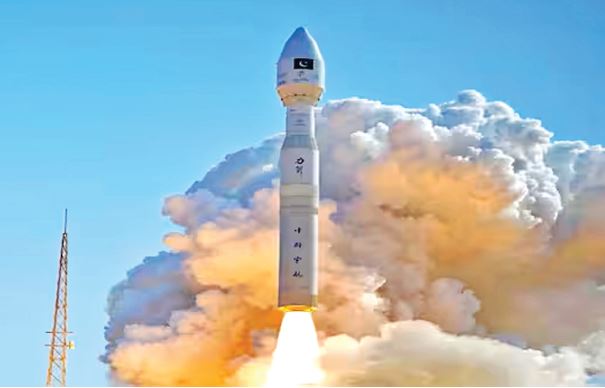
Pakistan on Sunday achieved a significant milestone in its space exploration program with the successful launch of its first hyperspectral satellite, HS-1, from China’s Jiuquan Satellite Launch Centre (JSLC). The event marked a new chapter in the country’s scientific and technological ambitions, particularly in the field of remote sensing, environmental monitoring, and sustainable development.
The launch was telecast live from the Space and Upper Atmosphere Research Commission’s (Suparco) Karachi complex. Officials, engineers, and scientists gathered to witness what the agency described as a “landmark achievement” under Pakistan’s National Space Policy and Vision 2047.
A spokesperson for Suparco confirmed that the satellite successfully entered its designated orbit. The spokesperson explained that it would take nearly two months for HS-1 to complete its in-orbit testing and calibration phase before becoming fully operational. During this period, scientists will assess its performance, data transmission capability, and the stability of its imaging systems.
Once operational, HS-1 is expected to play a key role in Pakistan’s development planning. The hyperspectral imaging technology onboard the satellite allows it to capture highly detailed images across hundreds of spectral bands. This advanced capability will enable precise analysis of land, vegetation, water bodies, and urban landscapes. According to Suparco, the satellite’s data will be particularly useful in monitoring agricultural productivity, deforestation, glacier melting, and environmental pollution.
The satellite’s imaging ability is also expected to support national infrastructure projects, including the China–Pakistan Economic Corridor (CPEC). Officials noted that HS-1 will help in identifying geological risks and supporting sustainable infrastructure planning along CPEC routes, which pass through seismically sensitive and environmentally fragile areas.
A Suparco official said the mission represents a leap forward for Pakistan’s scientific community, demonstrating growing self-reliance in satellite technology. “The HS-1 mission is designed to strengthen our capacity in environmental assessment, disaster management, and resource planning. It reflects Pakistan’s determination to use space science for peaceful and developmental purposes,” the official stated.
The Foreign Office also issued a statement, describing the successful launch as a major step in Pakistan’s long-standing partnership with China in space exploration. “The launch of HS-1 from the Chinese Satellite Launch Centre is a major milestone that underscores the depth of Pakistan–China collaboration in the peaceful uses of outer space,” the statement said.
It added that the satellite would support various national development initiatives, particularly those linked to the CPEC, by identifying geo-hazard risks and contributing to sustainable infrastructure planning. The collaboration with China, officials said, highlights the growing technological exchange between the two nations and reaffirms Beijing’s support for Pakistan’s ambitions to expand its space program.
Experts have described hyperspectral imaging as one of the most advanced tools in modern earth observation technology. Unlike traditional imaging satellites that capture data in three primary color bands, hyperspectral satellites detect light across hundreds of narrow spectral wavelengths. This allows scientists to study the chemical composition of soil, water quality, crop health, and mineral deposits with unmatched precision.
By deploying HS-1, Pakistan has joined a select group of countries that operate such advanced observation satellites. Analysts believe this will strengthen the country’s ability to respond to natural disasters, manage agricultural resources, and plan sustainable development initiatives.
The HS-1 mission also represents Pakistan’s continued progress in 2025, a year that has already seen two successful satellite launches. Earlier in the year, Suparco launched EO-1 (Earth Observation Satellite) and KS-1 (Communication Satellite), both of which are now fully operational. With the addition of HS-1, the country’s space assets have expanded significantly, enabling greater data integration and analysis across multiple sectors.
In a statement, Suparco highlighted that the satellite’s launch aligns with its Vision 2047, which aims to position Pakistan among the leading nations in space science and technology. The long-term vision focuses on advancing research, innovation, and collaboration to support the country’s economic and environmental goals.
The agency further stated that data from HS-1 will be shared with government institutions, research organizations, and universities to enhance scientific study and evidence-based policymaking. “Through this mission, Suparco seeks to ensure that space science directly contributes to improving the quality of life of citizens by enabling efficient resource management and environmental conservation,” it said.
The successful launch also reflects Suparco’s expanding partnership with China in space cooperation, which dates back several decades. China has played a key role in developing Pakistan’s space infrastructure, including the launch of earlier satellites such as PakSat-1R in 2011 and PRSS-1 in 2018.
For Pakistan, the HS-1 launch is not only a technological achievement but also a statement of intent to build scientific capacity and reduce reliance on foreign data sources. As the country continues to face environmental challenges, ranging from floods and droughts to deforestation and rapid urbanization, the ability to generate and analyze its own satellite imagery is seen as a crucial step toward sustainable development.
While in-orbit testing will continue for the next several weeks, Suparco officials expressed confidence that HS-1 will meet all performance parameters. Once fully operational, the satellite will transmit high-resolution hyperspectral data to ground stations in Karachi and Islamabad, where teams of analysts will process and distribute the imagery for various applications.
As Pakistan moves forward in implementing its National Space Policy, the HS-1 mission stands as a testament to its growing scientific ambition and regional cooperation in the peaceful use of outer space. The launch marks a pivotal step in the country’s efforts to harness space technology for national growth, environmental stewardship, and sustainable development.
Pakistan's Defense Minister Khawaja Asif has questioned alleged plans by senior government officials to permanently settle abroad. He...

The Baloch Liberation Army (BLA) has claimed responsibility for carrying out 34 operations between October 9 and 20...

Russian President Vladimir Putin said on Wednesday that Russia's first tanker carrying 40,000 tons of diesel fuel will...

Ten people were killed and 44 others injured in a horrific road accident in Pakistan's Punjab province. The...

North Korean leader Kim Jong-un's influential sister, Kim Yo-jong, and a military marshal inspected fortification work along the...

New Delhi: US Secretary of State Marco Rubio has assured India that America’s relations with any country in...

Aries: The day will be auspicious...