Last Updated: October 8, 2026
Last Updated: October 8, 2026





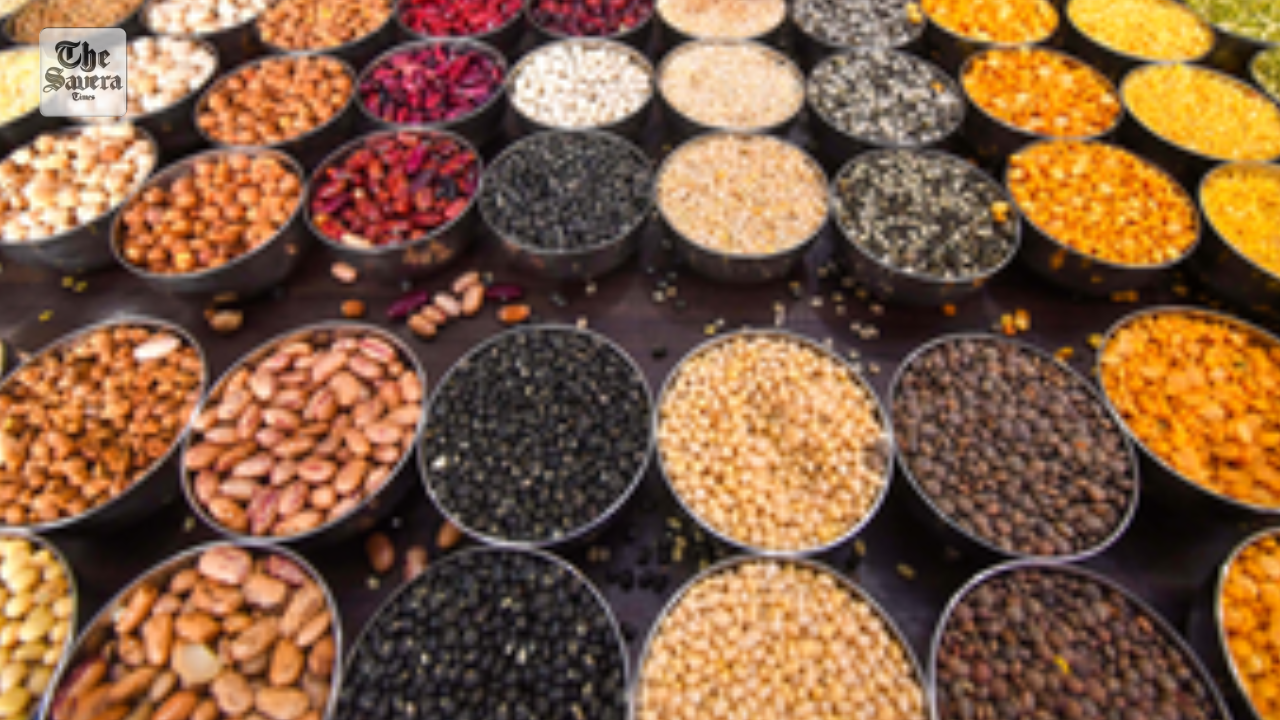
New Delhi: NITI Aayog’s Thursday report, Strategies and Pathways for Accelerating Growth in Pulses towards the Goal of Atmanirbharta, examines the current state of India’s pulses sector and its growth potential. The report is particularly significant as pulses play a vital role in ensuring food security and rural livelihoods.
India’s Pulses: Largest Producer and Consumer
India remains the world’s largest producer and consumer of pulses. These crops are a key source of plant-based protein, rich in fibre, vitamins, and minerals, making them essential for both human and animal health. They also provide a cost-effective and sustainable dietary option for millions.
The sector supports over five crore farmers and their families, contributing significantly to rural economies. The Union Budget 2025-26 announced a six-year Mission for Aatmanirbharta in Pulses, focusing on Tur, Urad, and Masoor.
Government Measures: Buffer Stocks and Imports
To tackle issues like crop shortfalls and price volatility, the government maintains buffer stocks of major pulses — Tur, Urad, Chana, Moong, and Masur — under the Price Stabilisation Fund (PSF). As of April 1, stocks stood at 15.75 LMT.
To improve domestic availability and stabilise prices, duty-free imports of Tur and Urad have been permitted until March 31, 2026. According to the Standing Committee on Agriculture, production rose from 198 lakh tonnes in 2013-14 to 242.46 lakh tonnes in 2023-24, although the latter was still 50.04 LMT below target. In 2023-24, India imported 47.39 LMT of pulses, while exports reached 6 LMT.
Production Trends and Acreage Data
The government’s third advance estimates for 2024-25 place production at 252.38 LMT, compared to the target of 299 LMT. Acreage, as of August 15, increased by 1.14 lakh hectares over last year’s 108.39 lakh hectares. However, production in 2023-24 was down by 18.12 LMT compared to 2022-23.
While 2022-23 saw a production drop of 12.44 LMT over the previous year, imports actually fell by about 2 LMT, and exports rose from 3.87 LMT in 2021-22 to 7.63 LMT. Pulses are procured at the government’s Minimum Support Price (MSP), with 2.46 LMT of Tur purchased during the 2024-25 marketing season up to March 25.
Recommendations to Strengthen the Sector
NITI Aayog’s study, based on a survey of 885 farmers in Rajasthan, Madhya Pradesh, Gujarat, Andhra Pradesh, and Karnataka, suggests over a dozen strategies to boost production and sustainability.
Key recommendations include:
The report also underscores the need for proactive climate adaptation and data-driven monitoring systems to transform the sector and achieve self-reliance.
West Bengal Assembly Speaker Rathindra Bose will hear the disqualification plea against 10 rebel TMC MLAs, including Leader...
BJP national president Nitin Nabin criticised Rahul Gandhi over his protest against the Election Commission and said Gandhi...

An IndiGo flight from Patna to Lucknow was struck by lightning at around 17,000 feet amid bad weather....

The 57th GST Council meeting will be held in Delhi on Thursday, with the Council expected to discuss...

Delhi-NCR is likely to see isolated rain and thunderstorms on Thursday, while Delhi's air quality remains moderate amid...

Stay updated with The Savera Morning Brief, featuring the top India and world news, latest headlines and major...