Last Updated: October 12, 2026
Last Updated: October 12, 2026





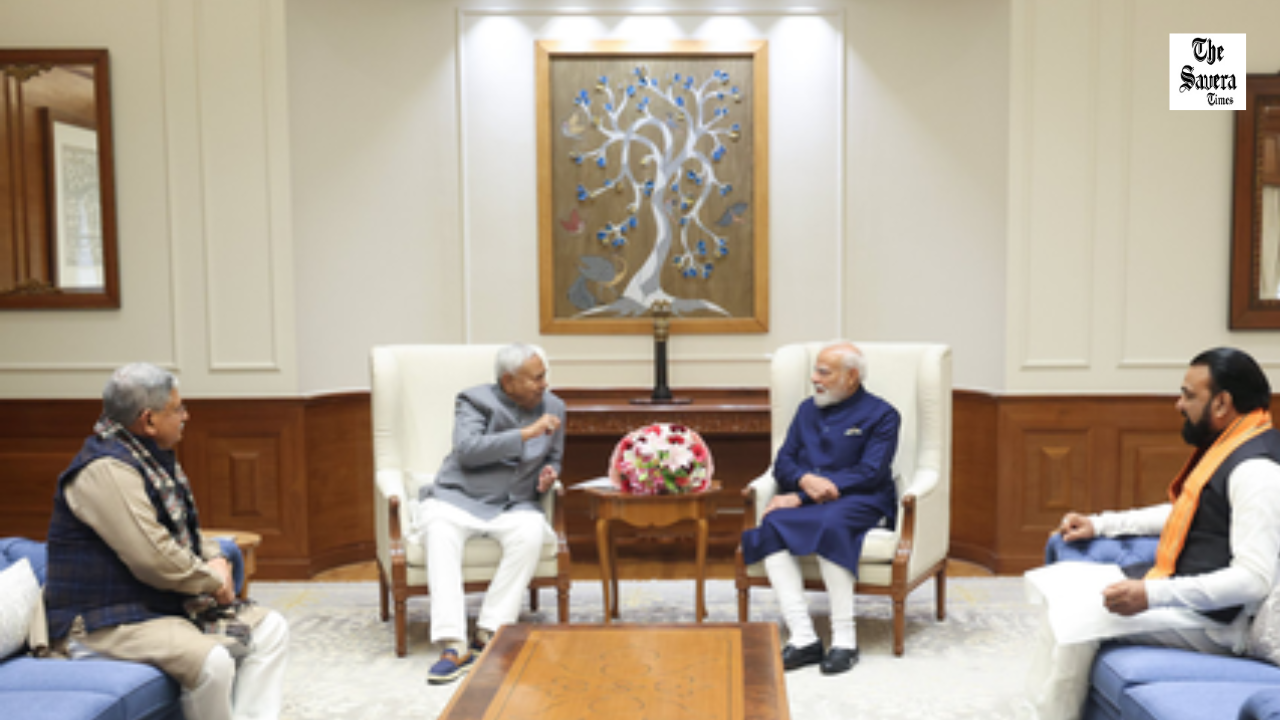
Bihar Chief Minister Nitish Kumar on Monday met Prime Minister Narendra Modi in New Delhi, marking his first visit to the national capital after being sworn in for a new term. The meeting, held at the Prime Minister’s residence, lasted for around 20-30 minutes and focused on a mix of developmental priorities and political matters concerning Bihar.
According to sources, the two leaders discussed several important topics. A main focus of their talks was the ongoing hijab controversy in Bihar, which has drawn political attention and public debate across the state. Both leaders are understood to have exchanged views on the matter and its broad implications.
In addition to the social issue, the meeting addressed political developments within Bihar, including prospects around cabinet expansion and state governance priorities. Senior BJP and JD(U) leaders accompanying Nitish Kumar included National President Lalan Singh and Bihar Deputy Chief Minister Samrat Choudhary.
Discussions also reportedly touched on key development projects and collaborations between the Centre and the state government. These include implementation of welfare schemes, infrastructure initiatives, and alignment on policy goals for Bihar’s socio-economic growth. The meeting highlighted the importance of centre-state coordination as the new government charts its development roadmap.
This high-level interaction comes at a significant political juncture for Bihar. Following the state’s recent assembly elections, the NDA government secured a strong mandate, and leaders are keen to ensure smooth governance and strategic planning ahead of future challenges. The discussions in Delhi are seen by analysts as part of ongoing efforts to strengthen alliance cooperation and clarify political priorities in the run-up to future electoral cycles.
Nitish Kumar’s two-day visit to Delhi is also expected to include talks with other senior Union ministers, including Home Minister Amit Shah, to further consolidate plans for Bihar’s progress and address administrative issues. As political and governance priorities evolve, the outcomes of this meeting are likely to influence the state’s policy trajectory in the months ahead.
The Delhi Police has registered an FIR regarding the alleged disturbance at the Bangla Sahib Gurdwara in...

The Delhi Police on Monday removed Jantar Mantar from the list of officially designated protest sites. The police...

The Supreme Court on Monday clarified that it has not passed any judgment on the Election Commission's (ECI)...

The Kerala Assembly passed a resolution demanding the removal of Chief Election Commissioner (CEC) Gyanesh Kumar from his...
Amidst heavy security and barricades by the Delhi Police, INDIA Bloc leaders began a protest march towards the...
The Reserve Bank of India (RBI)'s new measures to curb speculation in the rupee and maintain stability in...