Last Updated: October 28, 2026
Last Updated: October 28, 2026





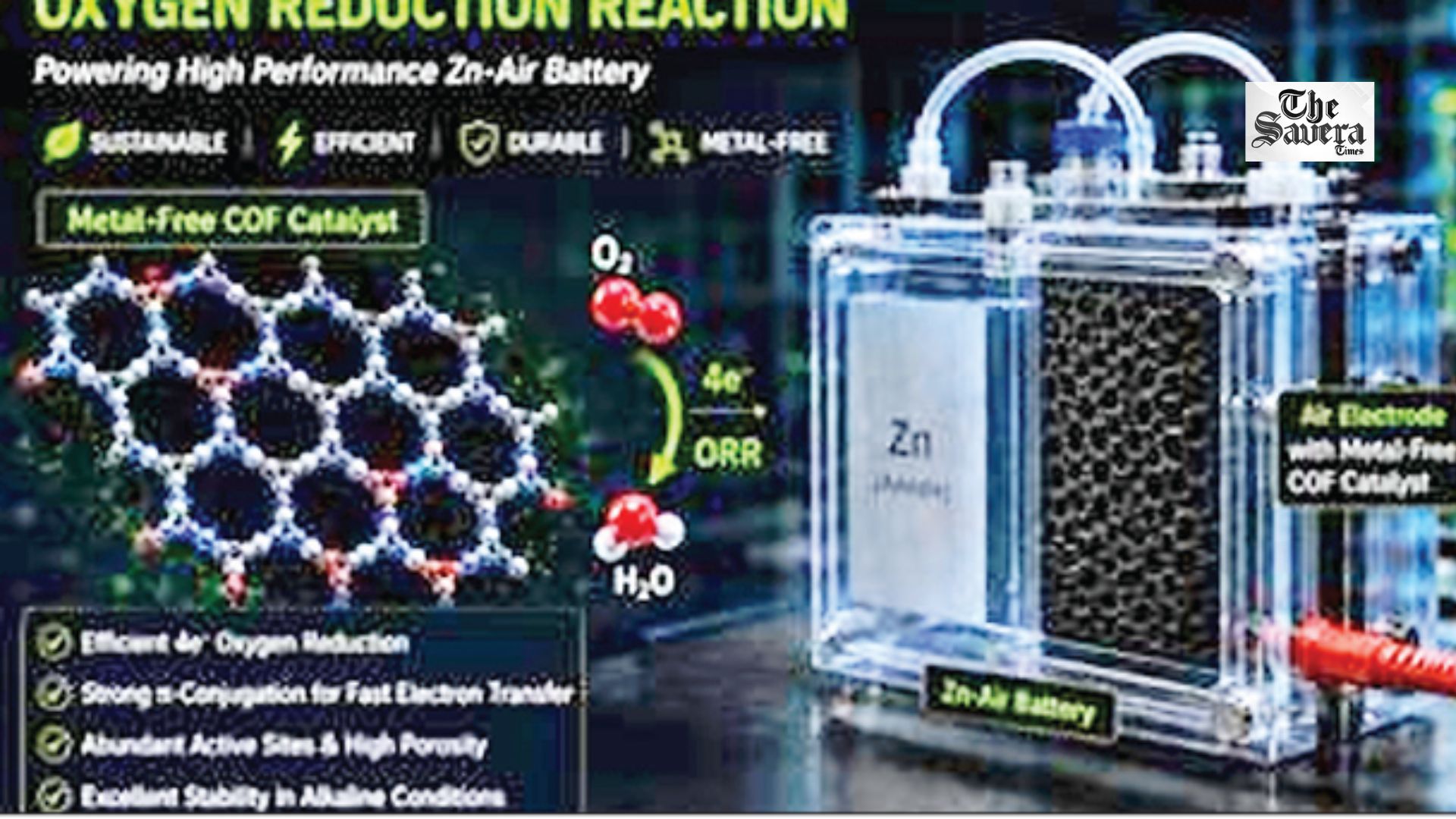
A team of Indian researchers developed a metal free porous material that can perform nearly as well as platinum as a catalyst in zinc air batteries that can significantly lower costs for next generation clean energy technologies. The material, named TTT DHTD and built from abundant elements including carbon, sulfur, nitrogen and hydrogen, forms an ultra porous honeycomb like network that efficiently converts oxygen into electricity.
Laboratory tests showed that the new catalyst achieved about 96 per cent of the performance of commercial platinum catalysts, while remaining remarkably stable. Even after 120 hours of continuous operation, the material maintained its performance without the degradation or contamination that often affects conventional metal-based catalysts.
Compared with hydrogen fuel cells, Zn–air batteries can provide a simpler, more compact energy storage solution that does not require high-pressure hydrogen storage or extensive hydrogen infrastructure. However, both Zn–air batteries and hydrogen fuel cells critically rely on efficient oxygen electrochemistry. Currently, many clean-energy technologies, particularly hydrogen fuel cells, depend on platinum, one of the world’s rarest and most expensive metals.
While platinum provides excellent catalytic performance, its high cost, scarcity and limited availability remain major barriers to large-scale deployment. It stressed the need for platinum-free ORR catalysts. The newly developed material has an engineered molecular structure that creates ideal sites where oxygen molecules can readily attach and react, enabling electricity to be generated quickly and efficiently.
Replacing platinum with inexpensive organic materials could dramatically reduce the cost of Zn-air cells, making clean transportation, portable power systems, and renewable energy storage more affordable and accessible.
By combining innovative molecular design with advanced computational studies, the researchers have demonstrated that earth-abundant materials can rival the performance of precious metals in one of the most important reactions for clean-energy technologies.
The World Circular Economy Forum (WCEF) is over in Gandhinagar. Across the week-long event, circular economy (CE) was...
Meta is facing questions from Democratic senators and state attorneys general over the suspension of an antiTrump protest...

Incidents of paddy stubble burning are being reported from Punjab, Haryana, Uttar Pradesh, Rajasthan, Madhya Pradesh, Delhi, and...
Indian banking has progressed so much since independence that a large part of the nationwide postal services are...

India used its role as Partner Country at SIAL Paris 2026 to showcase climate-resilient farming and women-led agricultural...

Union Petroleum and Natural Gas Minister Hardeep Singh Puri said that India is rapidly diversifying its import sources...
Aries: The day will be auspicious...