Last Updated: November 25, 2026
Last Updated: November 25, 2026





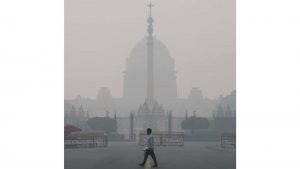
New Delhi: Air quality in the national capital, Delhi, remained in the ‘poor’ category on Wednesday morning. At 6:00 AM, Delhi’s average Air Quality Index (AQI) was recorded at 228. According to data from the Delhi government’s Environment Department, pollution levels were significantly high in several parts of the city.
The highest pollution level was recorded at the Delhi Technological University (DTU), with an AQI of 331. This was followed by Anand Vihar (327), North Campus (314), and both IGNOU-Maidan Garhi and Burari Crossing, which each recorded an AQI of 304. Air quality in Ashok Vihar was also poor, with an AQI of 224.
Possibility of Fog and Haze in the Morning
Meanwhile, the India Meteorological Department (IMD) has predicted that the sky over Delhi will remain mostly clear with no rain for the next few days. However, haze and light fog are expected during the morning hours.
According to the Meteorological Department, the maximum daytime temperature is likely to range between 24 and 26 degrees Celsius, while the minimum temperature is expected to be between 8 and 11 degrees Celsius.
The IMD has issued a forecast for haze and light fog in several areas of the region for November 25 and 26. Moderate fog may occur in some locations on the morning of November 25, and in other areas on the morning of November 26. As the five-day forecast progresses, the fog is expected to become more widespread, which could affect visibility across Delhi-NCR during the morning hours.
Pollution Levels Remained High in Several Areas on Tuesday
Earlier, at 8:00 AM on Tuesday, Delhi’s average AQI was recorded at 200. According to real-time data from the Central Pollution Control Board (CPCB), PM2.5 remained the primary pollutant at that time.
On Tuesday, air quality remained in the ‘poor’ category at several monitoring stations. AQI levels recorded included 333 at Siri Fort, 330 at IGNOU-Maidan Garhi, 322 at North Campus, 319 at Talkatora Garden, 311 at CRRI Mathura Road, 305 at Burari Crossing, 302 at the Commonwealth Sports Complex, and 300 at IIT-Delhi.
Actions under Stage II of GRAP continue
To control air pollution in Delhi-NCR, the Commission for Air Quality Management (CAQM) continues to implement Stage II of the Graded Response Action Plan (GRAP).
Under this, mechanical sweeping of roads has been intensified. Measures such as water sprinkling to control dust, other dust-suppression techniques, and strict enforcement of regulations at construction sites are being carried out.
CAQM reviews pollution control measures at the district level
In another development, Tarun Kumar Pithode, Member Secretary of the CAQM, reviewed winter pollution control measures and the ‘District Action Plan 2027’ with Deputy Commissioners and District Magistrates from Delhi-NCR and surrounding areas.
During the meeting, the concerned officials were tasked with achieving the set targets for emission reduction. In a post on the social media platform X, the CAQM stated that the meeting emphasized the effective implementation of district-level action plans to curb pollution.
A case of an alleged gang-rape of a 22-year-old woman inside a cafe in Preet Vihar, East Delhi,...
Some studies on the drivers of global deforestation inaccurately attribute forest loss to shifting cultivation. Confusing tree cover...

Trump claims credit for Huang’s return, raising concerns over federal government meddling in corporate board decisions.

India and Pakistan had 42 of the world’s 50 most polluted cities in 2025. Millions now face another...
After Dhanteras, the auspicious time for weddings begins. Gold and silver prices have begun to fall this season....

Antibiotics are a public good and a critical resource for human and animal health Antibiotics are fast losing...

Aries: The day will be auspicious...