Last Updated: October 13, 2026
Last Updated: October 13, 2026





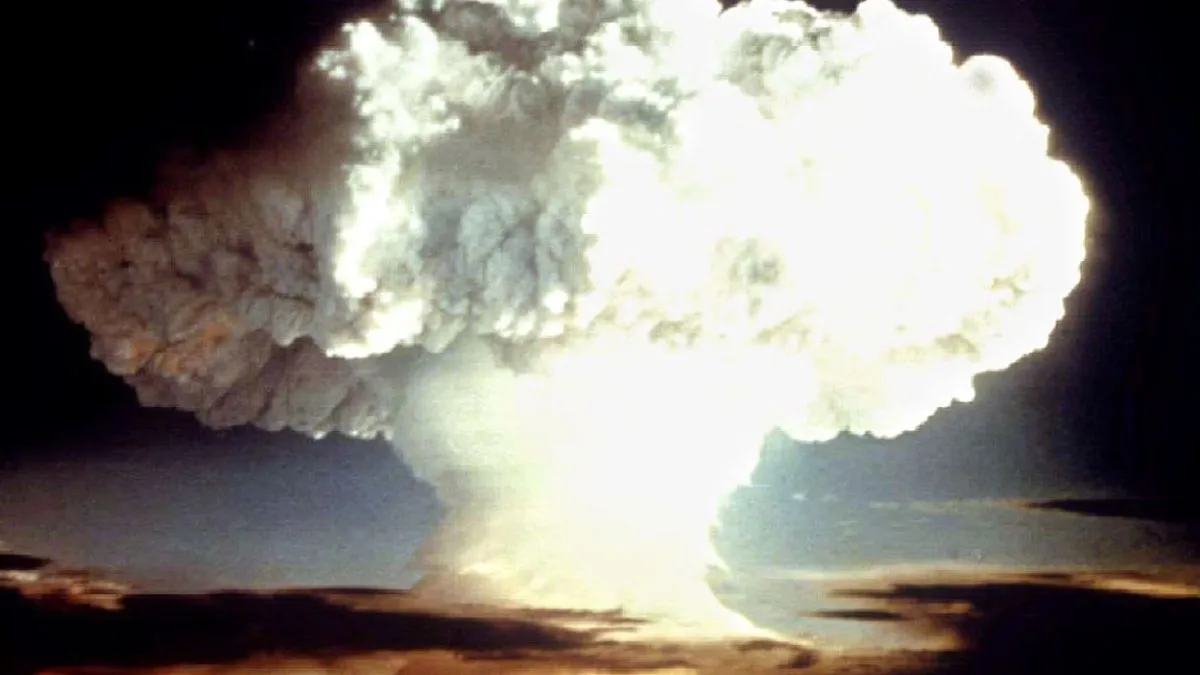
In a characteristically unrestrained interview, former US President Donald Trump reignited global debate over nuclear testing and diplomacy, claiming that both Pakistan and China have been secretly conducting underground nuclear detonations. He coupled these claims with the announcement that the United States would resume its own nuclear testing program after more than three decades, citing the need to “keep pace” with rival powers.
The remarks, sweeping and provocative, touched on nuclear security, regional politics, and Trump’s own role in preventing what he described as a “potential nuclear war” between India and Pakistan. Allegations of Secret Tests Trump’s assertions painted a picture of a shadowy nuclear landscape where countries are allegedly testing weapons beyond the reach of international monitoring. “Russia’s testing and China’s testing, but they don’t talk about it,” he said. “We’re an open society. We talk about it… They don’t have reporters that are going to be writing about it. Certainly, North Korea’s been testing. Pakistan’s been testing.”
He went further, alleging that these tests are being carried out deep underground, away from the seismic sensors and verification mechanisms operated by the Comprehensive NuclearTest-Ban Treaty Organization (CTBTO). “They test way underground where people don’t know what’s happening. You just feel a little vibration,” Trump claimed. His comments, however, lacked supporting evidence or reference to intelligence reports, leaving analysts scrambling to interpret whether they reflected classified briefings or Trump’s personal conjecture. If true, the implications of such secret testing would be grave.
China and Pakistan both maintain nuclear arsenals that directly impact India’s security calculus. Covert testing by either nation would suggest ongoing efforts to refine their weapons capabilities, challenging regional stability and international arms control norms. But without corroboration, Trump’s statements remain assertions rather than verified facts. A Return to US Nuclear Testing Equally startling was Trump’s declaration that the United States would restart nuclear testing for the first time in 33 years. The last confirmed US test was conducted in 1992 under President George H. W. Bush, after which the country entered a self-imposed moratorium. Trump justified the reversal as a matter of strategic necessity. “We’re the only country that doesn’t test — and I don’t want to be the only country that doesn’t test,” he said. “You have to see how they work.”
Trump’s defense of renewed testing reflects his longstanding belief in military deterrence and visible power projection. During his presidency, he frequently emphasized modernization of America’s nuclear forces, calling for advanced warheads and new delivery systems. In the interview, he underscored that the United States already p o s s e s s e s ove r wh e l m i n g destructive capacity. “We have enough nuclear weapons to blow up the world 150 times,” he said. Such rhetoric plays to his image of strength but revives old anxieties about the nuclear arms race. Resuming tests could unravel decades of non-proliferation progress and invite similar responses from other powers. For countries like India, China, and Pakistan, which maintain sensitive regional balances, any shift in American nuclear posture would inevitably influence strategic planning.
Boasts of Averting a Nuclear Conflict Trump also revisited one of his most dramatic claims — that he personally prevented a nuclear war between India and Pakistan earlier this year. “India was going to have a nuclear war with Pakistan,” he said. “If Donald Trump didn’t get involved, many millions of people would have been dead.” According to his account, he intervened by pressuring both nations to de-escalate. “I told both of them, if you guys don’t stop, you will not do any business with the US,” he said. He attributed his success to what he called “tari� diplomacy,” suggesting that the threat of trade consequences pushed both sides toward restraint. Trump linked the episode to India’s Operation Sindoor — precision strikes reportedly targeting terrorist camps inside Pakistan and Pakistan-occupied Jammu and Kashmir. His narrative casts himself as a decisive broker who leveraged economic power to prevent catastrophe. It also aligns with his broader view of diplomacy as transactional, where trade tools serve as instruments of security policy. Yet, as with his nuclear testing claims, the story lacks independent confirmation. India’s Firm Rebuttal Indian officials have consistently denied Trump’s account of having mediated between New Delhi and Islamabad.
According to India’s Ministry of External Affairs, the ceasefire that followed Operation Sindoor was achieved through established military and diplomatic communication channels, not through American intervention. Indian defense sources have emphasized that while the situation was tense, it never reached the threshold of nuclear confrontation. New Delhi’s denial is rooted not only in factual disagreement but also in principle. India has long maintained that all issues with Pakistan are bilateral and not open to third-party mediation — a position consistently reaffirmed since the Simla Agreement of 1972.
Trump’s repeated claims of involvement, therefore, have been met with polite but firm rejection. Reading Between the Lines Trump’s remarks — spanning secret nuclear tests, renewed American detonations, and dramatic peacemaking — reflect his trademark blend of bravado and unpredictability. His comments could carry political undertones, aimed at projecting toughness on national security and reinforcing his narrative as a global dealmaker. Yet they also reveal how easily nuclear discourse can become entangled in politics and perception. Experts caution that such statements, especially from a former president, can unsettle allies and embolden adversaries.
The suggestion that Pakistan and China are secretly testing nuclear weapons could strain already fragile trust in arms control regimes. At the same time, Trump’s call for renewed US testing challenges the norm that has restrained nuclear explosions for more than three decades. Whether his claims stem from insider knowledge or political showmanship, they have reopened debates about deterrence, verification, and leadership in a world still shadowed by nuclear anxiety. A Familiar Pattern For Donald Trump, controversy is not a byproduct but a strategy. His sweeping assertions — some unverifiable, others exaggerated — command attention and reinforce his image as a disruptor. In this interview, he once again placed himself at the center of global events, claiming credit for peace and justification for power. The world, however, continues to view his words with a mix of fascination and caution. Behind the spectacle lies a sobering reality: nuclear weapons remain the most destructive instruments ever created, and the lines between deterrence and danger are thinner than they appear
Chandigarh: Condemning the murder of anti-drug activist Parvinder Singh Jhota, BJP Rajya Sabha MP from Punjab Raghav Chadha...
Jammu: Joint security forces recovered a cache of arms and ammunition during a search operation in Jammu and...
New Delhi: The Centre on Tuesday cleared the appointment of two judicial officers as Additional Judges of the...

New Delhi: The Supreme Court on Tuesday issued notice to the Centre and the Election Commission of India...
Mumbai: Highlighting Maharashtra’s competitive edge, Chief Minister Devendra Fadnavis on Tuesday affirmed that the state stands at the...
Nicosia: Defence Secretary Rajesh Kumar Singh called on Cypriot Defence Minister Vasilis Palmas in Nicosia on Tuesday as...
Aries: The day will be auspicious...