Last Updated: October 21, 2026
Last Updated: October 21, 2026





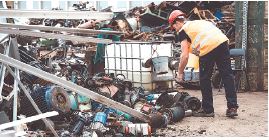
According to the Global E-Waste Monitor 2024, the world generated 62 million tonnes of e-waste in 2022, a figure projected to rise to 82 million tonnes by 2030. E-waste is among the fastest-growing toxic waste streams globally, comprising both valuable metals and hazardous materials.According to the Global E-Waste Monitor 2024, the world generated 62 million tonnes of e-waste in 2022, a figure projected to rise to 82 million tonnes by 2030. E-waste is among the fastest-growing toxic waste streams globally, comprising both valuable metals and hazardous materials.
On October 14, 2025, the world observed International E-Waste Day, with a special focus this year on the recovery of Critical Raw Materials (CRMs) from discarded electronic devices. The spotlight highlights growing global concern over mounting e-waste, which not only depletes valuable resources but also poses serious environmental and health hazards.
According to the Global E-Waste Monitor 2024, the world generated 62 million tonnes of e-waste in 2022, a figure projected to rise to 82 million tonnes by 2030. E-waste is among the fastest-growing toxic waste streams globally, comprising both valuable metals and hazardous materials. Its management poses a complex challenge due to the combination of economic value and environmental risk.
CRMs, present in many electronics, are a key reason for this focus. Silicon metals are used in semiconductors, lithium, cobalt, and nickel are vital for electric vehicles, and tungsten supports vibration technology in mobile phones. The Royal Society of Chemistry defines CRMs as materials critical to a nation or sector’s economy that may become difficult to source. A significant portion of CRMs is mined in politically or socially unstable countries, making the supply chain vulnerable to disruptions. For example, within the European Union, China, South Africa, and Turkey supply 100 per cent of heavy rare earth elements, 71 per cent of platinum, and 98 per cent of boron, respectively.
Recovering CRMs from e-waste has therefore become a strategic priority. Yet collection and recycling rates remain low. The Global E-Waste Monitor 2024 estimated that only 22.3 per cent of global e-waste in 2022 was collected and recycled. This inefficiency results in an annual loss of approximately $62 billion worth of recoverable resources. With demand for CRMs expected to rise to support green and digital transitions, reliance on mining virgin materials could continue to damage fragile environments.
Consumer participation is crucial in improving CRM recovery. The Waste Electrical and Electronic Equipment (WEEE) Forum, which coordinates International E-Waste Day, stresses that technological and legislative solutions alone are insufficient. Consumers must take responsibility by bringing their end-of-life electronics to collection points. Short, easily accessible intervals for collection facilities encourage responsible disposal.
While developed countries have made some progress, emerging economies, including India, continue to struggle with effective e-waste management. Privacy concerns also affect consumer participation, as individuals are often reluctant to dispose of laptops, smartphones, or other personal electronics. Initiatives such as dismantling or destroying devices in the presence of consumers can help build confidence in collection schemes.
Public awareness remains a major hurdle. Many consumers do not recognize smaller items—such as power tools, electronic toys, or vaping devices—as e-waste. Without proper recognition and participation, access to CRMs from discarded electronics will remain limited, perpetuating environmental pressures and concentrating extractive activities in a few countries.
International E-Waste Day 2025 underscores the need for global action: increasing public awareness, establishing robust collection systems, and recovering CRMs efficiently. Until consumers actively engage, the environmental and health risks associated with both e-waste and raw material mining will continue to rise, highlighting the critical intersection of technology, sustainability, and responsible consumption.
Reduced water levels at Har Ki Pauri and other Haridwar ghats have inconvenienced pilgrims during the Upper Ganga...

Six people returning from a Dussehra Mela were seriously injured when a car hit them on National Highway...

A bus travelling from Pachiound to Ramnagar fell into a gorge at Gulli Gula in Udhampur district. Nine...

Start your day with The Savera Morning Brief, bringing you the latest news from India and around the...

Union Home Minister Amit Shah will pay tribute to police martyrs at the National Police Memorial in New...

Four more people, including two women, have been arrested in the Tiger Shroff firing case. Delhi Police are...
Aries: The day will be auspicious...