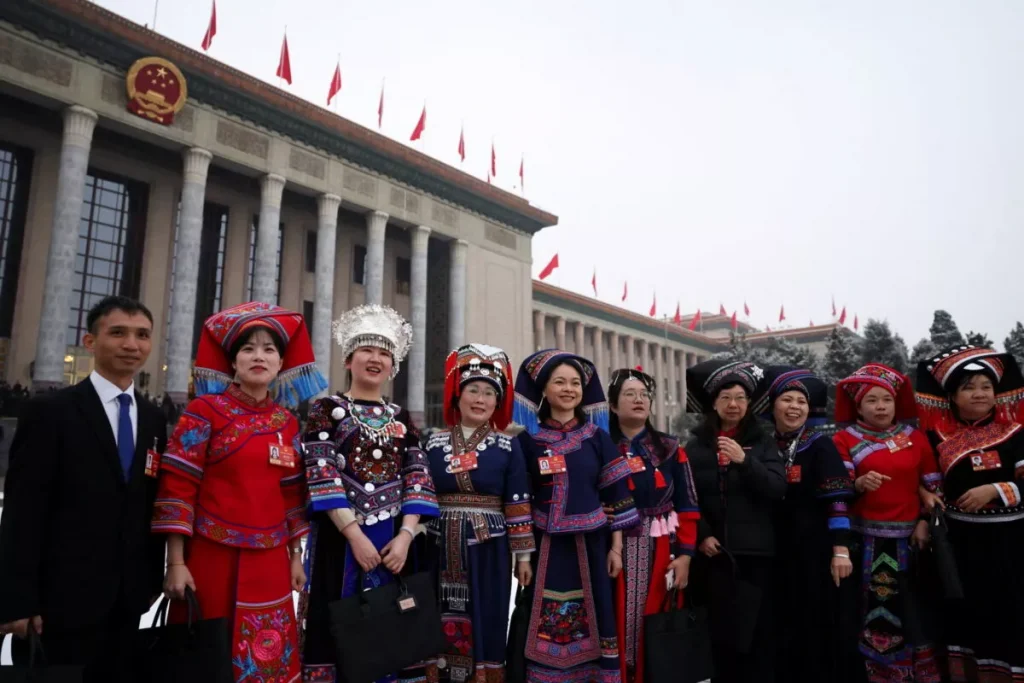
China, on July 1, 2026, did not merely bring a new statute into force – it gave legal language to a long-running project of cultural control. The Law on Promoting Ethnic Unity and Progress is presented by Beijing as a framework for harmony among China’s 56 officially recognised ethnic groups. But for Tibetans, Uyghurs, Mongols, Hui, Kazakhs and others, its real danger lies in how it turns identity into a matter of state discipline. Across the world, Tibetan organisations and supporters marked the law’s implementation with coordinated protests, including in Dharamshala, warning that the law gives formal legal backing to policies that have already weakened minority languages, religions, family life, education, and diaspora activism. The heart of the law is Article 6, which declares that a “sense of the community of the Chinese people” is the root of ethnic unity and bans acts that “undermine ethnic unity” or “create ethnic division.” The danger is not only in what the article says, but in what it does not define. In China’s political vocabulary, “ethnic division” has often been stretched to cover peaceful speech, cultural advocacy, religious expression and criticism of state policy. Amnesty International has warned that these broad terms risk arbitrary enforcement and could further criminalize activities such as promoting minority languages, documenting abuses, or campaigning for detainees. Article 10 widens the threat by saying ethnic unity work must not be interfered with by “foreign forces” and that acts using “ethnicity, religion, or human rights” to undermine China must be opposed. This is deeply concerning because it frames human rights scrutiny itself as hostile interference. The article does not distinguish between a government-sponsored destabilisation campaign and a Tibetan exile asking for language rights, a Uyghur family searching for a missing relative or an international journalist investigating forced assimilation. This language fits a familiar Chinese state pattern – when minorities speak of rights, Beijing often recasts their claims as separatism or foreign manipulation. The language provisions are among the most alarming. Article 15 makes the “national common language and script” the basic language of teaching and official work, promotes Mandarin learning from preschool, and requires Mandarin to be given prominence when used alongside minority languages. Article 16 then pushes the “community of the Chinese people” through the entire education process, including classrooms, textbooks, social practice and online education. On paper, the law says minority languages are respected; in practice, it places Mandarin and state ideology above mothertongue education. The case study already exists in Inner Mongolia. In 2020, authorities moved to replace Mongolian with Mandarin as the language of instruction for key subjects including language and literature, morality and law and history. Human Rights Watch documented protests, school boycotts, censorship, detentions, and the shutdown of Bainu, the only Mongolian-language social media platform in China. The lesson is clear: once the state defines Mandarin-first education as “unity,” defending mothertongue learning can be treated as resistance. Tibet shows the same pattern. Human Rights Watch found that Chinese-medium teaching was expanding in Tibetan primary schools and that Tibetan-medium schooling was being steadily squeezed through teacher transfers, textbook controls, school consolidation and pressure on informal Tibetan-language education. The case of Tashi Wangchuk remains a warning: after publicly advocating for Tibetan language rights, he was sentenced to five years in prison for “incitement to split the country.” Under the new law, the same kind of peaceful language advocacy can be framed even more easily as undermining “ethnic unity.” Article 20 takes the law inside the home. It says governments should integrate the requirements of forging a Chinese national community into families and family education, and it requires parents or guardians to guide minors to love the Communist Party, the motherland, the people, and the Chinese nation. It also says guardians must not instil ideas “not conducive” to ethnic unity. This turns family memory into a political battlefield. A Tibetan parent teaching a child about exile, a Uyghur parent teaching religious heritage, or a Mongol parent defending native language could be placed under suspicion if that teaching conflicts with the state’s version of unity. This is not theoretical. United Nations experts warned in 2023 that around one million Tibetan children were affected by Chinese government boarding-school policies aimed at cultural assimilation. These schools separate children from their families and place them in Mandarin-heavy, state-run environments where Tibetan language, religion, and local identity are pushed to the margins. When Article 20 is read with Articles 15 and 16, the law appears to legitimise exactly this kind of state intrusion into childhood. Articles 22 to 27 promote “interaction, exchange, and integration” through housing, population management, student movement, employment, teacher exchanges, and youth activities. The language sounds soft, but it is built around state-directed social engineering. In minority regions, “integration” often means weakening the social spaces where minority life survives: villages, monasteries, local schools, community networks, and language environments. Article 14 also instructs authorities to highlight shared Chinese cultural symbols in public facilities, architecture, exhibitions, place names, and public activities.
One Nation, One Voice: China’s New Law and Silencing of Minorities